


 Francais
 Deutsch
 Italiano

Refine Your Search
Melville Rhode Island 1943 stock footage and images
- Showing 157 to 162 of 6735 results more
 Hide
Color Sound
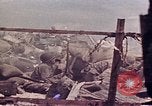
U.S. marines mopping up after battle for Tarawa, in Pacific. Generals Holland and Julian Smith. Admiral Harry Hill. Marine dead.
U.S. Marine Corps during Battle of Tarawa of World War II in November 1943. United States 2nd Marine Division Corps fire artillery. On the beach,Chaplains Assistants remove one dog tag from each of many dead marines. General of the United States Marine Corps Generals Holland McTyerie Smith and Julian Constable Smith U.S. Navy admiral Harry Wilbur Hill, commander of the task force. Bulldozers dig the ground in search of Japanese in bunkers as deep as 20 feet. They destroy the Japanese bunkers. Japanese prisoners are marched by the Marines.
Operation of United States Coast Guard in Tarawa, Pacific Theater during World War II
Overseas activities of United States Coast Guard in World War II. November 20, 1943, U.S. Marine Corps invade Tarawa Atoll. Naval warships bombard Tarawa. Transport ship USS Arthur Middleton underway. Only 1 out of 5 U.S. troops reach the beach in first wave of attack. Firing and explosion. U.S. troops wade. Many U.S. Marines injured during the landing on Tarawa. The U.S. Coast Guard brings back the wounded to the transport ship. Wounded soldiers lifted on stretchers.
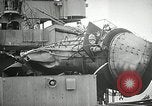
Damaged USS Louisville and men overhaul it in Okinawa, Japan.
Damaged USS Louisville (CA-28) hit by Japanese Kamikase in World War 2. Damaged forward stack of the ship. Float of its scout plane left on catapult, is jettisoned. Large stack of the USS Louisville knocked down. Engine of seaplane blown up by explosion on the signal bridge. Man welds in superstructure. View of other men working to repair damage to the Cruiser.. [Note: The following eyewitness account of the kamikaze attack was recorded by Seamen 1st Class, Enrico Trotta, who was a crew member on the USS Louisville (CA-28) from 1943 to 1946, "At 1923 (hours) two planes which were identified as friendly flew around and one kamikaze dove onto the battleship USS Mississippi BB 41. The other kamikaze plane turned to the Louisville and started to make a run on us. I was on No. #4 - 20 mm AA gun mount on the port side below #2 main battery and I fired 58 rounds to set the kamikaze plane on fire prior to hitting the Louisville’s front smoke stack bending and twisting it and killing 9 men on the 40 mm gun mount mounting on the forward superstructure tripod about 140 feet from our gun mount. The kamikaze also cut our sea plane off and left only the pontoon on the catapult. Three other 20 AA mm gun crews opened up firing 4, 11, and 20 rounds as well. We were not told to fire for we did it on our own. We were only manning the guns at the time and were not on general quarters. Later, the officers came by and said good job."]
Research Bell towed out to M-2 Buoy Jamestown Island in Narragansett Bay, Newport.
Underwater Research bell at Newport shipyard in Newport. Workers on deck handle hoses and lines. Two personnel converse with each other standing in front of Research Bell. The bell lifted by sling. Research bell lowered two blocks from where it was hoisted. Men work around the bell. Raymond Edwards opens the hatch door and enters inside. He does final check up of all equipment. Small tug toes bell on a barge en route to M-2 Buoy off Jamestown Island in Narragansett Bay. Barge with Research Bell aboard towed out to M-2 Buoy.
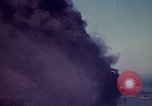
Sailors work to extinguish fire on Allied ships at the Tunis Port following aerial attack in North Africa Campaign.
Allied ships on fire in Tunis Port during the North African Campaign. View on shore as a U.S. Navy sailor and a camera man operating a moving image camera view the fire blazing in the harbor on a sunny day. Black and white smoke clouds arise from the ships. Flames leap upward on the ships. Sunken ships in the water. U.S. Navy sailors use water hoses to extinguish the fires at the bow of a ship. Charred gun on the bow of the ship. Sailors survey remains of burned ships and damage at harbor. Men extinguish the fire with water hoses. (This is possibly footage of the surprise day time raid by German Luftwaffe aircraft attacking Allied ships at Tunis harbor on May 19, 1943, six days after the Axis surrender in North Africa.)
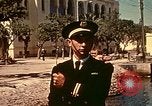
General Dwight D. Eisenhower meets Admiral Sir Andrew Cunningham at Tunis Port during the North Africa Campaign
On shore at Tunis harbor, a British Navy officer gives a sword salute to a senior Naval officer in World War II. U.S. Navy and British Royal Navy sailors lined up on either side of dock for a salute. General Dwight D. Eisenhower accompanied by Admiral Sir Andrew Cunningham and other British and American Navy officers walk past the sailors in review. Cunningham has a walking cane hooked over his left forearm but does not use it. The Union Jack and the British Royal Navy flag are visible. Ship at dock in the background. Eisenhower and Cunningham and the other officers pause and greet in front of a waiting Royal Navy car, RN ME 4096, parked on shore. Eisenhower, Cunningham, and another British officer enter the waiting car and it leaves, passing by a Allied landing ship with number 5 seen on its bow, anchored at the port. Closeup view of U.S. Navy Rear Admiral Richard L. Conolly and another U.S. Navy officer watching after the car drives away. Honor guard sailors march with rifles, departing the dock after the officers leave. (Eisehhower visited Tunis for meetings with British and U.S. Navy officers May 11-13, 1943. This footage is likely during those 3 days.)
CRITICALPAST.COM: About Us | Contact Us | FAQs - How to Order | License Agreement | My Account | My Lightboxes | Shopping Cart | Advanced Search | Featured Collections | Website Terms & Conditions | Privacy Policy ©2026 CriticalPast LLC.
License Agreement |
Terms & Conditions |
Privacy Policy
©2026 CriticalPast LLC.