


 Francais
 Deutsch
 Italiano
Refine Your Search
Melville Rhode Island 1943 stock footage and images
- Showing 163 to 168 of 6726 results more
more Hide
Hide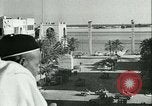
The North African Campaign, Allied invasion of Sicily, and Allied bombings of Nazi Germany during World War II.
Pictures taken by military and news cameramen during World War II. North African Campaign: The British Eighth Army enters Tripoli in Libya. Allied soldiers on tanks. Civilians and children watch as the troops move into the city. A British flag. British Army Field Marshal Harold Alexander (1st Earl Alexander of Tunis) stands in a car and greets the troops and civilians as it moves along. Allied invasion of Sicily, 1943: Field Marshal Alexander's British Dominion and U.S. forces advance. The task force underway off the Sicily coast. Soldiers get off landing ships and crafts. They wade through shallow water and advance inward on the beach. Germany: Allied aircraft in flight. The airplanes bomb Nazi industries. The aircraft bay doors open, bombs away as bombs are released, and they descend towards the target area. Smoke due to the explosions.

French civilians and military officials inspect the ruins of Le Portel, France after its destruction in Operation Cockade
French civilians and military officials inspect the ruins of Le Portel, France, after its bombing destruction of September 8-9, 1943, triggered by Operation Cockade. Bombed out buildings, debris and destroyed buildings in the resort town. Cars on road with ruined buildings all around. Damage near the Hotel des Bains et Belle-vue Reunis on the sea shore. Military officials look out over beach toward the Fort de l'Heurt. Damaged building of Cafe de la Rade. View of a large destroyed statue with officials in the background. Ruins of various buildings in the French town.Sign for Hotel de la Providence. Sign "Buvette Americaine" written on a French shop. Instrumental soundtrack heard in background of clip.
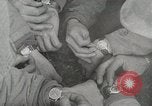
Scenes from the Battle of San Pietro, Italy, during World War II
Elements of the U.S. 36th Infantry Division engaging in the Battle of San Pietro, during World War 2. Opening scene shows U.S. infantrymen of the 141st Infantry Regiment synchronizing their watches on H-Hour, D-Day, the 15th of December, 1943. Next they move forward 400 yards from their positions and are immediately pinned down by heavy artillery fire from German defenders. Soldiers of the 2nd and 3rd Battalions of the 143rd Infantry Regiment advance 100 yards and hunker down at barbed wire barrier close to German defense line. They also come under heavy German artillery fire. American Sherman tanks enter the Town of San Pietro to find and destroy the German artillery interfering with the American advances. Views of U.S. tanks on the move. Narrator states that 16 tanks were dispatched along the road to San Pietro. Three reached the outskirts. German gunfire destroys two of these. Smoke rising from a struck tank. Views of pieces of destroyed tanks. Destroyed and abandoned American tanks. American infantrymen carrying a wounded on a litter past a knocked out Sherman tank. View of one (of four) tanks returning to the Regimental Bivouac area. Parachute flares illuminate the battlefield at night, where small American units succeed in penetrating German defenses, but are forced to move back again due to flanking German artillery and machine gun fire. Closeups of several wounded American infantry being moved on stretchers.
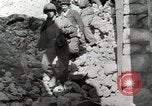
Inhabitants of San Pietro Infine, Italy, attempt to begin life anew, after U.S. Forces capture the village from German Forces, during World War II
Aftermath of the Battle of St. Pietro Infine, Italy, after it was taken by soldiers of the U.S. Army 36th Division, 143rd Infantry Regiment and troopers of the 82nd Airborne Division, 504th Parachute Infantry Regiment, during World War 2. Several U.S. soldiers of the 143rd Infantry Regiment, scramble down a mountainside over rubble from destroyed buildings in San Pietro Infine, Italy, following the battle there during December 1943. (These scenes were photographed later, in 1944.) Next, more local people are seen running from a mountain cave, where they had taken refuge during the battle of San Pietro. Old people, women, and children make their way down the rubble strewn hillside and onto a remnant of road surrounded by destroyed buildings. Italian women carry their belongings balanced on their heads as they walk towards the remains of their dwellings. A man leads two cattle. One woman carries a new coffin balanced on her head. An 82nd Airborne trooper warns local people about the danger of mines and booby traps left behind by retreating German soldiers. A soldier removes a booby trap in a doorway. Women trying to clean up and settle in the ruins of their homes. As one woman sweeps debris, an huge explosion occurs, bringing down large portions of a building. U.S. Soldiers dig through debris, with shovels. An MP and infantryman stand with several Italian men as one is grief stricken while they retrieve the body of a loved one from the rubble. A woman weeps. Women nurse and comfort their babies. Small children are seen happily emerging from a cave. A mother admonishes her boy. Women and children are relieved and smiling. Several children scamper down a hill. Others are seen walking about and posing shyly for the camera. Local men clearing rubble and women washing clothes in an outdoor stream as they try to reestablish some normalcy in their lives. A shoemaker resuming business at a small bench outdoors. Men unloading sacks of flour from a truck. People purchasing flour being weighed in an outdoor market. Farmers plowing fields with oxen. A church procession, led by a youth carrying a Christian banner, moves from a bombed out church, between mounds of rubble, . Statue of a Saint at the church.
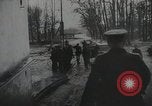
Spanish General is decorated and German and Italian military leaders coordinate defense of Italy during World War 2
Commander of the German 18th Army, Colonel General Georg Lindemann, arrives to personally recognize Spanish Army General Emilio Esteban Infantes, commanding officer of the Spanish "Blue Division" (German 250th Infantry Division) for successfully repelling attack by the Russian 55th Army, in the Battle of Krasny Bor on the Eastern Front in February, 1943. Other officers help General Esteban Infantes to place an Iron Cross decoration around his neck. Scenes of German General Field Marshal Albert Kesselring reviewing Italian and German troops in Italy at an airfield and presenting award to some of the soldiers. In next scene, Benito Mussolini enters a room and then is seated in the first meeting of the leaders of the new Fascist Republican Party, including Alessandro Pavolini and Italian Minister of War Rodolfo Graziani. Next segment covers arrival of German Field Marshal Erwin Rommel to Italy, touring fortifications and inspecting defenses in Italy. He is seen reviewing port lookouts and defense points with German artillery. In once scene he passes an elderly Italian civilian and gives him the Nazi salute, which is returned weakly by the Italian. Next segment covers further expansion of Italian defenses, with the laying of barb wire by troops, including one soldier cutting his pants knee on the barbed wire. Also shows demolition of trees using dynamite. Explosions as trees are blown up. Then shows placement of new artillery guns and positions. German soldier reviewing a map while on phone receiving enemy position information. German soldiers in hills fire artillery at enemy position in a valley.
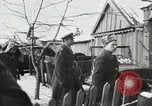
German Field Marshal Friedrich Paulus surrenders to Soviets, in Stalingrad; masses of captured German soldiers
Field Marshall Friedrich Wilhelm Ernst Paulus approaches and enters small building to meet with Soviet officers and surrender German forces to the Russian Army after the German defeat in the Battle of Stalingrad in World War II. Paulus in a room with Soviet officers. Long lines of Nazi German soldiers marching in snow under Soviet guard after surrender. They march slowly past bombed buildings in the city, some with no boots and various injuries. Wide view from a high point over the city of Stalingrad, with a dead German soldier in foreground. Scene shows spring arrival and thaw of snow in Stalingrad. Map shows 186,000 square miles of reclaimed Soviet territory after pushing back and capturing German forces. Various abandoned German tanks, planes, rifles and and machine guns shown covered partially in snow after fall back of German troops. Masses of defeated German soldiers marching in snow. View of dead German soldiers and battlefield graves with German crosses on them. Animated map shows failure of German forces to capture Moscow, the Caucuses, and Stalingrad, in years 1941 through 1943. Scenes showing troops from Allied countries including Soviet, British, and American, and the flags of each of their countries waving.
CRITICALPAST.COM: About Us | Contact Us | FAQs - How to Order | License Agreement | My Account | My Lightboxes | Shopping Cart | Advanced Search | Featured Collections | Website Terms & Conditions | Privacy Policy ©2026 CriticalPast LLC.
License Agreement |
Terms & Conditions |
Privacy Policy
©2026 CriticalPast LLC.