


 Francais
 Deutsch
 Italiano

Refine Your Search
Melville Rhode Island 1943 stock footage and images
- Showing 229 to 234 of 6735 results more
 Hide
Color Sound
British Prime Minister Winston Churchill in many meetings before and after America's entry into World War II
Opening slate reads: "Quebec Conference August 1943." The English battleship, Prince of Wales, is seen in fog off the Coast of Newfoundland, in August 1941. View of sailor on fore-deck of the British ship. View inside engine room of the ship where sailor manipulates her power. Closeup of engine crankshaft stopping as she drops anchor in Placentia Bay. View of Prime Minister Winston Churchill, greeting U.S. President Franklin D. Roosevelt aboard the Prince of Wales. He proffers a letter to the President, from the King of England. View of Roosevelt and Churchill seated on deck with their respective military leaders standing behind them. Admiral Ernest King, U.S. Chief of Naval Operations converses with U.S. Army Chief of Staff, George Marshall, as they stand behind Churchill and Roosevelt. Wider camera view shows the larger military entourage accompanying the Prime Minister and the President. Glimpse of prisoners and enslaved workers taken by Nazi Germans in Europe. Glimpse of bombs falling from an airplane. Classic film views of the Japanese attack on Pearl Harbor in December 7, 1941. Bombs exploding along "Battleship Row." Heavy smoke rising from the bombed ships. The USS Arizona tilted heavily and burning. Camera pans along the path of destruction, as the voice of President Roosevelt is heard in the background, asking the Congress to declare that the Japanese attack created a state of War between the United States and the Japanese Empire. View of President Roosevelt speaking to the U.S. Congress. Seated behind him are Vice-President Henry Wallace and Speaker of the House, Sam Rayburn. Glimpse of Congress members applauding. Change of scene shows President Roosevelt and Winston Churchill meeting in Washington, DC, in December of 1941, during World War 2. Views of war preparations in the United States, including the building of new war production plants and facilities. A large steel ingot being forged into an artillery gun barrel. Machinist at work turning a gun barrel on a lathe in a munitions factory. Views of manufacturing plants in operation and steel being made. A railroad train carrying new Army trucks. Another meeting of Churchill and Roosevelt in Washington, D.C. June, 1942. Standing behind them is President Roosevelt's special assistant, Harry Hopkins, a British naval officer, and an American navy Captain. American soldiers boarding a troop ship, and closeups of them as they enter the ship, looking out of portholes, and waving from the ship's deck. Glimpse of Washington Monument and its image in the reflecting pool in Washington DC. Closeup of a book entitled, "Time Table for Invasion." General George Marshall with several of his generals doing preliminary planning. Series of scenes involving senior military officers engaged in war planning. A convoy of warships is seen at sea during the Operation Torch Allied invasion of French North Africa during 8–16 November, 1942. Views of Allied Navy ship guns firing. Allied troops riding in landing craft, and advancing from beached craft on shore of Algiers. Aerial view of a flight of Douglas Dauntless bombers in formation. "Bombs away" view from Allied airplane dropping bombs. Allied troops firing camouflaged antiaircraft guns from sandy positions near shore. Enemy shells or bombs exploding nearby. Two U.S. Army soldiers holding a document in French entitled, "Message from the President of the United States.
Germans prepare to launch an A-4 missile from Peenemunde, Germany, during World War II.
Preparations for the launch of an A-4 missile in Peenemunde, Germany during World War 2. German military officers and engineers near the missile in the test area. Technicians check the missile on a launching platform. Walther Thiel (in glasses) Deputy Director of the Peenemunde facility, pulls out a document that he and another civilian discuss with several uniformed German officers. View of launch control clocks for minutes and seconds. the second hand begins to move in a countdown. (Note: Walther Thiel was killed on the night of Aug 18 , 1943, during British Air raid - Operation Hydra, the first allied air strike in the "Crossbow" operations against German special weapons and research).
Jerry Jones, played by George Murphy, receives his draft letter during his performance at the Follies in New York, 1917
A 1943 American feature film titled 'This is the Army' depicts dancer Jerry Jones, played by George Murphy, as he receives a draft letter during a Follies performance during World War I. Dramatize scenes: Uncle Sam is depicted on a poster in New York that reads: 'I Want You for the U.S. Army Enlist Now'. Buildings along a side of a street. Camera zooms to newspaper headline that reads, "Huns Boast No American Troops Will Reach France." A woman in uniform sings in the street.. She sings and men play musical instruments. Exterior of a building. A banner outside the building reads: 'US Army Recruiting Station'. 'Follies' written outside a theater. Interior of the theater. Performance of singer and dancer Jerry Jones in the theater, played by actor George Murphy. Jerry Jones sings and girls dance in colorful costumes. People watch them. A woman watches the performance of Jerry Jones. A man arrives near her and gives her mail for Jerry Jones from the office of the President. The woman reads the mail. The mail is a draft letter to Jones, inducting him into the U.S. Army.
Manufacturing operations at Jack & Heintz Company war plant, Bedford Ohio, during World War II
Workers engaged inside the Jack and Heintz war plant in Bedford, Ohio, in 1943, during World War 2. The company designed and manufactured aircraft starters, automatic pilots, motors, and other aircraft parts and accessories for the U.S. Military. Film opens showing a machinist at his work station. Behind him is a bird cage, containing a facsimile of a turkey, a sign reading "Watch and Pray," and a picture of an American flag. Next, a row of other workers is seen. They stand att individual work stations working on small parts. A pinup picture of girl holding a bugle ia on the wall behind one worker. Closeup of the picture. Another worker has decorated his workplace with flowers. He pauses to smell them. He is smoking a cigar and responding rhythmically to music heard faintly in the background. View of employee chewing candy as he works. When another speaks to him, he shoves some of his candy into the other's mouth.. View of three girl pinup pictures on the wall. Another work station with picture of a pinup girl in a swing. Closeup of that picture.
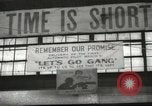
Views inside the Jack & Heintz Company war plant, Bedford Ohio, during World War II
The Jack and Heintz war plant in Bedford, Ohio, in 1943, during World War 2, where the company designed and manufactured various aircraft parts and accessories for the U.S. Military. First scene shows signs inside the factory reading : "Time is Short," and "Remember our promise, Delivery of the first automatic pilot March 31." And: "Let's Goo Gang, Its up to us to see that its kept." A picture of a war plant worker and a soldier with a machine gun is below the signs. Worker seen in a lab coat, smoking a pipe as he works at a machine. Behind him are two drawings of reclining pinup girls and a sign reading: "Quiet Please, War worker resting." Closeup of worker's hand machining a very small part.
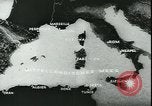
Views of Southern France, under German occupation in World War 2
Film opens with map showing lower France and Mediterranean areas. However, it shows images covering primarily the French Riviera (or Côte d'Azur) under German occupation during World War II, in 1943 or 1944. German infantry march along a road. A flight of German FW-190 Fighter airplanes flies inland from the Mediterranean Sea and crosses low above a harbor. Change of scene shows a single fighter plane buzzing the Marseille Port. (It looks like a P-47 with invasion stripes. But It does not draw any anti-aircraft fire.) Camera tracks it from vantage point at the Marseille Basilica, high above the harbor. Brief view of the Basilica as the aircraft passes. A glimpse of the Marseille Port below from the Basilica. View of the Marseille Transporter Bridge designed by Ferdinand Arnodin and built in 1905. (It was destroyed after these films were made, in 1944.) A German soldier peering through binoculars in front of a 2 cm Flak 30/38/Flakvierling, quad anti-aircraft gun position. Another one is seen in the background. Several more views of German anti-aircraft and other gun emplacements protecting the Marseille Port, including 88mm guns, heavy machine guns, and Atlantic Wall coastal defense guns. Scene shifts to German soldiers marching near the French Riviera beach and palm trees. Italian cavalry are seen riding in formation, ostensibly from Nice. Italian soldiers in trucks are being transported along the Riviera waterfront. A road sign points toward Toulon at 6.3 kilometers away. (So this location is probably near Sanary-sur-Mer.) View of the Toulon harbor, where the French battleship Provence, scuttled in 1942, is seen settled low in the water at a pier.
CRITICALPAST.COM: About Us | Contact Us | FAQs - How to Order | License Agreement | My Account | My Lightboxes | Shopping Cart | Advanced Search | Featured Collections | Website Terms & Conditions | Privacy Policy ©2026 CriticalPast LLC.
License Agreement |
Terms & Conditions |
Privacy Policy
©2026 CriticalPast LLC.