


 Francais
 Deutsch
 Italiano
Refine Your Search
Melville Rhode Island 1943 stock footage and images
- Showing 2803 to 2808 of 6726 results more
more Hide
Hide
Bomb damaged Place de la Concorde and unscathed Champs Elysees, Eiffel Tower, Arc de Triomphe, Notre Dame in Paris after WWII.
Results of selective strategic bombing by the British Royal and United States Eighth Air Forces in German-occupied Paris and surrounding areas during World War II. September 1944: Pont de Grenelle bridge over the Seine river. Eiffel Tower (Champ de Mars, 5 Avenue Anatole France, 75007 Paris, France) in the background. The Statue of Liberty replica on the Ile aux Cygnes Island (Pont de Grenelle, 75015 Paris, France). Shell blast damaged buildings and the Obelisk at Place de la Concorde (75008 Paris, France). Cyclists and motorists at the Place. Military cars pass the Arc de Triomphe (Place Charles de Gaulle, 75008 Paris, France) at Champs Elysees. Civilians around the Eiffel Tower. The French flag atop the undamaged tower. Unscathed Notre Dame de Paris (6 Parvis Notre-Dame - Pl. Jean-Paul II, 75004 Paris, France). United States military vehicles in the square before the cathedral. U.S. Army soldiers and French civilians crowding in front of the Cathedral. An FFI (French Forces of the Interior) flag at Notre Dame.
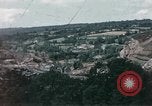
U.S. war correspondents touring France in the months after the Allied invasion near end of World War 2
U.S. war correspondents in France during the first few months after the Allied invasion to liberate France. Views of French countryside. Views in a village. People milling about on a street. Three young French children ride on the back of a mule as a boy pulls the mule. U.S. war correspondents pose with a French family. A woman with a child. A sign on a building reads 'Hotel and Restaurant Moderne' and a French flag flies out front. Small boats at a harbor of a coastal French town. U.S. Army jeeps on a street. Two French civilians walking with a bicycle and two U.S. soldiers together cross the wreckage of a partially destroyed bridge. A bicyclist on the street of a heavily bombed town with rubble and wrecked homes. Close and distant views of Mont Saint Michel, the small rocky island at the mouth of Couesnon River in Normandy. U.S. sailors aboard a vessel at sea.
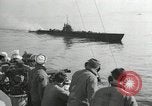
Operation Road's End, the destruction of the Japanese submarine fleet. Views from USS Everett F Larson escorting the submarines
April 1, 1946: “Operation “Road’s End.” View from the Destroyer, USS Everett F. Larson (DD-830) as it accompanies Imperial Japanese Navy submarines headed out of Sasebo Bay, headed to "Point Deep Six," (reportedly about 60 km west of Nagasaki and off the Gotō Islands) where they are to be scuttled by demolition charges and/or gunfire from the Larson or the USS Nereus (AS-17) (not seen). Captain Bell and Commander D.A. Mckee are seen on deck of the Larson with a Japanese interpreter who is issuing instructions to the skeleton Japanese crews through a megaphone. Views of the submarines underway.
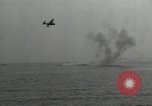
Submarines of the Japanese fleet, being sunk during Operation Road's End, after World War II
Operation Road's End. Japanese submarines being sunk after World War II. A U.S. Navy Martin PBM Mariner flying boat circles over several Imperial Japanese submarines as they are being scuttled and/or sunk by gunfire on April 1, 1946, off the Goto Islands, of Japan. Smoke drifts over the water from charges ignited aboard a sub. One of the submarines explodes raising a surge of water and huge black cloud. Clear view of a U.S. Baltimore class Cruiser with two scout planes aboard. Sailors watch from the U.S. Destroyer, USS Everett F. Larson (DD-830) as a submarine slips below the surface. Another submarine explodes and sinks. Gunfire from the Larson strikes another submarine. Smoke from the Larson's guns drifts in front of the camera. Closeup of the Larson's forward 5-inch guns, turned to starboard, firing.
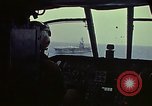
USO Troupe is ferried by helicopter to the Aircraft Carrier USS Hancock, during the Vietnam War.
Various scenes in unedited mix covering arrival of USO troupe aboard the USS Hancock. View of pilot in the cockpit of H-46 Sea Knight helicopter approaching the aircraft carrier USS Hancock ( CVA-19) as seen through the cockpit window. View from hovering helicopter as sailor crosses deck to assist landing. Sailors securing the chopper. Sailors gathered around USO Troupe members, and H-46 Sea Knight helicopter of HC-3 "Packrats.". Sailors and USO troupe members on flight deck overlooking open hangar deck below. Carrier island in background. Vought F-8 Crusader of Navy Squadron VF-24 on the flight deck. Douglas A-4F Skyahawk aircraft is seen displaying Logo of Squadron VA-212 ("Rampant Raiders"). USO troupe members walk about on deck. H-46 Sea Knight helicopter lands on the USS Hancock.
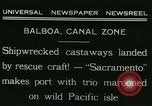
Shipwrecked castaways on rescue craft, 'USS Sacramento'
Shipwrecked castaways on gunboat USS Sacramento (PG-19). The USS Sacramento reaches port in Balboa, Canal Zone with three American citizens who had been marooned on Cocos Island. View of USS Sacramento arriving at the port of Pacific Isle. Man holds a bird in hand. Group of people rescued by USS Sacramento.
CRITICALPAST.COM: About Us | Contact Us | FAQs - How to Order | License Agreement | My Account | My Lightboxes | Shopping Cart | Advanced Search | Featured Collections | Website Terms & Conditions | Privacy Policy ©2026 CriticalPast LLC.
License Agreement |
Terms & Conditions |
Privacy Policy
©2026 CriticalPast LLC.