


 Francais
 Deutsch
 Italiano
Refine Your Search
Melville Rhode Island 1943 stock footage and images
- Showing 277 to 282 of 6726 results more
more Hide
Hide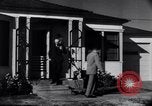
British worker and his American counterpart in labor exchange program visit the Lockheed aircraft plant in Los Angeles, Calfornia
A British guest on labor exchange program visit to the U.S. during World War 2. He leaves the home of his counterpart American host in Los Angeles, California. They leave in the American's car and drive a considerable distance to the Lockheed Aircraft Company facility. View of Honor Roll listing 15, 174 Lockheed affiliated members of the U.S. Armed Forces. The British-American pair walk past a Lockheed Ventura airplane under construction. View of a room filled with P-38 Lightning fighter planes completing final construction, outside the plant. A film clip of the maiden flight of the Lockheed Constellation aircraft (Later designated C-121 by the Army Air Corps) is inserted at this point. It shows the Constellation taking off from the factory airstrip in 1943, and climbing without raising its landing gear. View of aircraft fuselage under construction, where the British worker is inquiring about the manner of its assembly. Next he is seen observing a turntable press operation being run by men and women workers. View of workers using pneumatic hand tools to remove wrinkles from edges of pressed products. A woman punch operator is seen with safety straps on her hands that pull them away each time the punch comes down. Another woman worker demonstrates an electric spot welder. (The observing visitors are required to wear safety goggles in case sparks are created by the process.) Closeup of the aircraft part being spot welded. More workers operating similar machines in the plant, including an African American man and woman. Workers placing a large sheet of aluminum into a machine that fabricates wings for the P-38 fighter plane. Closeup of the British worker and his American counterpart on a balcony overlooking the production line for the Lightning aircraft. View across the production line floor. The two look into the factory first aid station available to workers and also see the transportation section where worker carpools can be formed. Employees are seen obtaining ration books and driver licenses from government clerks working in the plant itself. Employees are seen eating outdoors under foliage camouflage and others gather at an indoor eating site. Next, a section of a B-17 flying fortress wing, is seen moving out of a manufacturing jig. New components are immediately placed into the empty jig for construction. View of final installation area for B-17s, An overhead crane moves a finished wing, including engines, to be mated with its fuselage. Glimpse of numerous B-17s being assembled. A finished B-17 bomber being towed out of the factory.

Portion of Trial of Nazi war leaders during Nuremberg Trials in Nuremberg Germany. Audio only.
Audio only. Nazi war leaders on trial in Nuremberg Germany. Coverage on how the charges will be grouped. The speaker focuses on three major issues: international situations and aspirations for expansion of Germany between 1943-1945; conquering of Austria and Czechoslovakia, and improvement of military and political positions.
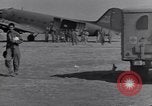
U.S. C-47 aircraft perform air evacuation missions during Operation Torch in Oran Algeria, during World War II
Opening scene shows American soldiers gathered around a C-47 transport plane on a desert field in Oran, Algeria during World War 2. They walk away en masse from the plane. Another C-47 is seen with tail number tail number 42-23507 (Records show this aircraft was delivered to Oran on May 20, 1943 and supported Operation Torch- The Italian Campaign of World War 2.) Scene shifts to interior of a C-47 rigged as an air evacuation aircraft, with wounded American soldiers in stacked bunks on both sides of the aircraft. A nurse and corpsmen are attending to the wounded. Two soldiers carry one of the wounded soldiers on a litter to the aircraft door. View from the outside of the soldier being carried by others to a waiting field ambulance. More views of the wounded being transferred from the plane to waiting ambulances. Scene shifts to ambulances parked on the desert field with a large Red Cross flag above them. A Curtiss P-40 fighter plane taxis past the camera. A large open field tent with a large Red Cross flag flying above it. Nurses and medical corpsmen tend to wounded soldiers lying in ambulances. A nurse serves water to some wounded.
Highlights of the War on various European Fronts captured by U.S. Coast Guard combat cameramen.
'Highlights of the War' depicts work by combat cameramen that has been honored with citations for outstanding photography. 'The Coast Guard at War' depicts the work of combat cameramen on the U.S. Coast Guard. U.S. Coast Guard Arctic Patrol. CG personnel aboard a cutter. Deck gun and the U.S. flag. A sailor communicates over the radio. Sailors on deck, the bow and deck. Combat cameramen record the CG activities including a religious ceremony. Sicily Invasion, 1943: Combat cameramen capture the scene as a German bomb hits an ammunition ship off the coast. Explosion on the ship, a mushroom cloud rises up. Sailors watch with binoculars. Normandy, 1944: Allied troops climb down rope ladders into Landing Craft Personnel (LCP). which deliver the men and cargo to the Normandy beaches. Soldiers wade through the water towards the shore under enemy fire.

World War 2 film promoting public investment in War Bonds and stamps to aid the war effort and temper inflation
World War 2 era film that also includes some World War 1 scenes. Show girls or chorus girls in follies-like show, costumed as U.S. silver dollars and marching to tune and lyrics alluding to dramatic increase of currency in circulation, over the years. Animation with stacks of coins shows increase in national income from $46 billion,in 1933, to $71 billion, in 1939, and $142 billion in 1943. Back to the "follies dollars," a boy asks why, and then scenes of the Japanese attack on Pearl Harbor,are shown, with U.S. battleships being sunk. Wartime arms plants are shown. An M2A3 Light Tank rolls off a production line. Ships being constructed in a shipyard. B-24 Liberator bombers being built in a factory. Artillery shells being produced. Defense workers receiving their pay. The "follies dollars" group themselves to illustrate the fractions of income devoted to taxes and savings. But other spending is curtailed by wartime shortages. A woman talking with clerk in a drug store. U.S. Army troops crossing a pontoon bridge in open trucks, towing 75mm M1A1 howitzers. Infantry on the march. Animation showing industrial production devoted to war materiel and lots of dollars chasing few civilian goods. A grocery clerk offers to sell a woman customer butter for more than the established price, and she agrees. The "follies" performers then introduce the idea of an "inflationary dollar," and some history of past U.S. inflations. Animated examples of price inflation are shown. Glimpses of World War I scenes are seen, circa 1917 -1918, including: a 12-inch railway gun firing; a huge explosion from shell bursting near the camera; various scenes of United States infantry soldiers and French soldiers in battle action, running to bomb craters for cover and emerging from trenches to go up "over the top" into no-mans land during combat. Meanwhile, singing narration refers to the home front inflation due to competition for limited civilian goods. Map shows Europe and singing narration cites rising prices for food in occupied France and other countries suffering ravages of World War II. Montage of scenes showing needy civilians obtaining food in those countries. Animation shows increases, by 1944, in cost of U.S. civilian goods since the Pearl Harbor attack. "Follies" character called "Double-duty dollar," appears explaining he serves the war and curtails inflation on the home front by being saved through investments in War Bonds and stamps.
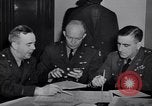
General Dwight D Eisenhower and Allied forces capture North Africa and Sicily, receives the French Legion of Honour medal (WWII)
General Dwight D Eisenhower from the North Africa campaign to the D-Day Normandy landings during World War II. Eisenhower with other military officers in the War Plan Office discusses strategy. A mural covering the west wall of the Eisenhower Museum in Abilene, Kansas. An animated map shows plan to seize key positions in North Africa. Fight in Algiers and Casablanca. Allied troops fire artillery, bombarding a North African coastal town. Troops advancing from beachhead, engage in street fighting with Vichy French troops in Casablanca, Morocco. A flare gun is fired. Unfavorable weather conditions delay the troops advancing towards Tunis and Bizerte. Allied troops fighting at nighttime. Allied soldiers walk through mud, allied military vehicles pass through water on the roads. Troops fire artillery under a canopy, hitting the side of a hill. Thick clouds of smoke cover a hill. U.S. General Omar Bradley and his troops capture Bizerte, Tunisia and the British 1st Army captures Tunis. German and Italian prisoners raise their hands up upon surrender. Animated map shows the surrender of the Axis troops. A ceremony commemorates the victory. North African cavalrymen join the parade. General Eisenhower and Free French Forces General Henri Giraud review a military parade. Henri Giraud bestows to General Eisenhower the French Grand Cross of the Legion of Honor. A mural on a wall of the Eisenhower Museum depicts the Allied invasion of Sicily. Allied troops march into Sicily in 1943.Civilians in the streets to celebrate. A mural on the wall of Eisenhower Museum depicts invasion of Italy. Allied troops land ashore and march into Italy. U.S. General Mark Clark 5th Army at Salerno. A sign reads Napoli. Eisenhower comes out of a tent. U.S. President Roosevelt visits the troops in the combat area with Eisenhower. United States President Roosevelt, British Prime Minister Winston Churchill, and Joseph Stalin in Cairo, Egypt. Another mural on the wall of the Eisenhower Museum. Eisenhower with other officers. Dramatization of German troops guarding and preparing the defenses of Normandy before the Allied landings. Eisenhower reviews training of the troops as they prepare for the invasion of France. Allied troops undergo physical training though obstacle courses. Churchill inspects the troops. Eisenhower reviews the troops on the eve of invasion. Eisenhower speaks to airborne troops wearing blackened camouflage face paint.
CRITICALPAST.COM: About Us | Contact Us | FAQs - How to Order | License Agreement | My Account | My Lightboxes | Shopping Cart | Advanced Search | Featured Collections | Website Terms & Conditions | Privacy Policy ©2026 CriticalPast LLC.
License Agreement |
Terms & Conditions |
Privacy Policy
©2026 CriticalPast LLC.