


 Francais
 Deutsch
 Italiano
Refine Your Search
Miami Beach Florida USA 1963 stock footage and images
- Showing 7975 to 7980 of 26838 results more
more Hide
Hide
Airplane flight endurance record set by U.S. Army Air Service Fokker trimotor aircraft using inflight refueling
The U.S. Army Air Service modified Atlantic-Fokker C-2A, named the 'Question Mark,' taxis and takes off. Refueling operation between the Question Mark and a Douglas C-1 aircraft. Question Mark in flight over the coast of California. A U.S. Army Air Service Douglas C-1refueling plane, with hose trailing below it, flies above the Question Mark. Crew member can be seen disconnecting the 3 inch fuel hose and throwing it off the Question Mark. After being aloft continuously for 6 days, the Question Mark landed at Metropolitan Airport, Van Nuys, California on January 7, 1929. Staff Sergeant Roy W. Hooe, Lieutenant Elwood R.(Pete) Quesada, Lieutenant Harry A. Halverson, Captain Ira C. Eaker and Major Carl A. Spatz, stand beside their airplane. (Spatz later changed spelling of his name to Spaatz.)
President Coolidge present pilots with citations after the successful goodwill mission.
Brief scenes from the U.S. Army Air Service Pan American good will flight that covered 22,000 miles on a goodwill mission to 21 Central and South American nations, during 1926-1927. A view of the hangar area and flight line of Kelly Air Field in Texas, as one of the five Loening OA-1 Amphibious aircraft, on the mission, takes off from the runway on Dec. 21, 1926. Five of the aircraft in formation over a large city. U.S.President Calvin Coolidge presents the aircrews with citations for the Distinguished Flying Cross, at Bolling Field, Washington, D.C., on May 2, 1927.
Animated map of U.S. Army's flight around the world. Expedition Commander, Major Frederick F. Martin congratulates crews.
Animated map shows the course taken by Douglas World Cruiser aircraft of the U.S. Army Air Service in their round-the-world flight in 1924. It also highlights mishaps, such as the location of Major Fredrick F Martin's crash in mountains off Alaska and where Lt. Wade was forced down and wrecked near Iceland. Animation shows route from England to Newfoundland to Greenland to Labrador to east coat of United states and aerial route across states. The expedition was completed by 2 of the 5 original Douglas World Cruiser aircraft, namely: the "Chicago," crewed by Lt. Lowell Smith and Lt. Leslie Arnold; and the "New Orleans," crewed by Lt. Erik Nelson and Lt. Jack Harding. They are seen being congratulated by their Expedition Commander, Major Frederick F. Martin at the completion of the mission, on September 28, 1924, in Seattle, Washington.
U.S. Army Air Service Lieutenants John A. Macready and Oakley G Kelly fly non-stop, coast-to- coast across the U.S.
U.S. Army Air Service fliers, Lt. John A. Macready and Lt. Oakley G Kelly, are seen boarding their Fokker T-2 and taking off from Roosevelt Field, Hempstead, Long Island, New York. They are embarking on the first non-stop coast-to-coast flight across the United States. Their airplane seen in flight.
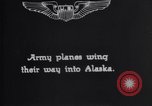
The U.S. Army Air Service flight expedition from Mitchel Field, New York, to Nome, Alaska, and return.
U.S.Army Air Service flying expedition to Alaska and back. DH-4B aircraft of the Black Wolf Squadron preparing to depart Mitchel Field, Long Island, New York, on their record-breaking flight to Nome, Alaska, and return. Change of scene to Alaska. Captain St. Clair Streett and other members of the expedition posing next to the DH-4B flown by 2nd Lieutenant C.H. Crumrine. An itinerary of their flight on the fuselage of the airplane. Two aircrew hold pet dogs.
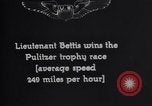
U.S. Army Air Service Lt. Cyrus Bettis wins the Pulitzer Trophy at the International Air Races, Mitchel Field, New York
U.S. Army pilot Lieutenant Cyrus Bettis gets out of his Curtiss R3C-1 racer airplane after winning the Pulitzer Trophy Race and setting a new world speed record of 249.3 miles per hour in the International Air Races at Mitchel Field, New York. He is congratulated by U.S. Army Air Service Major T. G. Lanphier.
CRITICALPAST.COM: About Us | Contact Us | FAQs - How to Order | License Agreement | My Account | My Lightboxes | Shopping Cart | Advanced Search | Featured Collections | Website Terms & Conditions | Privacy Policy ©2026 CriticalPast LLC.
License Agreement |
Terms & Conditions |
Privacy Policy
©2026 CriticalPast LLC.