


 Francais
 Deutsch
 Italiano
Refine Your Search
Miami Beach Florida USA 1963 stock footage and images
- Showing 11743 to 11748 of 26838 results more
more Hide
Hide
The Princeton Tigers defeat the players of the University of Pennsylvania in a football game at Franklin Field, Philadelphia.
A college football game between the Princeton Tigers and the University of Pennsylvania football team at Franklin Field, Philadelphia. The game in progress. Spectators in the stands cheer for the players. The Princeton Tigers defeats the University of Pennsylvania football team by a score of 13-7.
A model of the Statue of Liberty is unveiled at the launching of Liberty ship Benjamin Warner in Richmond, California.
Launching of the last Liberty ship in Richmond, California. 'Benjamin Warner' written on a Liberty ship in the Kaiser Richmond Shipyards. A miniature model of the Statue of Liberty is unveiled in the presence of Henry Kaiser. People cheer as the ship is launched.
Charles de Gaulle visits Arlington National Cemetery and addresses people of New York City in the United States.
Charles de Gaulle visits the United States. An aircraft lands at Washington National Airport in Washington DC. People at the airport. The leader of the Free French Forces General Charles de Gaulle disembarks from the aircraft. He is greeted by dignitaries. U.S. Army General George Marshall, U.S. Army Air Forces General Henry Arnold and U.S. Navy Admiral Ernest King salute as the French National Anthem is sung. De Gulle also salutes and shakes hands with these and other dignitaries. He gets in a car and leaves for the White House. At the White House he is greeted by U.S. President Franklin Roosevelt, his daughter, U.S. Secretary of State Cordell Hull, U.S. Secretary of the Interior Harold Ickes and U.S. Secretary of Navy James Forrestal. He visits Arlington National Cemetery to pay tribute at the Grave of Unknown Soldier. In Manhattan people line the streets and cheer as De Gaulle's car moves towards the New York City Hall. He addresses the people of the New York City from the top of the RCA Building. (World War II period).
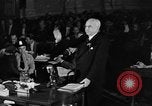
Under Secretary of State George Messersmith gives testimony about the Hans Eisler case and Dorothy Thompson to HUAC commission
Excerpts of testimony by United States Under Secretary of State, George S. Messersmith, to the HUAC (House Un-American Activities Committee) in Washington DC. Ambassador Messersmith raises his hand and is sworn in, and then seated beside his legal counsel, Norman M. Littell. Ambassador Messersmith gives testimony about Hans Eisler and Dorothy Thompson related to his own time in Berlin Germany in the 1930s on behalf of the U.S. State Department. He references his work with U.S. diplomat Sumner Welles. He says that he read the Eisler file to refresh his memory. He says that although they were not involved in the war at the time the responsibility on the State Department had increased. He talks about a case related to columnist Miss Thompson. He looks into his papers He talks about the time when he was posted in Berlin and Austria and she made a number of visits. He laughs. He tells about officers who showed prejudice in examining visa papers.
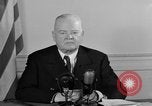
Comments by former President Herbert Hoover, serving as honorary chairman of the Famine Emergency Committee
Former United States President Herbert Hoover seated at a desk and delivering comments for the media. The U.S. flag behind him. The 71 year old Hoover is speaking in his role as honorary chairman of the Famine Emergency Committee, appointed by President Truman after World War II. President Hoover speaks of difficult conditions and suffering of people in post-war Europe and England, but also discusses the balance needed between relief and rehabilitation over the world, and the need to prevent starvation, without putting too much drain on the American economy. He calls for providing only what is needed for "the bare maintenance of human life." He notes how difficult the difficult winter of 1946 has been for all of Europe and the UK.
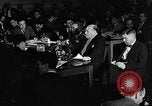
HUAC testimony of "Hollywood Ten" member Samuel Ornitz during investigations into Communist affiliations in Hollywood
Meeting of the House Un-American Activities Committee, or HUAC, in October 1947, under J. Parnell Thomas (the so-called "Thomas Hearings."). Hollywood screenwriter Samuel Ornitz is questioned and asked if he is a member of the Screen Writer's Guild. Ornitz begins his response and expresses that his response is a matter of conscience. He speaks out against the intimidation tactics of the committee chairman. The Committee members continue to cut-off the response from Ornitz and push for a rapid answer to the question. Ornitz continues to give a longer answer and states his belief that the Committee is asking him to violate the Constitution. Robert Stripling is directed to ask the next question. Ornitz is asked "are you now or have you ever been a member of the Communist Party." Ornitz continues to protest the line of questioning and likens his affiliation with any party to be like his affiliation with any religion and thus protected by the Constitution. The Committee asks if his party affiliations are directed by a foreign government. Ornitz is told to stand away and the next witness is called.
CRITICALPAST.COM: About Us | Contact Us | FAQs - How to Order | License Agreement | My Account | My Lightboxes | Shopping Cart | Advanced Search | Featured Collections | Website Terms & Conditions | Privacy Policy ©2026 CriticalPast LLC.
License Agreement |
Terms & Conditions |
Privacy Policy
©2026 CriticalPast LLC.