


 Francais
 Deutsch
 Italiano
Refine Your Search
Miami Beach Florida USA 1963 stock footage and images
- Showing 11749 to 11754 of 26838 results more
more Hide
Hide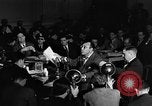
During HUAC hearing in the United States, Herbert Biberman is questioned about his affiliation with the Communist Party
A hearing of the House Un-American Activities Committee (HUAC) in the United States, under Congressman J. Parnell Thomas (the "Thomas Committee") . People seated during the hearing. Hollywood director and screenwriter Herbert Biberman is questioned about his occupation in the Screen Writer's Guild and his affiliation with the Communist Party. Biberman begins his response and does not directly or quickly answer the question, which draws an angry, heated response from J. Parnell Thomas pounding a gavel, shouting from Congressman Thomas and from Robert Stripling, and demanding an answer. Biberman is subsequently asked, "are you or have you ever been a member of the Communist Party" and Biberman begins a response in which he decries the work of the committee and its negative effects on the Hollywood film industry. Biberman, one of the "Hollywood Ten," is dismissed from the stand.
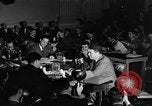
Emmet Lavery, President of the Screenwriters Guild of Los Angeles, is questioned by the HUAC members
Questioning of the President of the Screenwriters Guild of Los Angeles, Mr. Emmet Lavery, by members of the House un-American Activities Committee, including J Parnell Thomas and Robert Stripling, in October 1947. Mr. Lavery speaks into a microphone and answers questions of the Committee. He opens by saying he will break the suspense and states that he is not a Communist and has never been one (even before he is asked.) This elicits laughter from those present in the hearing. In testimony, Emmet Lavery states that he is "a Democrat who in my youth was a Republican, and if the Committee wants to know why I changed..." He is cutoff with response "No we don't want to know..." and again there is laughter. Mr Lavery concedes that there are probably communists in the Guild, but he doesn't know who, by name. He expresses concern that the questioning by the Committee may negatively affect the Guild elections that are approaching. He states that no individuals have control of the Guild. The Committee asks if Trumbo (Dalton Trumbo of the Hollywood Ten) has control of the Guild. Lavery says no. Lavery states that he agrees with J Edgar Hoover of the FBI that it would be wrong to outlaw the Communist party, especially in a time of peace.
Shows the importance and application of camouflage techniques during combat in World War 2.
A film 'Camouflage in Combat' underlines the importance of tactical exploitation and counteraction of shadows and use of nets, underbrush and other camouflage during World War II. The film shows U.S. soldiers going into a theater in the United States and watching a movie 'Camouflage'. The movie shows a soldier in a forest. He is shot down. A soldier approaches him. He looks skywards. He applies mud on his face to camouflage himself. Soldiers paint each other's faces with GI paint. On 5th June 1944, fully camouflaged Airborne and pathfinder U.S. paratroopers preparing for D-Day invasion jump over Normandy, France. Soldiers with camouflaged helmets. A soldier camouflages his helmet with grass and twigs. A soldier on an island with his helmet camouflaged with grass and twigs found in the area which gives him a perfect blend. U.S. soldiers with camouflaged helmets in France. A camouflaged tank rolls. An officer inspects soldiers standing in a line. Their helmets are camouflaged. A U.S. soldier hiding in shadows in Casino, Italy fires his gun. His ring sparkles. A soldier in a prone position fires. A New Zealand soldier fires while in shadows.
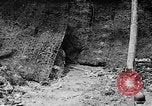
U.S. soldiers receive training on enemy camouflage during World War II.
A film underlines the importance of tactical exploitation and counteraction of shadows and use of nets, underbrush and other camouflage during World War II. The film shows camouflaged aerodromes which are covered with chicken wire and feathers in jungles of the Solomon Islands. A man opens a window of an Italian hot dog stand which was actually a German pillbox. A German pillbox camouflaged as a farmhouse. A U.S. Army soldier handles mats of a matted house. A soldier looks at windows painted on a pillbox. A German pillbox camouflaged as an entertainment outlet. A dummy building which hides a bridge. A German airfield disguised as a decoy village in Belgium. Buildings in the village. A jeep drives on a road in the village. Men move a sliding wall of a phony building. Helmets and shirts on branches to appear as dummy soldiers. A man near a dummy soldier. Vehicles roll past in France. An artillery piece hidden in thick vegetation. U.S. soldiers watching the film in a theater in the United States.
A U.S. Navy PV-3 helicopter is being demonstrated in Philadelphia, Pennsylvania.
A United States Navy PV-3 helicopter in Philadelphia, Pennsylvania. The PV-3 helicopter with a capacity of 10 passengers on a field. Rotor blades rotate. Men and women board the helicopter. The helicopter lifts off and in flight. Twin rotors of the helicopter rotate while it is in the flight.
Camouflaged facilities at Boeing aircraft production plant in Seattle, Washington during World War 2. Girls sun bathe on a camouflaged terrace.
A Boeing aircraft plant in Seattle, Washington during World War 2. Exteriors of the Boeing manufacturing plant. Many different camouflaged buildings at the plant. Camouflaged roofs of the plant. Girls on the garden like terrace of the plant. Artificial trees on the roof top fashioned with camouflage materials. Young women sun bathe on the roof top and walk on paths of an area showing different camouflage methods that disguise the plant facilities from possible enemy aircraft overhead. Direction signs in the area show the intersection of "Synthetic Street" and "Burlap Boulevard".
CRITICALPAST.COM: About Us | Contact Us | FAQs - How to Order | License Agreement | My Account | My Lightboxes | Shopping Cart | Advanced Search | Featured Collections | Website Terms & Conditions | Privacy Policy ©2026 CriticalPast LLC.
License Agreement |
Terms & Conditions |
Privacy Policy
©2026 CriticalPast LLC.