


 Francais
 Deutsch
 Italiano
Refine Your Search
Miami Beach Florida USA 1963 stock footage and images
- Showing 17197 to 17202 of 26838 results more
more Hide
Hide
War workers and buildings of Washington DC during World War II
Clip compares Washington DC to an industrial boomtown where the big business is government, during World War 2. Men and women working in offices. A young woman seated at a desk and doing clerical work. Identification cards of civilian women working for the U.S. Army. Pedestrians and workers walking on a street of Washington DC. Buildings along street sides. People at the entrance of Union Station. A woman identified as Phyllis Hood joins others in a Diamond Taxi cab leaving Union Station. Woman exits the taxi and looks at various buildings as she seeks a place to live in Washington. Boards on buildings read: 'No Vacancy', 'No Rooms' and 'Filled Up'. Wearing a fur coat and hat, she stops and sits on her suitcase, removes a shoe, and rubs her tired feet. She talks to a police officer on a traffic corner, who directs her to the U.S. Office of Information. She is seen inside the main hallway of the Office of Information. They direct her to an availble room at the former French Embassy building at the intersection of 16th Street and Kalorama Road NW in Washington DC, by Meridian Hill Park. She enters the building which that narrator says serves as a hotel for girls. She talks to a receptionist in the main hall lobby and then ascends the stairs. Phyllis Hood along with two other girls seated inside a room. They talk amongst themselves and relax. Woman hangs nylon stockings from a hanger to dry. The women going to sleep at night and turning out bedside lights. A large room with an operations maps, and clocks on the curved wall showing time in various international cities.

U.S. Secretary of War Henry Lewis Stimson seated at a desk in his office in Washington, DC (WW2)
U.S. Secretary of War Henry Lewis Stimson in his office in Washington during World War II. Stimson seated at his desk. He holds a document.
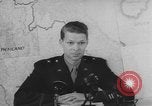
USAAF Brigadier General Lauris Norstad gives a report on the workings of the 20th Air Force in Tokyo, Japan.
U.S. Army Air Force( USAAF ) Brigadier General Lauris Norstad presents a report in the United States. Seated at a desk in his office Brigadier General Lauris Norstad presents a report on the working of the 20th Air Force in Tokyo, Japan. He gives the report on behalf of USAAF General Henry Arnold. He details information in context to the eight day period of the bombing of Tokyo by the United States Army Air Forces B-29 Superfortresses. He talks about the buildings and the areas damaged by the bombing. He speaks about the overall damage and economy loss caused due to the bombardment. (World War II period).

In the United States military analysts- Baldwin, Schubert and MacKenzie discuss about the Allied invasion of Europe.
A film titled: 'Invasion' shows a man seated at a desk in the United States. Three military analysts - Hansom Baldwin, Schubert and MacKenzie are seated at the desk along with the man. The man asks them questions about the Allied invasion of Europe. They explain their theories on the best way to invade Europe. Their explanations are followed by animation of the invasion moves. Baldwin states that bombing strategies of the Allies can prove to be a major factor in the decline of German Chancellor Adolf Hitler. Animated map shows air raids on German positions. A discussion about the best invasion route is carried out. (World War II period).
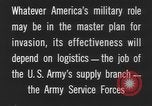
Officers and staff members of various departments of the Pentagon have discussions in Washington DC.
The working of the Army Service Forces in the United States. Exterior of the Pentagon building in Washington DC. Commanding General of Army Service Forces Brehon B. Somervell speaks with Army Service Forces staff officers. A flag with the emblem of the Quarter Master Corps. Men working inside a building. They pack supplies for shipment. Crates stacked in a building. Chiefs of Staff and staff members of the Chemical Warfare, Signal Corps, Ordnance, Engineers, Surgeon General and Transportation Corps discussing. Interior of the Army Map Service draft room. Maps rolling off presses. Officers discussing. Supplies being loaded onto a ship.
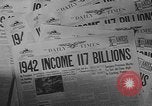
Men and women working in different war production factories for the production of raw materials and armament for World War 2 effort
The production of war materiel and supplies for soldiers and sailors in the United States during World War II. Newspaper headlines read: '1942 income 117 billions'. Men working in war production factories. Manufacture of aluminum and steel for the war effort. Sheet of aluminum rolling down conveyor in factory. View of assembly floor in a production plant building bomber aircraft. Brass being processed in factories, and hands of a worker sifting through new bullet casings in an ammunition factory. Use of copper exemplified in engine wiring and telephone communications applications. Steel being forged in factory. War ship being launched and a new Liberty ship SS Richard Bassett being launched from ship building slips on May 22, 1942. Tanks being built in a factory. Elevated view of many wood army barracks being built at an army base or camp. Then a view of homes being built as housing for war production workers. Lumber operations underway and coal miner in coal mines. A chart depicts the last year's production goals and then animated chart showing the production goals for the coming year shooting sky high. A sign on a door reads: 'Lt. Gen Brehon Somervell, Commanding General, ASF'. Lt. General Somervell seated at a desk in his office. He talks about engineers and technicians working for the U.S. Army and making materials go further to do more jobs than ever before.
CRITICALPAST.COM: About Us | Contact Us | FAQs - How to Order | License Agreement | My Account | My Lightboxes | Shopping Cart | Advanced Search | Featured Collections | Website Terms & Conditions | Privacy Policy ©2026 CriticalPast LLC.
License Agreement |
Terms & Conditions |
Privacy Policy
©2026 CriticalPast LLC.