


 Francais
 Deutsch
 Italiano
Refine Your Search
Miami Beach Florida USA 1963 stock footage and images
- Showing 19837 to 19842 of 26838 results more
more Hide
Hide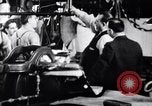
U.S. Labor strife - strikes and lockouts in the clothing industry in the 1920s
Post-World War 1 United States marked by labor-management strife and strikes, especially in the garment industry. Clothing workers are seen busy at their jobs in a factory in New York City. A man is seen symbolically closing and locking a steel door (narrative refers to a company "lockout.") Footage of police officers and crowd of laborers on New York City street. Police try to maintain order as crowds fill garment district streets in protest. Montage of persons awaiting a June 1921 decision by the Supreme Court of the State of New York, Kings County. Narrator announces that Justice James C. Van Siclen, has granted an injunction (against all picketing by the Amalgamated Clothing Workers of America). Narrator quotes Van Siclen's opening statement in the decision: "The court must stand at all times as the representative of capital, of the captains of industry..." View of Sidney Hillman, leader of the Amalgamated union (ACWA) sitting with other union members. View of a bustling New York City street lined with tenements and pushcarts in the lower east side of Manhattan. A man washing his face at a sink. A woman preparing a meal over a stove. Four children sharing a large bed. A gathering of idled clothing workers in a school room setting. Some in art classes. Dancers entertaining locked out workers. Young people presenting a puppet show. Narrator states that the lockout lasted 6 months, but the union prevailed. View of pleased union members.
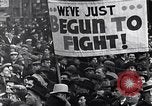
Auto workers union sit-down strike at the General Motors Fisher Body plant in Flint, Michigan, 1937
Union workers gathered in Flint Michigan, 1937, with a sign reading: "We've just begun to fight!" View of an Army truck, with a uniformed National Guardsman atop, manning a Browning M1917 machine gun mounted on a tripod. It drives past the Fisher Body factory, where striking workers, who have occupied the plant are seen looking out the windows. View from factory of National Guardsmen setting up machine guns outside. View from behind two Guardsmen, in battle gear, directing a machine gun from a high point along the factory roadway. Closeup of a machine gun crew setting up. Camera view looking directly into muzzle of the machine gun. Women and children watching the troops. Crowd of supporters waving at the strikers. Several women pass a basket of food to the strikers through a window. Strikers receiving cigarettes and one talking with his wife through a window. A striker lowers his child back down to his wife, after a visit with Daddy. Union workers marching along street, carry a banner of the new local 236 of the UAW (CIO) established on March 3, 1937, for workers at the L. A. Young Spring and Wire Corporation. Former sit-in strikers at the Fisher Body plant are seen outside,with family and friends, celebrating a contract after the 44-day ordeal. A crowd with banner reading: "GM Today, Ford Tomorrow." Several views of union workers from different industries, marching. In one, workers carry a coffin labeled "The Open Shop." Workers walking and waving in front of Chrysler's Desoto plant on Jefferson Avenue in Detroit, Michigan. More views of C.I.O. union workers in gatherings.
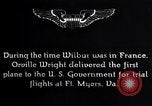
Orville Wright and Army personnel fly in Wright plane, Virginia United States.
Development of airplane by Wright brothers. Orville Wright in a plane presented to U.S. Government by him at Fort Myers, Virginia. Plane takes off catapulted in a field near a building. Spectators on ground observe the plane. Army personnel remove doors of hanger. Wright aircraft take out of the hanger. Army personnel stand near the plane. Lieutenant Lahm and Orville Wright sit in plane and take off for a flight. Lieutenant Foulois and Orville make preparations and sit in plane for a cross country flight.

People get employment, development of canals, roads and airports under the WPA projects in Missouri, United States.
WPA Development works in Missouri, United States during the Great Depression. Smoke stacks of a factory under halt. Depressed and discouraged men in public places of Missouri. Under the Works Progress Administration (WPA) projects, people work in agricultural farms and in factories. People lined outside a shop to purchase milk and eatables. Girls play in a park. A happy family. Streets paved in St. Louis and county roads surfaced. Gravel quarried by labors. The Joplin airport graded and surfaced by horse drawn rollers.
Schools under construction, and development works under the Works Progress Administration Projects in Missouri, United States.
Development works under the Works Progress Administration (WPA) Projects in Missouri, United States. Students of a school swim in a swimming pool. Masons and painters at work at a school under construction. A square dance is held in the Winona community hall. Couples dance as musicians play violin and other instruments in the Great Depression.

Potters make vessels and women at weaving jobs under Works Progress Administration Projects in Missouri, United States.
Development works under the Works Progress Administration (WPA) Projects in Missouri, United States. Experts dig clay from ground to examine its utility in pottery. A potter's workshop with various items kept. A potter makes a jar on potter's wheel. Women workers operate looms and traditional spinning wheels for wool and weaving industry in the Great Depression. The women are seen working on hand looms and making cloth. Workers include white women and African American women. Various fabric products made by the women.
CRITICALPAST.COM: About Us | Contact Us | FAQs - How to Order | License Agreement | My Account | My Lightboxes | Shopping Cart | Advanced Search | Featured Collections | Website Terms & Conditions | Privacy Policy ©2026 CriticalPast LLC.
License Agreement |
Terms & Conditions |
Privacy Policy
©2026 CriticalPast LLC.