


 Francais
 Deutsch
 Italiano
Refine Your Search
Miami Beach Florida USA 1963 stock footage and images
- Showing 19831 to 19836 of 26838 results more
more Hide
Hide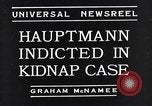
Colonel Charles A. Lindbergh arrives at court of grand jury to testify the suspect in case of his son's kidnapping, New York.
Kidnapping case of twenty months old child of aviator Colonel Charles A. Lindbergh. Grand Jury hearing in New York. Colonel Lindbergh arrives at court, protected by several policemen. Crowd outside court building. Policemen and detectives inspect suspect Hauptmann's house in the Bronx, New York. Jury members give their verdict that prime suspect Bruno Richard Hauptmann wrote all kidnap notes. Police official gives his statements. Lindbergh moves out of court, sits in car and drives away. Hauptmann's wife, Anna Schoeffler Hauptmann, seen singing a bedtime song in German to her young child, Manfred Hauptmann (Manfred Richard Hauptmann).

Death sentence by court to convict Hauptmann for kidnap and murder of son of aviator Charles Lindbergh, Flemington New Jersey.
The kidnapping and murder case of the infant son of aviator Charles Lindbergh, in Flemington New Jersey. Coverage of court ruling in 1935. A huge crowd outside the court during the trial of Bruno Richard Hauptmann for kidnapping and murder termed as 'the crime of the century'. Lindbergh and his wife confront Hauptmann from witness stand. The letters of ransom written by Hauptmann. Lindbergh testifies in the court of trial. Hauptmann cross examined by Attorney General Wilnetz. On February 13, 1935 Judge declares that Hauptmann will receive the death penalty, by electric chair. From a January 1960 newsreel recounting events 25 years earlier.

A ceremony at St. Patrick's Cathedral and traditional Communion Breakfast joined by members of film industry in New York.
Traditional Communion Breakfast attended by members of the Motion Picture Industry in New York City. Men and women enter through the door of the Roman Catholic St. Patrick’s Cathedral (5th Ave, New York, NY 10022, United States). A communion ceremony at St. Patrick's Cathedral attended by members of film industry. After the mass at St. Patrick’s Cathedral, Motion Picture Industry members assemble for breakfast (likely at the Waldolf Astoria Hotel). Motion Picture Industry Members from rank and file, union leaders and high company executives at the breakfast tables. A Roman Catholic priest sits with Motion Picture Industry executives during the breakfast.
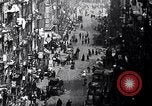
Lives of typical immigrants to the U.S., early in the 20th century
Tenements and open-air markets, part of life for many new immigrants, in Manhattan, New York City, early in the 20th century. Brief footage of elevated view of street likely in lower east side of Manhattan. Series of still images: Children pose on a fire escape platform. Merchants with pushcarts line the street. Men open a fire hydrant that spews water into the street. Men place cups in the stream. Children wade in the water. Many small children seen on the sidewalk. A boy tries to drink the last few drops from the hydrant, after it is turned off. Boys stand in an alleyway, near garbage cans. A boy at home preparing to wash in a basin. A boy holding a puppy in an unsanitary tenement apartment. View of Italian immigrant family members crowded into a Mulberry Street tenement. In contrast, a group of well-to-do young women are seen outdoors dressed in white, carrying parasols, as they learn social etiquette. A young woman, in a carriage, with a chaperone. Two well-dressed, mature women, conversing. A family, including several children, all engaged in needle work at home, for a pittance in wages. Men and women at sewing machines manufacturing clothes in a crowded "sweat shop.".
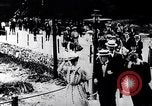
Conditions of American workers and the rise of labor unions, especially in garment industry, early in the 20th century
A large group of well-dressed men and women at an event in a park in Chicago, Illinois. Many men wear straw boater hats and many women wear bonnets. Men and women working at sewing machines in a factory of Hart Shaffner & Marx men's clothiers in Chicago, Illinois. Successive closeups of two foremen and one worker, posing for the camera. Pay envelope for a person named Herscowitz in the seaming department. Card shows pay of $1.78 for 23 hours & 20 minutes work. Men working as cutters in garment factory. Young girls, an older man, and mature women working in the factory. Several young women walking arm in arm, ostensibly in protest. Closeups of several factory workers. Group of labor protestors led by women, walking in a city street. Many workers in a protest parade in the snow as spectators watch from sidewalks. Gathering of workers dissatisfied with their union leadership. One carries a sign reading: "Our so called leaders say strike settled. This demonstration is contrary to their claims."
Labor dispute: Striking garment workers in Chicago suffer police opposition and conflict in 1910
Group of garment workers pose for photograph on steps of a building in Chicago. Police on horseback approach a group of people on a sidewalk. Horse-drawn wagon parked at curb. Mounted police breaking up a gathering. Two women caught in the commotion. One falls to the ground and is helped up by a uniformed policeman. Four women garment workers pose for a picture. Another view of the group seen earlier on steps of a building. Striking garment workers march and protest in streets of Chicago. Brief montage with scenes of unrest. Garment workers parade with sign lamenting the death of Charles Lazinskas .Formal portrait photograph of Charles Lazinskas, with caption beneath reading:"Was shot December 3, 1910." The Chicago Daily Tribune of January 4, 1910, with headline reading: "Man shot in strike riots, foreman of big clothing factory held." Another newspaper headline reads:"Strikers March With Mute Pleas, Garment Workers Rely on Banners and Placards to Air Grievances." Yet another reads: "Strike Embroils Social Workers, Pastor and U of C Student Interfere for Toilers and Are Arrested, Police Brutality." Picture of social worker, Jane Addams, with another woman. Early and later photographs of Joseph Shaffner, of Hart, Schaffner, & Marx company. Garment worker union leader, Sidney Hillman. Fabric cutters working at the clothing factory.
CRITICALPAST.COM: About Us | Contact Us | FAQs - How to Order | License Agreement | My Account | My Lightboxes | Shopping Cart | Advanced Search | Featured Collections | Website Terms & Conditions | Privacy Policy ©2026 CriticalPast LLC.
License Agreement |
Terms & Conditions |
Privacy Policy
©2026 CriticalPast LLC.