


 Francais
 Deutsch
 Italiano
Refine Your Search
Mig-15 stock footage and images
- Showing 595 to 600 of 681 results more
more Hide
Hide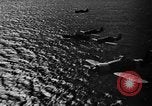
German and Italian aircraft dive through intense flak to bomb a British convoy underway in the Strait of Sicily.
A naval-air battle in the Strait of Italy during World War II. A formation of Italian and German bombers over the Strait of Italy. Ships of a British convoy underway. British ships fire antiaircraft guns at Italian aircraft. Flak bursts in the sky. Italian bombers bomb the ships. Explosions near and on the ships. British ships are heavily bombed by a large number of Italian bombers. Many ships sink after exploding. Smoke billows up from the ships afire. Italian MASs (torpedo armed motorboats) head for a British convoy. British ships are torpedoed. Smoke rises after explosions on the ships. The bombing of the convoy continues at night. Interiors of an Italian submarine shows its crew members at work. A list of claimed British losses includes HMS Furious (47), HMS Eagle, HMS Manchester (C15), HMS Cairo (D87) and HMS Foresight (H68). Victorious Italian MASs underway and Italian aircraft in flight overhead. View of letter from Mussolini congratulating the Axis forces, read by narrator. View of Italian attack boats moving at high speed in ocean.

6th Armored Division of the U.S. Army advances on a German road during World War II.
Armored fighting vehicles of the U.S. 6th Armored Division move up a road in Germany during World War 2. Vehicles including trucks, jeeps, M8 armored cars, half tracks and tanks advancing on the road. 15th armored regiment tanks in column. Large white tactical numbers synonymous with the 6th Armored Division displayed. Smoke rises from fire in the background. A T34 rocket launcher mounted on an M4 medium tank beside the road. A M4(105) tank of HQ company rounds a corner throwing up dust. A tank with a rocket launcher moves along the road. Jeeps loaded with medics move up with the armored spearhead (heading to their assembly area prior to the Rhine crossing the following day).
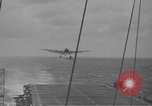
U.S. Navy TBF Avenger gunner from USS Essex is buried at sea with his aircraft during World War II
A Grumman TBF avenger torpedo bomber of VT-15 Torpedo Air Group, approaches and lands on the deck of the USS Essex (CV-9) during the Battle of Manila Bay, in World War 2. Upon landing, Lt. Robert Cosgrove (Pilot) and Sailor Digby Denzek (Radioman) can be seen in their respective forward and middle crew positions. But the rear gunner position, occupied by Aviation Machinist Mate 2nd Class, Loyce Edward Deen (Gunner), has been completely destroyed by Japanese enemy 40mm shell fire, and AMM2C Loyce Deen is dead. As the aircraft is parked among others, with wings folded up, U.S. Navy sailors of the USS Essex take fingerprints and cut dog tags from the body of AMM2C Deen in the gunner position. Captain Carlos W. Wieber, Commanding Officer of the Essex, and her crew, participate in funeral services on the deck. A chaplain conducts the services from beside the aircraft, where Loyce Deen's remains in the gunner's position have been shrouded. Closeup of Rear Admiral Frederick C. Sherman during the service of burial at sea. A bugler plays taps. Beside the bugler is David L. McDonald, who was XO of the USS Essex (and later Chief of Naval Operations in the 1960s). Deen's remains are then buried at sea in the TBF avenger in which he died. The aircraft floats off the fantail for a short time before sinking from view. Two TBF Avengers are seen flying overhead, in tribute. Crew members then disband and return to their duties.
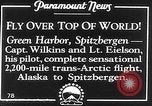
Captain Wilkins and Lt. Eielson stand near an aircraft in Spitsbergen, Svalbard after completing a trans-Arctic flight.
The history of famous airplanes. Australian polar explorer Captain Sir George Hubert Wilkins and American aviator Lieutenant Carl Benjamin Eielson in Spitsbergen, Svalbard after completing a 2,200 mile trans-Arctic flight from Alaska to Spitszbergen. Captain Wilkins in a civilian dress. An aircraft being moved out of the area. 'Detroit news, Arctic expedition' written on the side of the airplane. Captain Wilkins and Lt Eielson check over the airplane prior to a take off. Men dressed in civilian garb. The aircraft starts to taxi across the field. It is a Lockheed Vega aircraft. Animated world map shows the start of the Wilkins flight on April 15th from Point Barrow in Alaska and traces the route of the flight to Spitsbergen. The time of the flight was 20 hours, 20 minutes. They land at Green Bay in Spitsbergen.

A crowd gathers outside the University of Texas in Austin, Texas after a students kills several people.
Aftermath of the University of Texas tower mass shooting in Austin, Texas. University of Texas student Charles Whitman fires bullets from the tower of the building killing 15 people and wounding 33. Exterior of the University of Texas Main Building tower (110 Inner Campus Drive, Austin, TX 78705, United States). Men kneeling on a street. Cars parked on the street. Men run. A crowd gathers outside the university. Men carrying a casualty away. Cars parked on the street. Rifles and guns on a table. The crowd rushes towards the building.
Officers watch the preparations of the launch of an Atlas 12 D missile at Vandenberg Air Force Base in California, U.S.
Preparations for the launch of an Atlas 12 D missile at Vandenberg Air Force Base in California, United States. Strategic Air Command (SAC) Commander in Chief General Thomas S. Power, Commander of the 1st Missile Division Vandenberg AFB Lieutenant General David Wade and Commander of the 15th Air Force Lieutenant General Archie J. Old Jr, and the staff watches the launch. SAC insignia and emblem on Atlas missile in the service structure. The missile on a launching pad. Mark II nose cone on the missile. Base of the missile and the service structure. Number 630 is visible on the missile. Airmen check parts and sections of the missile on the launch pad prior to the launch. Major Ernest E. Bankey Jr. is the officer in charge of the launching pad and procedures. The airmen check equipment and the missile at the launching platform.