


 Francais
 Deutsch
 Italiano
Refine Your Search
Mig-15 stock footage and images
- Showing 631 to 636 of 681 results more
more Hide
Hide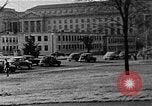
Street cars and traffic jams from 5 PM to 5:30PM on the mall and Pennsylvania Avenue in Washington DC in late 1940s
Traffic in Washington DC in late 1940s. Narrator notes that traffic jams from 5 PM to 5:30 PM on the mall and Pennsylvania Avenue in Washington D.C. Cars crossing the mall area. A woman driver waits for a passing street car at 15th and Pennsylvania Avenue. Streetcars or trolleys are seen, together with cars and buses, and view of traffic jam on Pennsylvania Avenue. View of L'Enfant's grave marker.
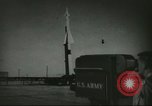
Atomic bomb scenes WWII; atomic testing at U.S. Army atomic experiment station 'Camp Desert Rock' in Nevada, United States
Episode of "The Big Picture", a U.S. Army series of news release programs. U.S. Army cameraman recording Nike missile launch. Atomic cannon fires shell creating atomic explosion and classic mushroom cloud.. Army troops spill out of Sikorsky YH-19 helicopters. U.S. Army infantry soldiers ascend hill firing their rifles. Atomic experiments at Camp Desert Rock in Nevada, United States. U.S. Army Master Sergeant Stuart Queen seated at a desk in his office. He speaks about a series of atomic experiments ("Desert Rock 6") held in barren lands of Nevada at Camp Desert Rock. Celebrating victory in Europe, during World War 2, American troops parade down the Champs Elysees in Paris, France, with the Arc de Triomphe behind them. Happy Parisians watch the parade. War scenes in Japan: footage of explosion and mushroom cloud rising after atomic bomb blast over Nagasaki on August 9, 1945. Barren land on the ground in Hiroshima after the August 6, 1945 atomic blast there . B-29 bombers in flight. Atomic bomb test detonation. Atomic artillery gun M65, also called the Atomic Cannon or Atomic Annie, fires and creates nuclear explosion on distant target.Viking missile launch. U.S. soldiers on parade. Headquarters sign at U.S. Army atomic experiment station at Camp Desert Rock, Nevada, displaying 6-pointed star with "A" in center.. Several atomic test explosions. Soldiers on hillside witness a non-nuclear explosion. Buses carry troops along a road past a sign warning of radiation hazard. Army captain, instructor, briefing troops before the start of atomic maneuvers.. Maps of planned maneuvers. Engineer surveyors lay out ground zero target. View of the ground zero area which is the target area for testing. Signal men lay communication lines to receive and transmit teletype messages. Men operate machinery and dig trenches in which troops will take cover. Other men cover them with sand. [Note: According to the U.S. Department of State, Office of the Historian, from February 18 to May 15, 1955, the United States conducted Operation Teapot, a nuclear test series at Yucca Flat and Frenchman Flat on the Nevada Test Site in the continental United States. During the test period 14 nuclear shots and 1 non-nuclear shot were detonated. Several thousand scientific, military (army, air force, navy, marines), and civilian contract personnel participated in the organization, planning, and execution of the test series. Military exercises undertaken during and following the shots took place under the name Desert Rock 6.]
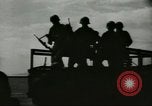
U.S. Army conducts exercise Desert Rock VI, as the "Apple 2" atomic explosive test shot is fired at the Nevada test site
U.S. Army troops silhouetted against sky at dawn as they step from trucks and then proceed to their protected positions in area of ground zero prior to the "Apple II" atomic explosive test shot, "Apple Two," associated with the Army exercise Desert Rock 6. They enter sand-bagged trenches. A briefing officer in a trench issues final instructions that are broadcast over a loudspeaker. View of desert dry lake bed, beyond which is ground zero (detonation site) about 5 miles away. Soldiers are seen foxholes and trenches. An M48 Patton tank, of Task Force Razor is seen, with a tank commander speaking to his group by radio. He instructs them to shut down engines, close all hatches and turn turrets to the rear. Views of tank crew members inside their tanks. The Commander goes down closing his hatch behind him. Other tank crews do likewise. Two Soldiers seen waiting in a trench. One smokes a cigarette. Others standing in their trench. At H-Hour minus two minutes, a siren blows and all begin taking protected positions deep within their trenches and foxholes, as instructed over the loudspeaker. Views of some soldiers in their positions. Glimpse of jeep and of B-45 bomber sitting unprotected on the desert. View of P-47 aircraft in protected positions. Several trees in a line. White flash fills screen as the atomic device is detonated. The explosion seen through camera filming through a porthole. A building flashes into flame and then is blown over by blast wave or shock wave. Interior of house containing mannequins seen, as windows burst in flames and then blast destroys it. Other buildings being swept away. A steel tower bending but remaining upright. Troops out of their trenches moving forward toward ground zero, as the mushroom cloud forms in the distance, and a helicopter flies overhead. Patton tanks of Task Force Razor move toward ground zero, "fighting" their way through obstacles. [Note: According to the U.S. Department of State, Office of the Historian, from February 18 to May 15, 1955, the United States conducted Operation Teapot, a nuclear test series at Yucca Flat and Frenchman Flat on the Nevada Test Site in the continental United States. During the test period 14 nuclear shots and 1 non-nuclear shot were detonated. Several thousand scientific, military (army, air force, navy, marines), and civilian contract personnel participated in the organization, planning, and execution of the test series. Military exercises undertaken during and following the shots took place under the name Desert Rock 6.]
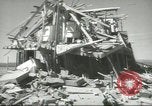
Soldiers assess damage from atomic explosive test shot,"Apple Two," during U.S. Army exercise Desert Rock 6.
Views of various structures and objects after being exposed to atomic explosive test shot "Apple 2" during U.S. Army Exercise Desert Rock VI. A wooden frame house splintered by the blast. A low concrete structure, relatively intact. An overturned Army vehicle. An unsheltered low-wing monoplane, number NG 489851, with skin stripped from its horizontal stabilizer and wing tips. A P-47 aircraft appearing relatively intact. A badly damaged two-wheel trailer. A relatively unscathed auxiliary power unit on a stabilized trailer. Vehicles reduced to rubble. Radar unit and accompanying truck and power unit, seemingly OK, but dish antenna may be damaged. Three soldiers stand around an M2HB heavy machine gun knocked from its stand. A B-29 bomber sits on a ramp with a sign in front of it warning of radiation. A ground crewman sprays the bomber down with a pressure hose to decontaminate it by washing off radioactive particles. A soldier rides a jeep out to check radiation readings on a vehicle that had been exposed. Troops walk back from ground zero and undergo personal cleaning with brooms and checks by geiger counters. A soldier being checked, including his boots. Soldiers sweeping dust from M48 tanks used in the exercise. A soldier being "interviewed" by another, about means of coping with atomic weapons on the battlefield. A formation of soldiers marching, led by one carrying a Corps of Engineers Guidon with the number 14 on it. [Note: According to the U.S. Department of State, Office of the Historian, from February 18 to May 15, 1955, the United States conducted Operation Teapot, a nuclear test series at Yucca Flat and Frenchman Flat on the Nevada Test Site in the continental United States. During the test period 14 nuclear shots and 1 non-nuclear shot were detonated. Several thousand scientific, military (army, air force, navy, marines), and civilian contract personnel participated in the organization, planning, and execution of the test series. Military exercises undertaken during and following the shots took place under the name Desert Rock 6.]
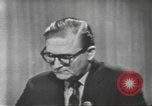
Vice President Nixon and Senator Kennedy debate in the U.S. over a summit conference between the U.S. and the Soviet Union.
The fourth presidential election debate held between Democratic nominee Senator John F. Kennedy and Republican nominee U.S. Vice President Richard Nixon in New York, United States on 21st October 1960. News correspondent John Edwards ask Vice President Nixon about the conditions to be met before meeting Soviet Premier Nikita Khrushchev at Vienna Summit of 1961. Nixon replies that an agenda should be prepared which should delineate those issues on which there is a possibility of some agreement or negotiation. He says that U.S. President should not go to the conference unless they have such an agenda, unless they have some reasonable assurance from Khrushchev that he intends seriously to negotiate on those points. News correspondent Quincy Howe asks Senator Kennedy to comment on the topic. Senator Kennedy says that the U.S. should not go to the summit until there is some reason to believe that a meeting of minds can be obtained on either Berlin, outer space or general disarmament including nuclear testing. He mentions the failure of the conference on May 15th 1960 in Paris, France. He further says it is important that they maintain their determination, that they indicate that they're building their strength, that they are determined to protect their position and that they are determined to protect their commitment.

U.S. President Richard Nixon addresses people in the United States on withdrawal of remaining U.S. troops from Vietnam.
Television broadcast of U.S. President Richard Nixon's speech from the White House in Washington DC, United States on the withdrawal of remaining U.S. troops from Vietnam on 29th March 1973 during the Vietnam War. The White House. The Seal of the President of the United States. The President talks about that period of the Vietnam War when he joined the office and speaks about the program he initiated to end the war. He says American prisoners are on their way from Vietnam and people of South Vietnam are now free to choose their government. He says North Vietnam is not complying with few provisions of the Peace Agreement. He says that they should honor all those American soldiers who died during the Vietnam War. He refers to the difficult days of the war including the moratorium to end the war which was organized on October 15, 1969 when millions of Americans took day off from work and schools to participate in local demonstrations against the war. Nixon refers to the period of April 1971 when he ordered attacks on Communist bases in Cambodia. He talks about the period of May 1972 when he ordered air strikes in North Vietnam and the period of December 1972 when he ordered more air strikes.