


 Francais
 Deutsch
 Italiano
Refine Your Search
Mig-15 stock footage and images
- Showing 211 to 216 of 681 results more
more Hide
Hide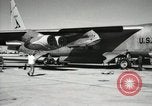
Step to step mating procedure of rocket powered aircraft with B-52 Stratofortress at Edwards Air Force Base in United States.
Mating of rocket powered aircraft X-15 with B-52 Stratofortress. Right inboard wings pylon and inboard engines of B-52 on ground. Technicians around B-52. A tug tows the X-15 underneath the wing of B-52. X-15 sitting under B-52 with large group of technicians around the nose of X-15. Ground support crew push X-15 back and line up with pylon. X-15 sitting on ground in place under pylon. Support crew works under nose of X-15. A man works on the top of X-15 and under pylon, a man works on tail assembly, three men work under nose of X-15, a man jacking up X-15 and two men work under nose of X-15. The majority of the men on right side of B-52 sitting on ground. A man works on top of X-15 under pylon. Support crew gathers around the X-15 and discuss. X-15 under the pylon and a part of B-52. Crew stands against the X-15. Three men stand in front of X-15. A man wears earphones. X -15 in neutral position. Support man on crew stands one on each side and work on X-15. A man stands in front of X-15 with a wrench in his hand. Support crew works on X-15. Two men work on X-15. X -15 is attached to pylon on right wing. Support crew work on X-15.
Soviet World War II propaganda film. A montage of war scenes reflecting Soviet forces and equipment in various times and places
Soviet soldiers receive orders to attack German forces. They salute and walk towards T-34 tank. Soldier on motorcycle fords muddy stream. Soldiers climb into what looks like a T-34 tank with turret turned backward. Soviet armorer directs loading of bomb on a TB-7 bomber. line of TB-7s. Navigator with charts. Aviators flight planning. A Soviet Polikarpov I-15 airplane with engine running. Pilot climbing into a Yakovlev Yak-9 fighter plane. I-15 taking off. Closeup of large all-metal Soviet aircraft with portholes and windows in fuselage. Another I-15 taking off. Another pilot climbing into YaK-9. Closeup of I-15. Formation of I-15s flying low over ground. Soviet officers reviewing aerial photos. Soviet gunners firing a heavy field howitzer (Canon de 155 C modèle 1917 Schneider). Maxim water-cooled heavy machine gun firing. Lots of field artillery firing. Aircrews planning. Several Soviet Polikarpov I-16 fighter planes in formation. Several T-26 tanks crossing a field and one crossing a wooden bridge. Russian infantry moving alongside a road and pulling a wheeled water-cooled 7.92 mm Maxim Machine Gun model 1910. A tank plowing through sandy hill. I-16 fighter planes flying above T-26 tanks maneuvering below. Soviet planes dropping bombs and tanks moving through explosions and smoke. View of bombardier in airplane. Huge explosion from a bomb. A Tupolev ANT-40 bomber flying through flak. Another huge explosion on the ground. ANT-40 aka Tupolev SB-2, in flight. More views of bombs dropping and huge explosions on ground. I-16s dive bombing. Tanks scurrying through smoke. Infantry following T-26 tanks. Smoke all around. Two I-16s in formation. Tanks laying smoke screens on ground below. More huge explosions. A Tupolev SB-2 speeding overhead. More explosions. A German Focke-Wulf Fw 58 Weihe aircraft in flight (reversed film-Swastika backwards). Gunners arm anti-aircraft guns and fire them as well as quad Maxim machine guns. A burning airplane descending. Crashed airplane burning. Narrator states "Junkers and Messerschmitts" are downed in flames. Many guns firing. Infantry and tanks passing area in flames. Soldier crawling in field. Yak fighter landing. Skull and crossbones wiped from captured German trucks. German prisoners stepping from open wooden ferry. Others surrendering. German POWs being marched. Military records being unloaded from German truck. More German prisoners. Soviet medic treating German wounded soldier. Large amounts of currency captured. Soviet soldiers offering German POWs cigarettes.
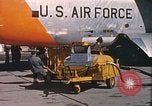
North American technicians help Scott Crossfield and crewmen position auxiliary power units beside B-52 at Edwards Air Force Base.
B-52 Stratofortress with X-15 gets ready for the flight. Ground crewmen position auxiliary power units beside B-52 on flight line. Two ground crewmen connect an auxiliary power unit hose in bomb bay of B-52. Several men speak to Scott Crossfield who is seated in X-15 under wing of B-52. X-15 attached to pylon under wing of B-52 on flight line. Several auxiliary power units under left wing engine of B-52. Group of North American technicians' stands and talks on flight line. North American technicians help Scott Crossfield who is seated in the cockpit of X-15 to put on his high altitude helmet. Number of North American technician stands in front of guidance vehicle. Fire truck in the background. Three motion picture cameramen on flight line. One uses a tripod and others have their cameras mounted on platforms on top of station wagons.
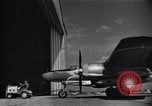
Use of artificial lightning equipment in Project Thunderstorm, and radar operations supporting project and its aircraft
Tug tows Northrop F-15 Reporter into hangar in Minneapolis, Minnesota to be instrumented for Project Thunderstorm. Various scenes of electrical equipment used in making man-made lightning, including a generator made up of hundreds of transformers, and a connected massive generator for producing high voltage. A large oscillograph is shown along with a smaller oscillograph designed for airborne use. A scientist is seen inside the giant generator. Artificial lightning tests are made on canopy of the F-15 occupied by a scientist, and the canopy remains intact following lightning strike. Lightning rods are attached to lightning-vulnerable nose, tail fin, and wing tip locations of the Project Thunderstorm aircraft. Pilot climbs into canopy of F-15. Airborne F-15 project aircraft seen in flight headed toward area of dark clouds. In Ohio at Clinton County Army Air Field, a project officer (AAF Captain) describes how search procedures of the pilot, weather observer, and radar observer are coordinated and key locations of radar and cooperating facilities at Jamestown and the Clinton County Army Airfield. Large radar antenna revolving on top of large tower, scanning for signs of thunderstorms. Radar antenna scanning vertically, near Quonset huts. Command center inside a quonset hut with project personnel at radar scopes and thunderstorm and aircraft positions plotted on large plexiglass screens. Technician adjust motion picture camera that photographs radar scopes every four seconds. Operator at vertical measuring instrument, showing reflected returns from targets, on July 18, 1947. View of operator at plan position indicator radar scope showing weather returns on June 6, 1947. Ground Control Approach (GCA) truck located near end of airfield to guide landings of Thunderstorm aircraft. Radio operators sitting at radar scopes inside the GCA unit. P-61 makes GCA approach and landing in good weather, to maintain skills needed when weather is bad. Briefing officer at blackboard cites radio channels to be used for various purposes. View of AAF aircrews in audience.
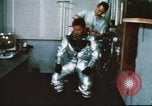
Sled tests being conducted with the help of dummies at Edwards Air Force Base in California, United States.
Sled tests conducted at Edwards Air Force Base, California. North American test Pilot Al White dons X-15 pressure and space suit. Wind blast tests being conducted on rocket sled with the help of a dummy. Rocket sled run with dummy wearing an X-15 space suit testing the ejection escape system. Dummy inside X-15 nose section during another test. Pilot jumps with a parachute in case of an emergency. Fabrication and assembling of X-15 at North American Aviation Company. Technicians operate control panel. Engineers check the aircraft parts at the center. Pilot Scott Crossfield undergoes g-force training seated inside whirling centrifuge. (Early in NASA space program)

British forces advance through the area of Oisterwijk and Moergestel, on the way to Hertogenbosch, Netherlands, in WW II
Map of the Netherlands with town of Hertogenbosch highlighted. Infantry move through the town of Oisterwijk, Netherlands, transported in "Kangaroo" armored personnel carriers of the 1st Canadian Armored Carrier Regiment. They are followed by armored vehicles of Squadron B,15th (Scottish) Reconnaissance Regiment. 15th (Scottish) Infantry Division Commander, Major General Sir Collin Muir (Tiny) Barber consults with two of his commanders at a river crossing in Moergestel (He is good-naturedly called "Tiny" because he is the tallest officer in the British Army. One of the officers with him may be Major Gordon or Major Mills.) British troops set up a battery of artillery and fire at German positions. British troops cross a canal in boats, while Churchill tanks and bren guns provide supporting fire. Soldiers climb the canal bank and proceed toward town of Boxtel. Several columns of the British 2nd Army proceed towards Hertogenbosch. A British Sherman tank firing. Buildings on fire due to bombardment. British forces employ a flame-throwing (Crocodile) Churchill tank. Members of the 15th (Scottish) Reconnaissance Regiment rescue civilians trapped in an air raid shelter. Fire and smoke rises. British tanks enter the town of Hertogenbosch. Liberated citizens come from hiding after the battle. (World War II period).