


 Francais
 Deutsch
 Italiano
Refine Your Search
Mig-15 stock footage and images
- Showing 241 to 246 of 682 results more
more Hide
Hide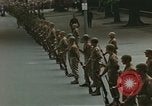
The funeral cortege of Franklin D. Roosevelt in Washington DC, United States.
United States soldiers stand at Parade Rest with their rifles, along the side of the street as the funeral cortege of President Franklin D. Roosevelt approaches. A "V" formation of Washington, DC motorcycle police approach and pass spectators lining the sidewalk. A jeep displaying the flag of the Military District of Washington and the two-star flag of its Commander, Major General Charles Fullington Thompson, who is riding in the back with a Marine officer and a Naval officer. View of large formation of military aircraft flying overhead, seen above trees. The U.S. Marine band, marching (but not playing). U.S. Naval Academy cadets marching with shouldered arms, wearing dress blues and white caps and leggings. The Washington Monument (2 15th St NW, Washington, DC 20024, United States 2 15th St NW, Washington, DC 20024, United States) in the background. A group of U.S. Naval officers watching with other spectators from sidewalk. Soldiers in leggings, marching. A Navy brass band. (World War II period).
United States Bell X-1 releases from B-29 Superfortress and X-2 releases from B-50 aircraft during test flights in California.
Speed and altitude tests being conducted by Bell X-1 at Edwards Air Force Base, California. U.S. Air Force B-29 Superfortess in flight with U.S. Air Force Bell X-1 under its wing. Speed and Mach attainment painted on fuselage of the aircraft. Bell X-1 aircraft releases from B-29 mid flight and begins a solo flight circa 1947. Next scene shows the X-2 released from a B-50 circa 1955. Animation shows radar tracking flight course details for the future X-15. It also depicts its course of flight and the landing of X-15.
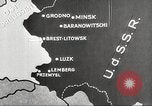
German forces attack Brest Fortress in USSR, during World War II
Map shows border of East Prussia and the Soviet Union. Arrow points to Brest-Litovsk (now Brest, Belarus) one of the first targets in Nazi operation Barbarossa, during World War 2. . German 15cm K39 (15cmKanone39) heavy artillery bombarding the Soviet fortress at Brest. Closeup of gun breech. German troops hunkered down in craters and trenches near buildings. More views of German heavy artillery firing from camouflaged positions. Smoke rising from the German bombardment. German infantry moving forward and approaching Brest Fortress. German soldiers in shell craters, observing as the shelling destroys buildings nearby. View of destroyed and burning structures. Soviet defenders of the garrison standing with hands raised, surrendering under white flags. A surrendered Soviet soldier stands on a hill waving his hat to others telling them it is safe to surrender. Other Soviet soldiers coming foreward from their defensive positions to surrender. Soviet POWs huddled together near a Soviet T-18 light tank (aka MS-1) inside part of the Brest Fortress. German officers surveying the situation. Damaged bridge over the Bug River. Surrendering Soviet troops use a rope to help cross river at bombed out section. Wounded Soviet soldiers with first aid bandages, lying on bank of river. Other Soviet POWs under German guard nearby. A soviet prisoner plays a harmonica. More views of destroyed and burning structures. German infantry running across a road, under fire from Soviet defenders. German troops entering the main part of the Brest Citadel, and fighting against stubborn Soviet snipers. Camera pans across destruction in and around the fortress. A dead Soviet soldier slumped in the seat of a vehicle. Others on the ground near a Soviet Army truck. A long line of Soviet soldiers taken prisoners of war, walking under German guard. The City Hall of Brest With German soldier standing guard. Belarussian citizens of the city going about their everyday activities, under German occupation.
Germany invades Estonia during World War II
German invasion of Estonia in World War 2. Film opens showing German artillery batteries firing 15 cm schwere Feldhaubitze 18 or sFH 18 (heavy field howitzers) at zero elevation from hills overlooking a river valley. Next, some troops and equipment are seen crossing a pontoon bridge, and others walk across an ordinary undamaged bridge over a stream. One German soldier checks for enemies under the bridge, as some motorcycles drive past. In a field, German soldiers watch, as others fire a 75mm field piece (7.5-cm Feld Kanone) downward from a hill overlooking a pond, some farm houses and trees. Scene shifts to shell exploding on a building in a village, causing dense white smoke to rise. German infantry firing and moving cautiously among trees at side of road. Others, firing from shelter in a ditch near pile of heavy timbers. Several duck down in a ditch under a Signpost pointing to Pankjavilsa-18Km and to Trboska-11Km, in opposite direction.Residential houses are behind them. They advance from that spot. Two German soldiers move near a damaged bus and burned wood. One throws a hand grenade that explodes in foundations of an old stone house. A pair of German soldiers fires a machine gun. Several German troops jump into an inflated rubber raft and paddle across a river. a damaged wooden bridge is behind them. View from above, of troops in several rafts. Some pass by a tall seemingly undamaged bridge. Views of several shelters in a field, that appear to be improvised by German soldiers. Troops standing on a dock as a large barge arrives, carrying light armored cars (Leichter Panzerspähwagen) of SdKfz series, which they offload and drive away. Other troops cross several sets of parallel railroad tracks. Views of destroyed rail cars. In a town,itself, one house in a block has been totally destroyed. and is on fire. Several civilians huddle near a doorway and one walks slowly across the street. Two dead horses lay in the street. German soldiers moving at intersection of a dusty road. Some ride bicycles. Some ride in a light utility car (Volkswagen Kübelwagen). A heavier army utility car is parked at the intersection. Next, a long line of German soldiers is seen riding bicycles. Change of scene shows a dozen German soldiers riding atop a Sturmgeschütz III (StuG III) assault gun. It is followed by a light halftrack (SdKfz 7) with a canvas cover and soldiers riding in an army utility vehicle. Final scene shows an 18 Ton Half-Track, Schwerer Zugkraftwagen (Sd. Kfz. 9) "Famo," raising lots of dust as it drives along a dirt road. It is camouflaged with tree branches and is towing a 15 cm sFH 18 field gun.

NCAA Track and Field events in Austin Texas, June, 1957
Gregory C. (Greg) Bell, a sophomore at Indiana University, is seen making his record-setting long jump of 26' 7", to win the national collegiate title on June 14, 1957, in Austin Texas. Bell sitting on the ground after his jump. Sequence shifts to the track where Don Bowden, of California, is running well ahead of favored Ron Delany, of Villanova, to win the 800 meter run in 1 minute and 47.2 seconds. (Note: Delany won the 1500 meter run in 4 minutes 6 and a half minutes.) The next day, on June 15, 1957, Bob Gutowski, of Occidental College,California, is seen breaking the World record in the pole vault at a height of 15 feet 9 3/4 inches. He poses momentarily afterwards.
U.S. Army Quartermaster Corps market centers, purchasing offices and depots in the United States.
United States Army Quartermaster Corps depots in the United States. Factories where production is a continuously running process. Equipment in operation in the factories. A diagram shows commodities classified into two groups: perishable subsistence and textiles clothing, general supplies, and non-perishable subsistence. Perishable subsistence commodities such as eggs, meat and vegetables are purchased on a daily basis by representatives of the Quartermaster Corps. The representatives move among cartons of vegetables. A map of the United States shows locations of offices at market points. Men and women operating a telephone network co-ordinating activities in these offices. A man takes a printout of hourly market coverage. A map of the United States showing 35 market centers through which perishable commodities for military needs are supplied. The representatives of the Quartermaster Corps among cartons of vegetables in an open market. The men look at the vegetables. The market centers in view. Non-perishable items such as clothing, textile, general supplies and K-ration packets in view. A map of the United States shows the 17 purchasing offices located in depots in the 15 procuring districts through which these items are procured. The Boston Quartermaster Depot purchases all footwear and shoes. Office supplies in view which have been purchased by Jersey City Quartermaster Depot. The Philadelphia Quartermaster Depot procures all textiles. A map of the United States shows the 15 procuring districts.