


 Francais
 Deutsch
 Italiano
Refine Your Search
Mig-15 stock footage and images
- Showing 259 to 264 of 682 results more
more Hide
Hide
U.S. AAF VIII Fighter Command Lt. Gen. JN Mcelroy strafes an airdrome and a train in Germany during World War II.
U.S. Army Air Forces Eighth Air Force, VIII Fighter Command operations in Germany during World War II. 15 April 1944: Lieutenant General JN Mcelroy of the 355th Fighter Group 358th Squadron attacks ground targets. He strafes an airdrome and a train. Smoke due to the bombardment and firing. An aircraft on the ground. Black smoke rises up into the air.
Gun camera views from P-47 flown by Captain HL Fogg of U.S. 8th AF, VIII Fighter Command, 359 FG, 368th Fighter Squadron
U.S. Army Air Forces Eighth Air Force, VIII Fighter Command operations in Germany during World War II. Gun camera views from 15 April 1944: Captain HL Fogg of the 359th Fighter Group 368th Squadron attacking ground targets, in one of their last combat missions in P-47s. (The unit converted to P-51s in April, 1944.) Captain Fogg strafes a train and an oil well. White smoke arises due to the firing and bombardment. An electric tower. The aircraft in flight over a field.
The Renault Works plant at Billancourt after three aerial attacks by the Allied forces during World War II.
Results of air assaults by the British Royal and U.S. Eighth Air Forces over industrial areas in and around German-occupied Paris during Wolrd War II. The Renault Works plant at Billancourt after one aerial attack by the Royal Air Force (March 3, 1943) and two by the U.S. Eighth Air Force (April 4 and September 15, 1943). Workers clear the plant interiors. The damaged plant, collapsed roof, rubble and debris on the floor. Workers clear the debris. Damaged steel structures, pillars and walls. Buildings at the plant. Damaged walls, wrecked equipment and material. Allied officers and workers at the plant.
U.S. Marine Corps raise American flag on Mount Suribachi in Iwo Jima during World War II; and original statue unveiling at Quantico in 1951.
A film titled 'Uncommon Valor' about the raising of the U.S. flag by U.S. Marines on Iwo Jima, Japan during World War II. United States naval fleet underway off the coast of Iwo Jima. U.S. Army Air Forces aircraft in flight. U.S. 4th and 5th Division Marines disembark from a ship and get onto landing crafts as they head towards the Iwo Jima shoreline. Marines land ashore and advance inland. They raise the American flag on Mount Suribachi. A newspaper boy sells newspapers on a street in the United States. A picture of the raising of the flag on Mount Suribachi. View of sculptor Felix De Weldon as he carves a sculpture of the flag raising event. Scenes from the unveiling and dedication ceremony of the original limestone statue on November 10, 1951, at the Marine Corps base in Quantico, Virginia, for the 176th anniversary of the founding of the Marine Corps. (The version of the statue seen in this footage had been placed in front of the Navy Department Building at the intersection of Constitution Avenue and 19th Street Northwest, Washington, D.C on 10 November 1945. It features 9 foot figures at 1.5 times life size scale. This sculpture was moved to Quantico Marine Base on 17 November 1947. It had been originally constructed by De Weldon of Indiana limestone, cement, and sand due to a lack of bronze during the war. At the time of its move to Quantico in 1947, the statue had deteriorated due to weather. Also, coats of paint to give the look of bronze had hidden much of the detail and had to be removed. Felix de Weldon supervised the repairs at Quantico before the statue was officially dedicated at the main entrance of Quantico on 10 November 1951, as seen in this ceremony). Officers lined up at the ceremony and many guests in the audience. A parking lot seen in the distance behind the assembled crowd. Cover sheets being removed as the war memorial is unveiled at Quantico.
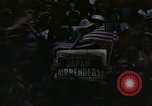
French General Charles de Gaulle is feted in Chicago during his visit to the United States in 1945
Film opens showing people in an American city (possibly Chicago) celebrating the Allied victory over Japan on VJ Day, August 15th, 1945. Scene shifts abruptly to Chicago, Illinois, where French General Charles de Gaulle is seen saluting in a reviewing stand at Victory Plaza near Lasalle Street entrance to City Hall. (On August 24th, he had accepted an invitation from Mayor Edward Kelly to stop in Chicago on August 27-28, 1945, during his visit to the U.S. and Canada.) Next, general de Gaulle and Mayor Kelly are seen in an open car in a motorcade amidst crowds of well-wishers. Enthusiastic spectators run along side their car. Glimpse of a dense crowd of people, including a contingent of sailors in dress whites. Final scene shows General de Gaulle speaking with reporters and photographers near a sign reading "W-G-N." (A Chicago radio station). (World War II period).
Construction of bomb proof shelter at the American Embassy in Prague, Czechoslovakia.
View of the United States Embassy (Tržiště 15 118 01 Praha 1 - Malá Strana) in Malá Strana, Prague, Czechoslovakia. To avoid possible German air raids, workers construct a bomb proof shelter at the American Embassy.