


 Francais
 Deutsch
 Italiano
Refine Your Search
Mig-15 stock footage and images
- Showing 283 to 288 of 682 results more
more Hide
Hide
A man displays Dayfield Body Shield showing front and back portions of the body armour in the United Kingdom, World War 1
A man displays a Dayfield Body Shield vest standing in a field in the United Kingdom during World War I. He displays the back and front portions of the body armour vest which weighed 15-20 pounds and had metal plates sewn in the fabric. Fence and trees can be seen in the background.

German rocket developments during 1930s
A man holds two rockets. The one shown on the left with the white nose is a double rocket. (These were demonstrated for the Navy at Meppen.) Flag flying over a cabin (named "Arenshorst," by Reinhard Tiling) as rocket firing trials get underway on the island of Wangerooge in the North Sea,during December 1930. Reinhard Tiling emergea from the cabin, carrying a long slender rocket . His assistant Angela Buddenboehmer, and another man (possibly Richard Tiling) follow him across the sand dunes. Two photographers are present and several other men. Tiling inserts the rocket into a launch frame already set up. The team elevates the launcher and Tiling makes some adjustment. At a signal from Tiling, Angela Buddenboehmer pushes a plunger on the ignition control box and the rocket fires and rises. Reinhard Tiling, Buddenboehmer, and Richard Tiling watch it in the sky. Several more launches are shown. Pictures of rocket projectile missiles being launched at Dummersee on April 15, 1931, and of larger missiles at later times.
Liquid rocket research and development, led by Robert H. Goddard, in America
Robert H. Goddard with the first flight of a liquid fuel rocket on March 16, 1926, in Auburn, Massachussets. He stands next to the rocket perched high on a launching frame. Goddard uses a long pole and can of benzene to fuel the rocket. Photogaph of his camera and barograph used on July 17, 1929. An 18 meter tower being prepared. A 6 meter high test stand. The barrel could be filled with water and serve as ballast. Picture of a Performance recording device. A man in a protective bunker 15 meters from the launch point for tests in New Mexico. A man using a telescope to observe from a shed 900 meters from the launch point. Another with a telescope and recording device on a tripod. Pictures from the first gyro-controlled rocket flight on April 19, 1932
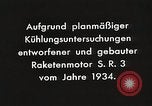
Rocket engine designs and tests by Professor Eugen Sänger, in 1934
Rocket cooling investigations influenced rocketry pioneer, Professor Eugen Sänger's design for his rocket motor, S.R.3. View of his drawings and notes from 1934. Display of mechanical parts from the S.R.3. Items comprising test apparatus for the rocket motor, with various parts labeled. Mechanical Testing setup in Sänger's work shop and instrumentation, labeled in German, showing things such as motor thrust, pump pressure, liquid oxygen level, etc. The first burn test on March 15, 1934. Sänger stands in doorway of his workshop in Vienna, using a long pole to initiate the burn. Various views of flames emanating from the prototype rocket motor during the burn test. A revised sketch of the S.R.3 prototype rocket motor. Test of this version with flames barely visible due to complete combustion, during start-up and operation.
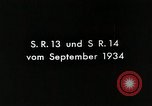
Professor Eugen Sänger's ideas for using rockets in national defense and space exploration
Drawings and pictures of Professor Eugen Sänger's S.R.13 and 14 Rocket motors from September, 1934. He holds a motor in his hand and points out its features. Photograph of Austrian patent certificate number 144809 issued to Doctor Eugen Sänger in Vienna, effective September 15, 1935, for Rocket engine and method for its operation. Glimpse of illustrations in the document. Drawing of planned 500 Kg thrust rocket motor designed by Sänger Rocket Motors. Eugen Sänger's drawings for a rocket-propelled missile to hunt airplanes. Design of a rocket motor (the S.R.X), on June 10, 1934, with 1000 kg thrust for a tropospheric experimental aircraft. Image of a letter to Dr.Sänger, from the the Federal Ministry of National Defense, dated February 3, 1934, stating that his ideas were not practially realizable.
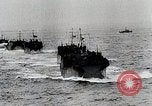
Operation Dragoon. 7th Army operations in France during World war II
Allied Operation Dragoon during World War 2. Invasion convoy of ships heading to French coast, on August 15, 1944. Three divisions of the United States 7th Army make amphibious landing on the coast, and proceed rapidly into interior of France. U.S. Sherman tanks entering the French city of Lyon on September 3, 1944. Local newspaper headline about the city's liberation . Infantry of the 7th Army moving through destroyed French towns. U.S. infantry and armor (Sherman tanks) fire at German positions in a French village.