


 Francais
 Deutsch
 Italiano

Refine Your Search
Mig-15 stock footage and images
- Showing 301 to 306 of 685 results more
 Hide

Worldwide Mercury network supporting NASA Friendship 7 mission
Mercury control stations all over world. Views of the station ship USAF Rose Knot (5-45-1850), at sea. Aboard the Rose Knot station: men on bridge controlling ship wheel and propulsion. Man descends internal stairs on ship and delivers a memo in a room filled with communication equipment and electronic monitoring consoles. Scene changes to Station 5 in Nigeria. Men recording flight data and working with transmission equipment at Station 5. Scene changes to the USNS Coastal Sentry (T-AGM-15) at sea in the Indian Ocean. Men on board the ship at monitoring stations. Views of recording, tracking, computer equipment. Scene changes to a station near Perth Australia, with a man speaking into a headset and men in monitoring room with electronic equipment. A man wearing a headset smokes a pipe. View of light clouds passing in front of a full moon at night. A satellite dish slowly rotating toward camera position. Men in a control room at a tracking station in Hawaii. They wear headsets and monitor electronic consoles. Another view of full moon at night. Night view of a Mercury station and satellite dishes at the facility. People working in a tracking station in Mexico. Engineers and communication staff standing at tall electronic consoles and wearing headsets. View of full moon again, and then men working in a California tracking station. Man reaches for a drink thermos, sets it on counter in front of communication equipment, and then pauses to receive a headset communication. More tracking equipment seen in a control room. Next scene shows staff in tracking station at Corpus Christi, Texas, wearing headsets and monitoring equipment. Close-up view of hands pushing buttons and lights on communication equipment and plugging in relays. Last location shown is interior of Goddard Space Flight Center in Greenbelt, Maryland. NASA staff walking past banks of computer equipment. Close up view of many pushing buttons on a tall standing reel-to-reel tape machine. Banks of reel-to-reel tape machines in the computer network. Various control units, consoles, communication equipment, and teletype machines in a large control room.
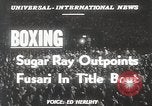
Sugar Ray Robinson wins the welterweight title in bout, Jersey.
Wrestling match between Sugar Ray Robinson and Charley Fusari in Jersey, France. James Farley and Walter Winchell seated on chair to watch the match. Sugar Ray Robinson and Charley Fusari fight on boxing floor. Cameramen record the match. Gene Tunney watches the wrestling match. Robinson successfully defended his welterweight title for the last time against Charley Fusari. Robinson won a lopsided 15 round decision. Robinson won the wrestling bout that was staged for the Runyon cancer fund.
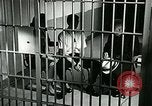
Actions taken to reduce drug addiction and illegal drugs in the United States.
Victim of drug abuse and drug dealing is interviewed in jail. He is questioned about the pills used and their effects on his memory and body. He answers the officer. Officials of drug administration seize the drugs. They investigate the drug smugglers and illegal distribution channels. A man sells drugs illegally. Officials arrest the drug dealers involved in selling drugs illegally. The Congress enacts the Drug Abuse Control Amendments. United States President Lyndon Johnson signs law on July 15, 1965 and speaks about drug abuse and illegal drugs like bennies and goofballs.. Commissioner of the FDA (Food and Drug Administration), James L Goddard, discusses the role of FDA in reducing drug addiction. Actor Paul Newman speaks about preventing misuse of drugs.
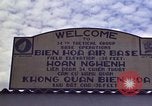
U.S. Air Force personnel construct sandbag bunkers and receive ammunition at Bien Hoa Air Base in Vietnam.
34th Tactical Group increases precautionary measures and aircraft buildup due to Viet Cong attacks at Bien Hoa Air Base in Vietnam. Sign: Welcome to 34th Tactical Group Base Operations, Bien Hoa Air Base, Field Elevation 36 feet (also in Vietnamese). Air Force Personnel construct sandbag bunkers. They look on notice board. Loudspeakers on pole. Air Force Personnel scramble from hut. They receive M-l6 (AR-15) rifles. They receive ammunition and proceed to bunkers. (Vietnam War period).
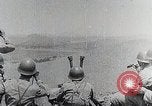
Role of metals in Japanese war against China during 2nd Sino-Japanese Conflict
Scenes of Second Sino-Japanese War, circa 1938. Japanese soldiers observing battlefield from a ridge. Japanese artillerymen firing field pieces. Flight of two Mitsubishi Ki-15-1 light bombers in formation, later called "Babs" by the Allies and known as a C5M in Japanese Navy usage. Aerial view of Japanese bombs falling on Chinese cities. Chinese citizens, including an injured woman, seeking shelter from bombing. Aerial view of Chinese ship being strafed by Japanese aircraft. The ship explodes. Downed Japanese warplanes burning. Scenes of destruction from bombing of oil facilities. Iron ore being moved in Japanese rail cars. Steel plants around Yawata, Japan. Numerous containers of molten steel inside a steel plant. Hot Steel ingots being moved. Animated map shows locations of iron ore deposits in Japan. Scrap steel being imported that, narrator states, helped boost Japanese wartime production to 12 million ingot tons in the Sino-Japanese war. More views of open rail cars moving alloying elements to a steel mill. Open mining using explosives. Mining operations for copper and bauxite (aluminum ore). Japanese miners shoveling ore by hand into open rail cars. Open rail cars moving in both directions on parallel tracks. (Note: Although some narration refers to 1941 Japanese production, the images are from earlier period.)
Second Sino-Japanese War
Opening scene shows formation of Japanese Mitsubishi G3M bombers in flight. View of bombardier at bomb sight inside a bomber. Bombs falling from the aircraft, upon the Chinese city of Shanghai, on a day in September, 1937. Ground level view of bomb exploding and Chinese civilians running for cover. A huge explosion throwing earth up. Aerial view of smoke rising from bomb strikes below. More ground views of bombs destroying structures. Chinese people fleeing across a bridge. Cluster of bombs falling from a Japanese airplane. More explosions and destruction. view from a G3M bomber, of others with bombs falling from them. View from above of civilians filling a street as they run for shelter. People on the ground rushing in all directions. Some are in horse-drawn carriages with luggage on top and other in rickshaws, apparently fleeing the city altogether. Bombing victims lying on the ground near destroyed structures. Heavy dark smoke rising from the attacks. Scene shifts to Japanese army officers entering the Yasukuni shrine in Tokyo. Behind them is A Shinto Tori (Gate) and behind that, the monument (statue) of Omura Masujiro. Scene shifts again, to view of the Temple of Heaven, an ancient Imperial Sacrificial Altar in Peking (Beijing) China. Chinese agriculture. Crowds of Chinese people. Stone statue of traditional Chinese lion. Picture of 1851 oil-on-canvas painting by the German American artist Emanuel Gottlieb Leutze, of Washington crossing the Delaware. Drawing of 15th century ship similar to one in Columbus'1492 voyage to America. Drawing of Roman Empire era building. Michelangelo’s statue of Moses. Drawing of ancient Egyptian pyramid and statue. Drawing of Chinese city and environs representing 4 thousand years ago. Extant ancient Chinese shrines and statues. Animated Relief map of China and surrounding countries of U.S.S.R., India,Burma,Thailand, Indo-China, Philippines, and Japan. Animation outlines China Proper. It also shows Manchuria and scenes from there of desolate mountainous land, with miners at work extracting raw materials. Mongolia and Sinkiang are outlined. The Gobi desert is seen with a long camel caravan crossing it. Closeup of nomads transporting animal skins by camel. The last region outlined is Tibet. The ice covered Himalayan mountains are shown. Buddhist monks praying in the courtyard of a shrine in Tibet. The Yellow, Si Kiang, and Yangtze Rivers are shown on the map. Views of Chinese sailing vessels.