


 Francais
 Deutsch
 Italiano
Refine Your Search
Mig-15 stock footage and images
- Showing 319 to 324 of 682 results more
more Hide
Hide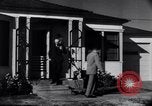
British worker and his American counterpart in labor exchange program visit the Lockheed aircraft plant in Los Angeles, Calfornia
A British guest on labor exchange program visit to the U.S. during World War 2. He leaves the home of his counterpart American host in Los Angeles, California. They leave in the American's car and drive a considerable distance to the Lockheed Aircraft Company facility. View of Honor Roll listing 15, 174 Lockheed affiliated members of the U.S. Armed Forces. The British-American pair walk past a Lockheed Ventura airplane under construction. View of a room filled with P-38 Lightning fighter planes completing final construction, outside the plant. A film clip of the maiden flight of the Lockheed Constellation aircraft (Later designated C-121 by the Army Air Corps) is inserted at this point. It shows the Constellation taking off from the factory airstrip in 1943, and climbing without raising its landing gear. View of aircraft fuselage under construction, where the British worker is inquiring about the manner of its assembly. Next he is seen observing a turntable press operation being run by men and women workers. View of workers using pneumatic hand tools to remove wrinkles from edges of pressed products. A woman punch operator is seen with safety straps on her hands that pull them away each time the punch comes down. Another woman worker demonstrates an electric spot welder. (The observing visitors are required to wear safety goggles in case sparks are created by the process.) Closeup of the aircraft part being spot welded. More workers operating similar machines in the plant, including an African American man and woman. Workers placing a large sheet of aluminum into a machine that fabricates wings for the P-38 fighter plane. Closeup of the British worker and his American counterpart on a balcony overlooking the production line for the Lightning aircraft. View across the production line floor. The two look into the factory first aid station available to workers and also see the transportation section where worker carpools can be formed. Employees are seen obtaining ration books and driver licenses from government clerks working in the plant itself. Employees are seen eating outdoors under foliage camouflage and others gather at an indoor eating site. Next, a section of a B-17 flying fortress wing, is seen moving out of a manufacturing jig. New components are immediately placed into the empty jig for construction. View of final installation area for B-17s, An overhead crane moves a finished wing, including engines, to be mated with its fuselage. Glimpse of numerous B-17s being assembled. A finished B-17 bomber being towed out of the factory.

America's amateur divers dive at a pool in Palm Springs, California; also Aquazanies perform.
America's amateur divers dive at a pool in Palm Springs, California, United States, in preparation for upcoming Olympic trials. Somersaults, flips and twist dives performed by the athletes. Champion Garry Tobias gets injured as he slips off the end of the platform while performing a dive. Narrator notes that Tobias required 15 stitches in his leg from the incident. Several other amateur divers dive from a high platform into the pool. Comedy diving group from New York called the Aquazanies demonstrates funny group dives during a show.

Vietcong rocket attack on the U.S. Da Nang Airbase in Vietnam
Shows a night time Vietcong rocket attack, just after midnight, July 15, 1967, on the United States Air Force flight line and barracks areas at the Da Nang Airbase in Vietnam. Heavy explosions and fires on the base. Fires started from secondary blasts by bombs and fuel. Aircraft destroyed included F-4 Phantom II's & C-130's. The U.S Marine Corps Fighter Squadron VMF (AW) 232, also based here, lost some of its F-8E Crusader aircraft in this attack. (Vietnam War period).
Barrage balloons from Goodyear inflated and raised in Akron Ohio as wartime production increases
Press and media persons with other spectators witness the inflation and raising of a great many helium-filled barrage balloons made by Goodyear in Akron Ohio, at Wingfoot Lake. Men filling balloons with helium gas. Various balloons and blimps flying high in the sky. "Goodyear" is written on some of the balloons. View of Wingfoot Lake below the balloons. A Goodyear stratosentinal balloon with six large fins capable of flying to 15,000 feet. Barrage balloon seen landing as air rather than helium is let into the lower fin as a stabilizer. A blimp with writing "Goodyear Lifeguard Tires" on it.
Crews of U.S. Air Force 80th Fighter Squadron and their P-38 aircraft, during World War II.
Crews of U.S. Air Force 80th Fighter Squadron "Headhunters", and their P-38 airplanes in Pacific theater during World War 2. A ground crewman playing with a model of a P-38 plane. Sign reading "Captain Jay T. Robbins, Commanding Officer" is updated by Robbins to say "Major..." Aircrews gather to study a map and discuss a mission. Large "W" on nose of one plane. Plane with 15 Japanese kill flags on it, labeled "Captain C. Homer," (who later succeeded Major Robbins as the Commanding Officer). U.S. pilots stand in front of their planes. Name "Adams" visible on one of them. Pilot inside the plane, gets ready for take off. (Among pilots seen are three 80th Squadron aces: Robbins, Homer, and Ken Ladd.)
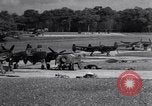
P-38 aircraft of the U.S. 55th Fighter Group at British airfield Nuthampstead, England
U.S. 55th Fighter Group P-38 planes at Nuthampstead Airfield (Station 131) in England in World War 2. Mechanics prepare P-38 planes prior to the 55th Fighter Group's first combat mission on 15th October 1943. Some of the mechanics work on the .50 Browning machine guns mounted in the nose of the plane. One of them checks fuel lines and the interior of the plane. 38th Fighter Squadron pilots gather in front of their Commander, prior to the mission. Pilots include the Group's first P-38 "Ace," Gerald Brown, and fellow 38th pilots, Jerry Leinweber and Jo Myers. Visual and Audio of 55th Fighter Group Commander, Lt. Colonel, Frank James (Group CO), briefing pilots and emphasizing their bomber escort mission. He tells them not to break off to pursue individual German aircraft. The crews disperse to their respective aircraft for take off. View of Lt Col. Jack Jenkins' P-38H "Texas Ranger" readies for take-off with assistance from his crew chief Sgt. Donald Maloney