


 Francais
 Deutsch
 Italiano
Refine Your Search
Mig-15 stock footage and images
- Showing 361 to 366 of 682 results more
more Hide
Hide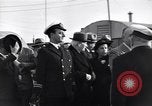
Greek Prime Minister, Themistoklis Sofoulis, boards the Greek Destroyer, RHS Hastings, in the Port of Piraeus.
Themistoklis Sofoulis (Sophoulis) Prime Minister of Greece, arrives at the port of Piraeus. Officials greet and welcome him. A color guard of Greek sailors presents arms in salute as Sofoulis is taken by the arm and escorted by a Greek admiral. He doffs his hat in acknowledgment. With the Admiral at his side, and , surrounded by civilian officials,and several naval officers, he makes his way to the Greek Navy Destroyer, RHS Hastings, tied up at the pier. A junior officer assists him as he ascends a gangway to board the ship. On deck, the ship's captain greets him and introduces several junior officers who salute and shake hands with him. The Greek National flag is seen fluttering in the breeze from the ship's mast. View of ship's bow as forward line is hauled aboard. The Greek State Flag is displayed from the ship. View from the pier as the ship backs away, followed by views of her underway. (This ship is the former British HMS Catterick, Class III Hunt destroyer, which was transferred on loan to Royal Hellenic Navy in 1946,as the Greek RHS Hastings. The number 15 appears on her hull which was formerly assigned to the Greek Destroyer Vasilissa Olga, that was sunk in 1943.)
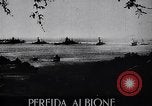
British Navy attacks French Vichy fleet at Mers-el-Kebir, Oran, Algiers, during World War II
Opening scene shows ships of the French fleet in the harbor of Mers-el-Kébir, Oran, Algeria, during World War 2. French tricolors seen flying from the superstructure of the French battleship, Dunkerque. A motorboat arrives, delivering a note from British Admiral Somerville, via HMS Foxhound (destroyer) to Vichy French naval officer Marcel-Bruno Gensoul, with final warning ultimatum against siding with the Axis powers. Sailors on the Dunkerque watch over the railing of their ship. The messengers board the Dunkerque. French and British Navy sailors exchange signal light messages between ships. Onboard the Dunkerque, the message is delivered to French Admiral Marcel-Bruno Gensoul. Closeup of the message. More signal light messages between ships. (The French had rejected the ultimatum.) French sailors are seen running across a concrete pier separating small pleasure boats in the foreground, from the French warships on the other side of the pier, in the background. View of sailors running to battle stations aboard French ships. An explosion occurs in the waters of the harbor. Striking shells create explosions near the French warships. The Battleship Dunkerque with heavy black smoke rising from her funnel getting underway. French sailors on a battleship with heavy white smoke surrounding them as they stand near her 13-inch guns. The French battleship, Bretagne, exploding after being hit by British gunfire. French sailors fighting fires on burning deck of a warship. Another view of the exploding battleship, Bretagne. A British warship firing its 15-inch guns. Unidentified French warship hit in its aft section by gunfire and exploding in heavy smoke. French survivors in life vests and lifeboats throughout the harbor. Wreckage of some destroyed French ships. (Note: The attack was part of Operation Catapult, a British plan to neutralize or destroy French warships in Vichy France, to prevent them from falling into German hands.)
General Mark W. Clark and other Allied Generals inspect honor guard and inspect bomb damage in Milan Italy (WW2)
General Mark W. Clark and other officers of Allied Forces in Milan, at the end of World War II. General Clark, General Willis D. Crittenberger and Lieutenant General Sir Richard L. G. McCreery inspect honor guard. General Clark with other dignitaries. The party enters Milan Cathedral (Duomo di Milano, P.za del Duomo, 20122 Milano MI, Italy) and inspect damage by Allied bombing to the 12th century Romanesque Basilica di Sant'Ambrogio (Piazza Sant'Ambrogio, 15, 20123 Milano MI, Italy).
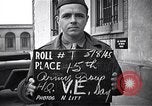
General Clark, Allied officers and soldiers at the V-E Day thanksgiving services in Florence, Italy during World War II.
General Mark W. Clark, other Allied officers and soldiers at the V-E Day thanksgiving services in Florence Italy, at the end of World War II. The assembly at the headquarters of 15th Army Group, reads the thanksgiving note. Flags of United States and Great Britain at the victory celebration ceremony. Soldiers at the ceremony.

Highway, houses, bridges, waterfront, skyscrapers and cars on roads of Chicago, Illinois United States.
Film opens with hazy aerial views of Chicago Illinois. Scene shifts to views from vehicle driving on Chicago highway. A road sign reads "Des Plaines River Rd exits 1/2 mile ahead." A Boeing 727 commercial airliner is seen overhead with wheels down as it descends to land. Some 1960s cars drive past. 1961 Ford C-Series truck driving. View back, of the airliner descending above the highway, and of truck and cars passing the camera vehicle. Overhead highway road sign reads "Chicago Downtown 15 Miles." View of the Chicago skyline of buildings on Lake Michigan waterfront. View from slow moving aircraft of the Wrigley Building; the Michigan Avenue Bridge across the Chicago River; and the Tribune Tower. Camera continues to pan to East and then at the Kemper Building with "United Insurance" written near its top. Camera then swirls downward to river and bridges directly below and then back up from street and down again, ending on avenue near building displaying two American flags.
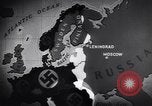
German Operation Barbarossa on the Eastern front in World War II
Animated map shows extent of German controlled areas in Europe following their conquest of the Balkans in World War 2. Norway is under their control and German forces threaten Leningrad and Moscow. A soviet defense line is shown on the map. The German attack is shown to come from 5 directions on June 22, 1941, with the launch of German Operation Barbarossa. A sky filled with German Heinkel He 111 bombers is shown. German Panzer III tanks with 75 mm guns. Army trucks carry German troops into battle. German soldiers on motor cycles and infantry advance under fire. Animated map shows principal German targets as Leningrad, Moscow, and Kiev. It then shows beginning a drive from the North to encircle Leningrad. Arrows show where German Marshal Fedor von Bock's forces drove 480 miles into Soviet territory. Slates identify cities being overrun by German invaders, including: Pskov, Novgorod, Brest-litovsk, Minsk,Mogilev, and Vitebsk. On July 17, 1941, a German tank is seen entering Smolensk, past the Dnieper River threatening Moscow, itself. To the south, German forces, under Marshal Gerd von Rundstedt, cut deep into the Ukraine. Newspapers world-wide consider the Soviet forces close to defeat. Slate shows communique from the German High Command stating: "The issue in the East is already settled. Smolensk is the last halt on the road to Moscow." German infantry marching. Scene shifts to heavy artillery being fired by Soviet forces in a snowy scene clearly later in the year. Animated map shows German forces very close to Moscow on October 15, 1941, forcing the Soviet Government and all foreign missions to move to Kuibyshev, 700 miles to the east. Adolf Hitler, in a speech on October 3, 1941, states that the enemy is broken and will never rise again. Animated map shows 500 thousand square miles of Soviet territory occupied by German forces. Views of fires burning in Russia. Damaged and abandoned Soviet industrial plants. A German guard atop a hill looks down on thousands of Soviet people in the occupied areas of Russia. Damaged and abandoned Soviet T-26 tanks. Glimpse of damaged Soviet aircraft and field artillery. Headline in New York World Telegram newspaper reads: "Berlin Admits Russ War May Last Winter." Another headline reads: "Red Army Holds Push On Moscow." Weary German soldiers traveling in horse-drawn wagons, pulling field artillery. Soviet and German war planners are seen at work. Slate quotes Adolf Hitler saying: "A single blow must destroy the enemy, without regard for losses... A gigantic all-destroying blow." German armor moving along a road. Animated map shows this technique in the German invasions of Poland, France, the Balkans, and Yugoslavia. In contrast, the Soviet planners are seen, as map illustrates how they intend to take advantage of the vast area of their land by holding lines of defense an falling back as necessary to keep engaging the invaders across interior of the Soviet Union. Soviet infantry are seen marching along a road. German troops riding atop their tanks. Soviet troops forcing German invaders into close combat in her cities. Soviet soldiers running in a city and firing heavy machine guns. Bomb damage and rubble inhibit German armor mobility in cities. Cities where this kind of Soviet resistance prevailed were: Rostov, Kharkov, Kiev, Kursk, Smolensk. German troops leaving a city with heavy black smoke rising in the background. More views of cities where Soviet troops are engaged German forces in House-to-house battles, including: Odessa, where the Old Opera Theater building is shown sandbagged and relatively undamaged. The Odessa NI tank, created from an STZ-3 agricultural tractor.