


 Francais
 Deutsch
 Italiano
Refine Your Search
Mig-15 stock footage and images
- Showing 439 to 444 of 682 results more
more Hide
Hide
Allied bombing of Wilhelmshaven, Germany, as seen from participating B-17, "Memphis Belle."
Views from inside the B-17 "Memphis Belle, " part of a formation of U.S. 91st Bomb Group B-17s on mission to bomb Wilhelmshaven, Germany. Pilot, Robert Morgan dons steel helmet. High altitude view of enemy coast. Smoke from Flak bursts is seen. Docks and submarine pens of Wilhelmshaven are seen. Germans set off smoke screens. Thick barrages of Flak explode around the aircraft. As lead aircraft in the formation, Captain Morgan changes course every 15 seconds as an evasive tactic. Morgan passes control of the B-17 to Bombardier Vince Evans as their bomb run begins. Crew's gunners fire at attacking German fighters. One B-17 is hit but continues bomb run. B-17s drop bombs. Explosions and heavy smoke from targets. As they head home, Flak stops and German fighter attacks begin in earnest and "Memphis Belle" gunners are busy fighting them off. A B-17 with number 1 engine smoking, and another with fire in number 3 engine. A B-17 falling out of control. Some crew parachutes are seen. Gunner hits an attacking German Me-109 fighter and its pilot bails out. A B-17 trailing smoke descends away from the formation. (World War II period).

Farm production for war effort in World War 2 with farming and processing of hemp, dried milk and dried eggs in United States
Agricultural progress motivated by the demands of World War II production in the United States. American farmer holding raw hemp for making rope. Farmers in Kentucky or Tennessee harvesting hemp to replace sources lost in the Philippines due to war in the Pacific. Hemp seed harvesting in southern states. A bag of hemp seed. Thick planting of the seeds yields straight, long fiber hemp plants. A boy on a farm stands next to tall hemp plants. A tall harvester attachment is seen cutting the hemp plants at harvest. Workers tie hemp plants in bundles and stack them for breaking. Hands of a man shown tearing and testing strong hemp fibers on a dried hemp plant stalk. Butter and milk bottles stacked closely in a cooler. Large metal bins of eggs are shown. Exterior view of a factory for egg drying. A tank truck parked outside the plant containing broken raw eggs to save space. Large dryers are shown producing a dried golden yellow powder from the eggs. Factory worker sits at a vibrating table that shakes and sifts the dried egg powder and loads it into bags. Scrambled eggs cooked in a pan over a stove. View of raw dozen eggs and packaged box of dried eggs side by side. The small box of one dozen eggs weighs only 5 ounces. View of a wooden barrel that holds the dried equivalent of 5000 eggs. Cows graze on a field. A milk tank truck parked at a drying factory. Cans of dried milk move on a factory assembly line. A machine applies a lid to each can. A wall of 15 gallon barrels of dried milk are shown, each containing the equivalent of 150 gallons of raw milk. Blocks of cheese shown in a dairy case display.
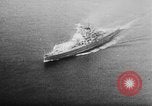
German Scharnhorst class Battlecruiser fires guns while underway during World War II
German naval vessel underway at a sea in the European Theater during World War 2. A brief view of a Scharnhorst class Battlecruiser. The Heavy Cruiser Admiral Scheer following her refit in late July 1940. Note her (slight) raked bow and the seaplane mounted behind the funnel. The bow of a Scharnhorst class Battlecruiser. Note the two forward 28 cm. triple turrets. Crew stand at attention at the bow of the ship. A German flag flutters on a flag pole. The angled funnel cap and lack of torpedo launchers on the rear deck identify this as a Scharnhorst class Battlecruiser. The forward 28 cm. turrets rotate prior to opening fire. View of the 28 cm. main armament. 28 cm. and 15 cm. guns open fire (possibly on targets in Norway?).
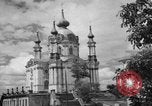
A destroyed church in Ukraine (WW2)
An Orthodox church in Ukraine during World War II. People gather in a market and purchase milk. A woman counting cash. Exterior of the church. Destroyed Kiev Pechersk Lavra monastery (Lavrska St, 15, Kyiv, Ukraine, 01015) in Kiev, Ukraine. Defaced icons on the walls of the church. Rubble on the ground.
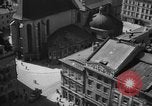
Views of buildings and a destroyed church in Kyiv Ukraine in World War 2.
Buildings in Kyiv Ukraine during World War II. An aerial view of the city. Buildings in the area. Exterior of a church. People are walking. Vehicles pass on a street. Buildings, houses, and trees in Kyiv, Ukraine. Exterior of the buildings. A woman and a man talk outside the destroyed Kyiv Pechersk Lavra monastery (Lavrska St, 15, Kyiv, Ukraine, 01015) in Kyiv, Ukraine. The woman holds a camera. Rubble on the ground. Damaged walls and structure of the church.
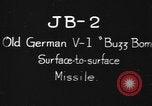
The launching of a JB-2, based on the German V-1 buzz bomb, surface to surface missile at Eglin Field, Florida.
From a review of research and development in guided missiles by the United States Air Force from 1919 to 1948. A JB-2 (Jet Bomb 2) "Loon" based on the German V-1 buzz bomb, surface-to-surface missile. Technicians examine a scale model of the JB-2 missile. Air Force research and development of American type JB-2 missile, the first unmanned guided missile in America's arsenal. A JB-2 is launched from Santa Rosa Island, Florida. A rocket assists in take off. The rocket unit falls away immediately after JB-2 rises into the air. A control aircraft flies overhead showing JB-2 launchings at Eglin Field. JB-2 in flight. The JB-2 was sub-contracted by Republic: Airframe by Willys-Overland; Engine by Ford Motor Company, the IJ-15-1, which copied the German V-1's 900-lb. thrust Argus-Schmidt pulse-jet; Guidance by Jack and Heintz Company; Launch System by Monsanto; Rocket launch sleds by Northrop.. (World War II period).