


 Francais
 Deutsch
 Italiano
Refine Your Search
Mig-15 stock footage and images
- Showing 433 to 438 of 682 results more
more Hide
Hide
Scenes from the German perspective of the Italian campaign in World War II.
German troops and artillery dug in and operating against Allied forces in Italy during World War 2. Infantry dug in near heavy artillery setup among hills. German Gun crew firing 15 cm K 18 gun. Explosions and gunfire all around, some likely from counterfire. A German soldier speaking on a radio. German soldiers in sheltered positions. German artillery barrage appears to be directed toward a town in the distance.
German forces bombard Allied forces with artillery fire during invasion of Anzio and Nettuno, Italy, in World War II.
German Commander speaks to members of his Army unit and they prepare to move and engage Allied forces in Italy, during World War 2. German gunners firing machine gun from sheltered position. German soldiers running. One carries an MG 42 machine gun over his shoulder. German infantry crossing a stream and climbing up a muddy hill, under fire. German gunners firing an FH 18, 15cm heavy howitzer. German Marshal Albert Kesselring observing through periscopic binoculars. A German 283mm Krupp K5 railway gun being fired at Allies in Anzio. Binocular view of shell striking with huge explosion, in distance. View of gunners atop the railway gun, removing a hot smoking spent shell, and placing another charge into the gun breech. German soldier pulling lanyard to fire the gun. (Apparently two rail guns are being fired, named, respectively, "Leopold and Robert," and called "Anzio Annie," by American soldiers.) View of another huge explosion from a railroad gun shell. Remainder of film shows more shelling by the railway guns including what appears to be a hit on an Allied ship in the bay.

Allied assaults against the German Gustav Line at Monte Cassino, Italy during World War II
Opening scene shows peaceful Italian mountains, including one snow-capped, in Spring, 1944, during World War 2. Camera focuses on the town of Monte Cassino and its historic Monastery, on a mountain above the town. (German forces held the Rapido-Gari, Liri and Garigliano valleys and some of the surrounding peaks and ridges that formed the heavily defended Gustav Line.) Animated relief map shows where, by mid January, 1944, American, Polish, and British forces had cleared the enemy from mountains east of Cassino and drawn up on the east side of the Rapido valley. Map shows progress of subsequent Allied attacks that finally reached Mount Castellone and then up Abbey Hill at Monte cassino, itself. Image of German soldier is superimposed on the scene, using binoculars on Abbey hilltop to observe Allied forces. (Narrator states: On February 9th, 75 yards from the abbey, we were stuck.") U.S. Army Air Forces Douglas A-20 Havoc aircraft are seen starting engines. Closeup of Fifth Army leaflet warning the local people to leave the Monte Cassino Abbey to avoid shelling and bombing. View of U.S. troops packing the leaflets into thin-skinned shells to deliver the warning by artillery fire. Next, 105 howitzer guns are seen under camouflage netting, firing bombardments of warning shells. Formation of A-20 aircraft taking off. Aerial view from high above, of B-25 bomber formation in flight. Formations of B-17s, B-24s, B-26s in flight enroute to bomb Monte Cassino. Bombs dropping from B-25 Mitchell bombers. Bombs exploding on Monte Cassino and the Abbey. Batteries of 155 mm guns firing. Formation of 6 B-25 bombers in formation. More bombs bursting on Monte Cassino. Animated map shows German forces taking up their earlier defenses again following the Allied artillery and air attacks. It also shows supplies streaming in to the German Green Devils Parachute Division (Luftwaffe’s 1st Fallschirmjaeger [Parachute-Hunter] division.) The map illustrates all the locations in the town that they occupied and would defend to the last man. Map also illustrates circling positions of Allied artillery batteries. Camera focuses on Polish troops and M4 Sherman tanks moving forward in an offensive. Glimpse of U.S. Army Air Forces mechanics working on a Douglas bomber engine. M4 prime movers towing 155mm howitzer guns. Gun crews camouflaging their positions with netting. Various views of A 240mm howitzer being put in place by a crane. Soldiers deploy detector microphones to locate enemy gunfire sources. They test them, and then enclose them in water-proof containers, bury and cover them. Sound from the microphones being recorded on film at a machine in the Command Post. The data being plotted on a map and corresponding grid locations phoned to Battalion headquarters. View of bombers resuming attacks again, on March 15, 1944. Formations of Douglas bombers, followed by B-25s, seen dropping bombs that explode in the town of Monte Cassino. Artillery firing. Formation of B-24 Liberator bombers in flight. Formation of B-17s dropping bombs. String of bombs exploding in a line on the town. More views of artillery barrages. More lines of bombs exploding. Allied forces storming the shattered town found German soldiers using destroyed structures as shelters to fire from and rubble obstructing the movements of Allied tanks, so the Allied advance was again stopped. Later, a newspaper headline reports resumption of Allied offensive.
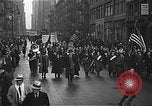
Supporters of expanded W.P.A. (Works Progress Administration) parade on streets of Manhattan, New York City, United States.
Marchers parade on the streets of Manhattan, New York City, to promote support for continuation and expansion of the WPA (Works Progress Administration), part of the New Deal Federal programs enacted in the administration of President Franklin D. Roosevelt during the Great Depression. The parade is led by a group of well-dressed men in business suits. It includes a brass band and many marchers carrying banners and signs. (A boy is knickers, on roller skates moves about near the front of the parade.) A woman walking alongside the marchers, carrying a canister, solicits contributions from spectators on sidewalks. The following are among the many banners and signs seen: "Workers Alliance-Greater New York"; "Yorkville Workers Alliance"; "On to Washington, January 15th, for the Continuation and Expansion of W.P.A. (Furriers Joint Council)"; "Stop! Mass Lay-offs on WPA (Fur Floor Boys and Shipping Clerks Union)" A big part of the march takes place on 8th Avenue. (A Department of Sanitation worker with broom and barrel on wheels is seen cleaning the edge of street near curb.) A float with popup figures of WPA worker, housewife, and farmer, is seen with another figure holding an ax over the WPA workers head. Writing on the float reads: "A blow to WPA is a blow to all" Finally, view towards backs of marchers is shown, near end of the parade.
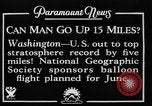
Major Kepner and Captain Stevens stand in front of a diagram and and plan a flight in Washington, United States.
National Geographic Society sponsors a balloon flight in Washington, United States. Major William E. Kepner, an army pilot and ballooner and Captain Albert W. Stevens, U.S. Army Air Corps geographic expert stand in front of a diagram which shows a 26-story office building, the shape of the balloon at the time of the launch and after it has reached the 15 mile mark. Captain Stevens explains the diagram.
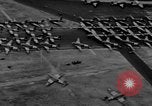
British and American C-47 tow planes and gliders during Allied invasion of Normandy in World War II
Aerial view of many USAAF Troop Carrier Command C-47 aircraft,together with gliders, parked on a field in England. The aircraft and gliders are all painted in D-Day stripes. Views on ground of C-47s taking off towing gliders behind. Formation of C-47s and gliders overhead. Views from an aircraft in a formation. Below, the Portland Bill lighthouse & directional beacon (code-named Flatbush) is seen as the formation departs the English coast. (Note: film view of Portland Bill light is reversed. Roundabout should appear to right of the lighthouse.) Closeup of a glider in the formation. View from a ship, in the English Channel, as an airplane crashes and explodes on the French coast. Aerial view of landing craft on the Normandy beach, as the formation passes overhead. View of French fields flooded by the Germans. Aerial view of parachutes from U.S. Army paratroopers who had dropped into France the night before (June 5th), but no sign of the troops themselves. Masses of gliders on the ground. View inside a glider as it cuts loose from its C-47 tow plane. View from ground as gliders cut loose and maneuver for landing. View of a glider that crashed into a German Headquarters building, and view of another landing in water. Allied gliders destroyed (some burning) and damaged by German gunfire and passive defenses (15 foot poles planted closely in landing zones). A German artillery piece concealed at the edge of a landing zone. American troops, from the gliders, marching into Saint Marcouf, France. Montage of Allied advances and gunfire. Road sign pointing to Sainte Marie-du Mont and Carentan. U.S. troops moving through French town of Sainte Marie-du Monte. U.S. troops riding in a captured German Ketenkrad tracked motorcycle.