


 Francais
 Deutsch
 Italiano
Refine Your Search
Mig-15 stock footage and images
- Showing 463 to 468 of 682 results more
more Hide
Hide
The Formal Christening of Princess Caroline Louise, of Monaco.
Opening scene shows Prince Rainier leading Princess Grace, of Monaco, who carries their baby daughter, Princess Caroline Louise, through a gathering of people as they enter the Saint Nicholas Cathedral (4 Rue Colonel Bellando de Castro, 98000 Monaco) for the baby's christening ceremony. A glimpse of the baptismal party including four bishops and 15 priests, as Bishop of Monaco, Gilles-Henri-Alexis Barthe, christens her, Caroline Louise Marguerite. Closeup of the baby Princess held in the arms of her Godmother, Margaret Ann Davis, from Philadelphia, Princess Grace's niece. Her Godfather, another cousin, Hungarian Prince Georges Festetics, from Vienna, is seen in military uniform. The royal christening party leaves the cathedral.
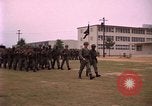
American soldiers trained to maintain their fitness in United States
U.S. Army soldiers trained at unit level to maintain their fitness in the United States. Soldiers march, play team sports like rugby, run cross country, workout. At a swimming pool, they undergo water survival test and swim with a rifle for 15 meters in a pool. Soldiers learn hand to hand combat tactics. Soldiers and paratroopers in simulated combat situations.
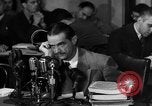
Howard Hughes testifies before a Senate Subcommittee investigating war contracts, in Washington, DC, United States
Howard Hughes testifies before the "Brewster" Senate Subcommittee, investigating war contracts. He talks about World War 2 contracts involving ordering of aircraft, light aircraft carriers, and the atomic bomb by President Roosevelt, through channels outside normal procurement bureaus. He states that he did not make 15 million dollars of profit on 40 million dollars in war contracts, despite assertions that gave the public that impression. In another comment he says, "If TWA (Trans World Airways) does anything wrong, I get blamed for it. But when TWA does anything right, then I had nothing to do with it. That's like Hollywood. When it's a good picture, Sam Goldwyn made it, but when its a bad picture, Willi Wyler (William Wyler) made it."
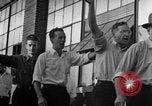
Union-sponsored film about the 1939 Tool and Die Makers Union strike against General Motors in Detroit, Saginaw, and Cleveland.
Union members march beside a building singing about "solidarity." Slate reads "Fleetwood" superimposed on "Detroit." Closeup of flag reading: "Fleetwood Local 15, U.A.W. Detroit." Marcher carries American flag. One carries sign calling for: "Time and a half for overtime, and double time for Sunday and Holidays." Among other signs, one reads: "Equal Pay for Equal Work." Bronze plaque on building reads: "Frederick Coleman and Sons, Inc." Yard filled with striking workers. Trucks sent by General Motors Company (GM), to remove tool and die shops, from a factory, are prevented from moving by the mass of strikers from the unionized Frederick Coleman plant, who refuse to become "Scabs" (strike breakers). Meeting inside their own factory building, Coleman workers promise George F. Addes, Secretary Treasurer of the U.A.W. (Union of Auto Workers) that not a GM tool or die will leave their shop. They pose near auto parts waving their hats. A new slate appears reading: "Fisher" overlaying "Cleveland." A picket line is seen in a Fisher Body Factory yard, guarded by uniformed policemen, including some on horseback. One striker walks to a building identified by a sign as Strike Headquarters. Narrator says he can get a meal there. Inside, a strikers women's auxilliary has set up a Strike Kitchen, where he receives a cup of coffee and converses with a woman of the auxilliary. Next, he is seen reading a Cleveland newspaper with headline: "Police and Pickets clash at Fisher Plant." He is then seen at his home, having supper as his wife reads the newspaper. (Narrator notes that strike has lasted 19 days.) The man and his wife argue about the wisdom of striking. Their little girl runs to her father. The three of them hug and the man then goes to join the picketing. Scene reverts to earlier conversation with the womens' auxilliary person. She sympathizes with the man's concerns. Next, three union auxilliary women visit the man's wife. They try to assuage her fears about the labor strife. (In background, voice of a union auxilliary woman speaks about the Wagner Labor Act.) More views of the Fisher Plant factory yard, with police and strikers struggling. Still photograph of men running as shots ring out. Closeup of hand holding a tear gas shell. Still photograph of police using tear gas to disburse strikers. The women visiting the wife convince her of the soundness of the strike and she joins them as a union auxilliary worker in their Strike Kitchen. View of the film's protagonist man and his wife conversing amicably in their kitchen. Final scene shows the wife with her husband on a picket line holding a sign reading: " Women's Auxilliary Stands Behind Local No. 45 in this Fight." Camera focuses on one striker riding a horse bearing two signs. One points to the front of his horse and reads: "This is the C.I.O end." The other points to the horse's rear and reads: "This is the Company end."
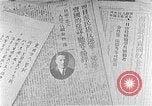
Depicts Korean suffering under Japanese occupation from 1910 through end of World War II
Korean propaganda film depicting suffering of the Korean people under Japanese occupation prior to and through World War 2. Korean citizens answering questions of Japanese civilian officials during period of Japanese occupation before World War 2. Japanese warship carrying Nakajima E4N bi-wing scout plane. Steel truss bridge being bombed. Koreans being forcibly recruited to fight for Japan. Koreans being tortured and imprisoned at hands of Japanese. Aircraft dropping bombs on ground targets. Slate announces August 9, 1945, marking the Soviet invasion of Japanese occupied areas, including North Korea, in World War II. Destroyers dropping depth charges. Battleships firing heavy guns. Soviet infantry rushing from a ship to engage Japanese forces. Soviet soldier offloading an M1910 Maxim Sokolov Machine gun onto a pier. Amphibious assault by Soviet forces. Artillery barrages. Explosions and smoke. Soviet infantry attacking industrial facilities and planting the Red flag on a hilltop in a rural area. Japanese troops surrendering to Soviet soldiers. Fallen Japanese gunner in gun position with shell in his hands. Numerous other fallen Japanese soldiers. Captured Japanese weapons and war materiel, including many swords. Japanese prisoners of war seated in an open area. Various destroyed Korean buildings and temples. Denuded trees in war zone. August 15th, 1945, shows Japanese citizens listening to a loudspeaker broadcast by Emperor Hirohito, announcing the surrender of Japan, and end of World War II. Shackles are removed from Korean prisoners. Koreans celebrate in the streets. The Korean flag flies from houses in a village. Korean people march, sing, and cheer everywhere in the country. A seated band of musicians plays. Scene shifts to the deck of the battleship USS Missouri, where Japanese Foreign Minister Mamoru Shigemitsu in formal attire sits to sign documents of surrender. General Douglas MacArthur, and other senior allied officers, stand nearby as Soviet Lieutenant General Kuzma Nikolaevish Derevyanko sits to sign for the USSR. Japanese civilians living in Korea, during the Japanese occupation, are seen moving with their belongings, to be relocated back in Japan.
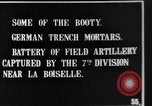
German artillery captured by British troops during Battle of the Somme during World War I
British troops carrying two captured German 9.15cm Light Trench Mortars, in the Battle of the Somme, during World War 1. They place them on the ground where an officer examines them and British gunner demonstrates how they work. At La Boiselle, France, British artillerymen, with horses, pull captured German 77mm field guns and limbers. One of the captured guns is seen with writing on it in chalk reading: "Captured by 7th Division."