


 Francais
 Deutsch
 Italiano
Refine Your Search
Mig-15 stock footage and images
- Showing 511 to 516 of 682 results more
more Hide
Hide
The SS France is ready for trans Atlantic service after completing trial runs in France.
Launching ceremony of ocean liner SS France at the Chantiers de l'Atlantique shipyard, in Saint-Nazaire, France. People gather for the launching ceremony at the Chantiers de l'Atlantique shipyard (Avenue Antoine Bourdelle CS90180 44613 Saint-Nazaire Cedex France). French President Charles de Gaulle addresses the crowd from a stage. People applaud. The liner is christened by the First Lady of France Yvonne de Gaulle at 4:15 PM. The newly launched ship slides down the shipway. The ship sails out into sea.

A successful space journey of NASA astronaut Virgil Ivan Grissom aboard Liberty Bell 7 Capsule from Cape Canaveral.
Astronaut Virgil Ivan Grissom's space journey from Cape Canaveral. Crewmen pipe the fuel aboard the Redstone rocket. A missile on a launch pad. Captain Virgil Grissom disembarks from a transfer van and boards a gantry elevator. The crew helps Grissom to board the Liberty Bell 7 capsule. Helicopters take off from Essex class aircraft carrier USS Randolph CV-15 to pick up the astronaut and the capsule. A helicopter rescues astronaut Grissom and tries to keep a hold on the sinking capsule Mercury. Astronaut Grissom climbs into the helicopter. The cheering crew welcomes astronaut Grissom on the carrier Randolph after his success.
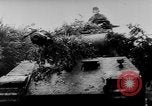
German forces defending against Allies during Normandy invasion of World War II
German forces defending against Allies during invasion at Normandy in World War 2. Camouflaged German Panther tank on the move. Others with German infantry on the way to engage invading Allied forces . Views from German positions of artillery fire and German machine gunners. A huge explosion. Battery of German 15 cm mobile rocket launchers (Nebelwerfer 41) firing. Rockets being fired from an Opel Maultier halftrack equipped with 10 tubed rocket launcher (Panzerwerfer 42) and a Wurfrahmen 40 (launch frame 40) multiple rocket launcher on SdKfz 251 halftrack. German forces firing on allied forces. A huge oil fire. German soldier using a flame thrower.
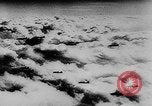
German Air Defenses battle against U.S. bombers during World War II. Capture of U.S. B-24 "Sunshine."
German fighter aircraft and antiaircraft guns battle against U.S. B-17 B-24 bombers during World War 2. Formation of B-17s in flight. A high altitude formation of U.S. bombers leaving condensation trails. German air defense coordinators in control room give instructions to German and Italian defenders. Antiaircraft gunners fire at Allied bombers. Views of the American B-24 Liberator bomber "Sunshine,"tail number: 42-52106, of the 719th Squadron, 449th Bomb Group of the 15th Air Force, which force-landed with two engines shot out, inside enemy occupied Italy. (After repairing the aircraft, the Germans filmed it with its American crew for propaganda purposes. Those scenes are what appear here.) Artwork is seen on the "Sunshine." The final scenes include gun camera footage of Me-109s firing at B-17s and B-24s.
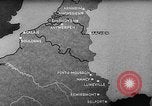
German forces defending against Allied advances toward Germany during WW2.
Map highlighting France, Belgium, and low countries, and German border city of Aachen during World War II. Soldiers riding on German Panther tanks camouflaged with foliage. They pass infantry walking along the side of the road. A Panzer IV with side track protectors. Commander of the German 5th Panzer Army, General Hasso von Manteuffel, conversing with officers of the 116th Panzer Division, September 1944. German tanks and infantry moving across a field. German soldier firing from prone position in a field. Knocked out American M3 halftracks. Captured American jeep and M3 halftrack. A very young German boy soldier escorting two ambulatory wounded American soldier prisoners of war. A small group of American prisoners of war. German field artillery firing and smoke rising from their shells exploding in distance. German troops entering town of Moncel-Les-Luneville, in Northeast France. Fire burning in the town. The Moncel-les-Luneville building after bombing in Luneville, France, at 15 Rue des Tuiliers, 54300 Moncel-lès-Lunéville, France. A Panzer tank enters Luneville. A huge smoke column rising in background.
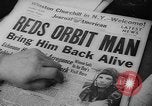
Russian cosmonaut Yuri Gagarin returns after his historic space walk and NASA launches Mercury spaceships for sub orbital flights.
Soviet and American achievements in space travel in the year 1961, during the so called "space race". Russian cosmonaut Yuri Gagarin returns after his historic trip in space and NASA launches its Mercury Freedom 7 spaceship for sub orbital flight by Astronaut Alan Shepard. A news paper reports about the success of Russian space mission as the Yuri Gagarin returns after a space trip. A large crowd gathered cheers for Gagarin. National Aeronautics and Space Administration (NASA) workers work on Mercury-Redstone 3 spacecraft "Freedom 7" for carrying out sub-orbital flight, manned by Alan Shepard. Scene shows launch of the Mercury MR-3 mission on May 5, 1961. View of Commander Shepard in capsule during flight. Helicopter lifting Alan Shepard to safety after the successful flight. Commander Shephard shown beside the spaceship capsule on deck of aircraft carrier after recovery. View of flight preparations for Mercury-Redstone 4 (MR-4). Liftoff of MR-4 on July 21, 1961, commanded by Astronaut Captain Gus Grissom. NASA scientists in Mission control room. Helicopter rescues astronaut Grissom from sea after safe splashdown of MR-4. View of bridge of ship USS Randolph (USS-15) during recovery effort. Astronaut Grissom walking on the deck of the aircraft carrier after recovery.