


 Francais
 Deutsch
 Italiano
Refine Your Search
Mig-15 stock footage and images
- Showing 517 to 522 of 682 results more
more Hide
Hide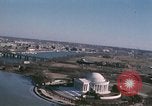
Aerial views of the White House, the Washington Monument and the National Gallery of Art and a helicopter flies over them.
An aerial view of the Jefferson Memorial and then the National Gallery of Art. A helicopter flies over it and crosses near the Potomac River. It flies past the Washington Monument (2 15th St NW, Washington, DC 20024, United States). The South Lawn of the White House. Cars on busy roads outside the White House.
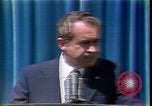
U.S. President Richard Nixon talks about the principle of confidentiality with regard to the Watergate tapes in San Clemente.
U.S. President Richard Nixon talks about the Watergate tapes during a press conference in San Clemente, California. Journalist Tom Jarriel seeks an explanation from the President regarding his meeting with the Assistant Attorney General Henry Petersen, the head of the Criminal Division on April 15 regarding evidence against his top aides. The journalist also wants the president to clarify that even after accepting the resignation of Mr. H. R. Haldeman and Mr. Ehrlichman why did the president involve Mr. Haldeman while listening to those confidential tapes. The president clarifies that he involved Mr. Haldeman to hear only those recorded tapes in which conversations were been carried out between all three of them -- the President, Mr Haldeman and John Dean. They did so to prepare themselves to respond appropriately to the allegations made by Mr. Dean. Another journalist questions the President regarding his failure to make the tapes available to the Senate Committee or the special prosecutor and whether he could let the public see a report about the tapes. The President confirms hearing of the tapes by Mr. Right. He believes that the hearing of tapes either by a judge, before a camera or Senate Committee is against the principle of confidentiality. He believes that the President must conduct affairs with his associates in his office with regard to the principle of confidentiality, irrespective of the fact whether it is a tape or any presidential paper.
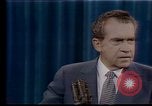
President Nixon answers a journalist questions during a news conference in Orlando, Florida.
U.S. President Richard Nixon answers journalist George Gill questions regarding the Watergate issue in Orlando, Florida. George asks the President about his realization of the fact that 2 of the 9 Watergate tapes did not exist and his delay in disclosing this matter to the Federal Court and public. The President responds that on September 28th or 29th he came to know about the non-existence of those two conversation tapes. His secretary has listened to 7 tapes and has made notes for him. On October 26th they were determined about the non- existence of those two tapes. He directed White House Counsel Joseph Fred Buzhardt to carry out investigations. On 27th Buzhardt reported that he could not find those two tapes. He had arranged a meeting with Judge John Sirica. The President talks about his 5 minutes conversation on June 20th with the Attorney General John Mitchell. He had called to cheer him up. The conversation on April 15th with John Mitchell was not recorded because the call was made from family quarters where recording is not allowed. He talks about the shorter recording capacity of tape machines. Due to which his complete conversation with U.S. Secretary of State Henry Kissinger did not get recorded. The only evidence available for this were his hand written notes. He mentions the difficulty in hearing those recorded tapes due to non-sophisticated recording system. He states that he knows what is there in those recorded tapes. He believes that the tapes will prove that he did not have any knowledge of breaking of the Watergate issue, that he had not authorized anybody on clemency nor had he any knowledge regarding the payment of blackmail money. He talks about his conversation with the White House Counsel John Dean.
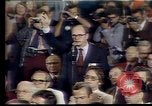
President Nixon answers a journalist questions regarding the Watergate tapes during a news conference in Orlando, Florida.
U.S. President Richard Nixon answers journalist Richard questions regarding the Watergate issue in Orlando, Florida. Richard asks the President about his reaction both personal and political regarding the credibility with the American people as well as his reaction on the discovery that the tapes for White House Counsel John Dean and U.S. Attorney General John Mitchell did not exist. The President responds that he was disappointed. He states that the missing of such tapes gives the impression of things being covered up by the President or his staff members. He states that he would have been been more disappointed in case the tapes which were considered more important would have been missing. He briefly talks about the tapes of September 15th, March 13th and 21st. He states that even though those two missing tapes are not been considered as an essential part of the investigation by the Urban Committee, but he is still disappointed.
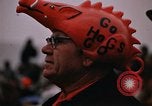
U.S. President Richard Nixon moves towards locker room of Texas who defeated Arkansas in football game at Fayetteville, Arkansas.
A huge crowd of spectators watch a football game between Texas and Arkansas at Fayetteville in Arkansas. Excited spectators watch the football game while waving the confederate flag. Band plays and cheerleaders cheer during the game. The scoreboard at the stadium shows Texas 15 to Arkansas 14.. Texas players leave the field after game. U.S. President Richard Nixon moves towards the Texas locker room, among a crowd leaving the field.
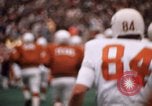
Legendary 1969 football game between Texas and Arkansas at Razorback Stadium in Fayetteville, Arkansas.
Film begins as Texas takes the field, wearing red warm-up jackets. Stadium appears filled to capacity. Numerous plays in the game are seen throughout the film. A banner draped over a front row railing, in the grandstand, cites 100th anniversary of the NCAA and reads:"Welcome President Nixon." Several police officers are seen in that vicinity. Scoreboard shows Arkansas ahead 14 to nothing (after third quarter). Numerous shots of the crowd in the stands, but none showing the President or his party. As the game nears the end, some spectators appear to be covering up because of a light rain. (Note: In the 4th quarter, Texas rallied to win the game 15 to 14.)