


 Francais
 Deutsch
 Italiano
Refine Your Search
Mig-15 stock footage and images
- Showing 553 to 558 of 682 results more
more Hide
Hide
American occupation troops collect military uniforms and weapons from German population, at end of World War II. U.S. troops display Nazi plundered treasure in a salt mine.
German civilians in a city on the Elbe River, gather around a poster containing Law Number 5, issued by the Military Government-Germany (American Occupation forces). It announces the dissolution of the Nazi party. Next, a German Army medic talks to an American, near a huge pile of German military uniforms, military equipment, and accessories. Civilians including former German soldiers throng a town square, adding items to the pile. A woman pulls uniform items from her wash basket. An American soldier talks with a German woman as bystanders watch and listen. A man and boy look at a small rifle before the boy throws it on the pile. View from above of the square with people crowded around the pile of castoffs in its center. Women placing officers' swords on the pile. Complete change of scene shows a U.S. soldier from the 3rd Army, in a salt mine, in Merkers, Germany, on April 15, 1945. He is perusing Nazi seized and stolen jewelry, cutlery, and precious metal trinkets in a case. Another soldier looks at a bar of gold and displays it for the camera. Many wrapped gold bars are behind him. German currency bank notes are seen in the hands of a soldier. Numerous packages of currency sit in the background. American soldiers show some of the stolen art works also hidden in the salt mine. Among the seized paintings seen is "Wintergarden," by French impressionist painter Edouard Manet.
'Emergency Conservation Work' shows development of parks and Civilian Conservation Corps at work in the United States.
Film 'Emergency Conservation Work' shows development of the National Parks system in the United States. Images from early 1930s in the United States with idle and quiet factories, mills, and smokestacks due to unemployment and Great Depression. Factory with a board that reads 'Closed' on it. Unemployed workers stand in line at the gates of the General Employment Agency and gather around bulletin boards at the agency. Young men of the Civilian Conservation Corps (CCC) at a meal with heads bowed in prayer, and then standing in a line at the start of a work day. CCC workers digging in a field. Several sign boards seen including: Edisto State Park developed by U.S. department of Interior; CCC (Civilian Conservation Corps) camps SP-3 Poinsett Co. 421; Myrtle Beach State Park Emergency Conservation Work; Co. 262 CCC Camp Florida SP-3; Old Lodge Camp SP-15.
United States President Franklin Delano Roosevelt watches the Inaugural Parade on Pennsylvania Avenue in Washington DC.
Inauguration Ceremony of United States President Franklin Delano Roosevelt in Washington DC. Police and cavalry escort President Franklin Delano Roosevelt and Mrs Eleanor Roosevelt to the White House. Police on motorcycles followed by officers on horseback. Huge crowd cheers standing along the road. President Roosevelt along with his wife in a car. President and guests take their seats in the Court of Honor to review the Inaugural Parade. Ongoing parade on the Pennsylvania Avenue take a turn on the 15th Street. U.S. Army band and troops of the 1st Division parade on the street. Troops march with the American flag. The 12th U.S. Infantry marches with rifles in hand. The 13th Engineers take a turn on the 5th Street. Crowd gathered along the road to watch the parade.
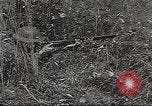
American soldiers learn to identify sounds of Flat Trajectory Weapons as part of their training in the United States.
United States Army soldiers undergoing weapon identification training in the United States. Soldiers listen to the sound of Flat Trajectory Weapons. Squad lying on ground fires the .30 caliber rifles. Rifleman fire 10to 15 shots in a minute. Soldiers seated in trenches with rifles in hand. Sandbag wall behind them. They carefully listen to the firing and look up from the trench. Firing of bullets on ground. Squad camouflaged with bushes fires the U.S. Rifle, Caliber .30 M1. Riflemen fire the M1 rifles. One of the soldier carefully looks out of the trench and points in the direction of fire. (World War II period).

Racehorse "Swaps" wins the Sunset Handicap at Inglewood, California.
Sunset Handicap Race in Inglewood, California. Opening scene shows the heavily favored racehorse, "Swaps" (number 5) being readied for the race. View of stands filled with spectators. The horeses entering the track. Close view of spectators. Horses making a turn and entering the final straightaway, with Swaps pulling ahead of the field and crossing the finish line in record time of 2:38 1/5
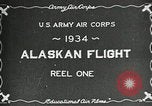
U.S. Army Air Corps airplanes and crews preparing for Alaskan Flight in 1934
Slate lists planned flight legs of U.S. Army Air Corps aircraft as: Washington DC to Edmonton, Alberta; Fairbanks Alaska to Seattle Washington; and Washington DC to San Diego California. Another slate explains that under command of Lieutenant Colonel H.H. Arnold,ten B-12 bombers demonstrate their capabilities in an 18,000 mile flight. Lt. Col Henry H. Arnold, U.S. Army Air Corps, stands in front of a large map on which planned flights are charted. Sign behind him identifies "Engineering Office," at Patterson Field. Arnold uses pointer to show the routings to another officer who has joined him. The next sequence shows Arnold describing the flight plans to more participants, using more charts. Camera pans across ten assembled Army personnel. Lt. Col. Arnold poses with 15 aviators in front of a YB-12 bomber (displaying air intake on port side of engine). Camera pans over eighteen mechanics and ground crewmen posed in front of the bomber. Symbol of eagle superimposed over map of alaska, is painted on side of forward fuselage. Arnold discussing the mission with Army officers and civilian officials, as they walk past a YB-10 (with air intakes atop the cowlings). Camera pans across Patterson field ramp, where officials, automobiles, YB-10 aircraft, and local civilian workers, including several women, are seen. Crew chief seen refueling a YB-10 with long hose from an underground fuel tank installed at edge of the ramp.