


 Francais
 Deutsch
 Italiano
Refine Your Search
Mojave California 1955 stock footage and images
- Showing 1687 to 1692 of 3122 results more
more Hide
Hide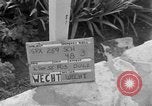
U.S. Colonel Brooks greets Congressman Sheppard in Breverhaven, Germany.
U.S. Colonel Brooks in Breverhaven, Germany. He comes out of the building and greets Congressman Sheppard (representative California). They enter a building. A board at the entrance reads 'Bremerhaven Port of Embarkation, Headquarters'.
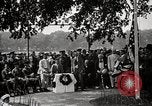
Dedication of the temporary Zero milestone marker at start of the 1919 Transcontinental Motor Convoy
Location is the Ellipse, south of the White House, in Washington, DC. The occasion is the dedication of a temporary Zero milestone in ceremonies at the start of the U.S. Army Motor Transport Corps'so-called "Truck Train," a convoy of military vehicles that is to travel the "Lincoln Highway" across the United States, to San Francisco, California. The ceremony begins with a flag raising, where all stand and uniformed Army officers salute. Congressman Julius Kahn, of California, salutes with his hat over his heart. The temporary marker is covered with white cloth and two wreaths, which officials remove and Secretary of War Newton D. Baker, begins his speech accepting the temporary marker. (A permanent marker needed an act of Congress for approval. So a temporary one was approved to allow the launch of the Army cross-country convoy.) The Washington Monument is visible in the background, as Mr. Baker delivers his remarks.
Various "firsts" in U.S. aviation history from 1918 through 1924; early history of flight and vintage flight scenes
Shows several aviation "firsts" accomplished by U.S. Army Air Service aviators in the period from 1918 through 1924. A close formation of biplanes in flight. President and Mrs. Woodrow Wilson chat with Major Fleet, Officer in charge, on the occasion of the first air mail flight, inaugurated on May 15,1918 between Washington DC and New York.The mail is loaded into the Curtis JN-4 aircraft. Pilot in the cockpit. The aircraft takes off and in flight. Air Service. Mention of aviators helping spot forest fires. Smoke rising from forest fires and mountain ranges. In 1920, U.S. Army Captain St. Clair Streett is seen with some of his Squadron who flew four De Havilland DH-4 aircraft 9,000 miles, from New York City to Nome, Alaska. Two of the men play with pet dogs. Their itinerary is painted on the side of one of the aircraft, along with the names of pilot and mechanic (C.E. Crumline and J.E. Long). In 1923 the first non stop coast-to-coast flight was made in the Fokker T-2 aircraft. . A sign on the aircraft reads 'Army Air Service non stop coast to coast'.First Lieutenants Oakley O.Kelly and John A. Macready board the aircraft, at Roosevelt Field, Long Island, New York, on May 2, 1923. Their Fokker T-2 in flight. Their arrival at Rockwell Field, on Coronado Island (San Diego) California. In 1924, Lt. Russell Maughan is seen boarding his P-1 Hawk airplane at Mitchel Field, on Long Island, New York, and taking off , bound for Crissy Field at the Presidio, San Francisco, California. His goal is the first dawn-to-dusk, coast-to-coast flight. Views of his P-1 Hawk airplane flying over Manhattan, New York City.
U.S. Army Air Corps sets new airborne endurance record using midair refueling
The U.S. Army Air Corps Fokker C-2 named the 'Question Mark' is rolled out and takes off.from Van Nuys, California, on New Years Day 1929 with Capt.Ira Eaker at the controls. Shortly thereafter,it is refueled by a C-1 airplane piloted by 1st Lt. Odas Moon and 2nd Lt. Joseph G. Hopkins., View of the The C-1 above and slightly ahead of the Question Mark, maintaining 20 to 30 feet of vertical separation, with both aircraft stabilized in level flight at 80 mph. The refueling hose is reeled out. View of the Question Mark in flight over the coast of California. At the conclusion of the mission, cut short by engine trouble after 150 hours aloft, the crew, Sgt Hooe, Lt. Elwood Quesada, Lt Halverson, Captain Eaker and Major Spatz are seen standing in front of their airplane, the FokkerC-2, Question Mark.
Airplane flight endurance record set by U.S. Army Air Service Fokker trimotor aircraft using inflight refueling
The U.S. Army Air Service modified Atlantic-Fokker C-2A, named the 'Question Mark,' taxis and takes off. Refueling operation between the Question Mark and a Douglas C-1 aircraft. Question Mark in flight over the coast of California. A U.S. Army Air Service Douglas C-1refueling plane, with hose trailing below it, flies above the Question Mark. Crew member can be seen disconnecting the 3 inch fuel hose and throwing it off the Question Mark. After being aloft continuously for 6 days, the Question Mark landed at Metropolitan Airport, Van Nuys, California on January 7, 1929. Staff Sergeant Roy W. Hooe, Lieutenant Elwood R.(Pete) Quesada, Lieutenant Harry A. Halverson, Captain Ira C. Eaker and Major Carl A. Spatz, stand beside their airplane. (Spatz later changed spelling of his name to Spaatz.)
A carnivorous pitcher plant is displayed in Toledo, Ohio.
Darlingtonia californica, or California Pitcher Plants are displayed in Toledo, Ohio. Also known as Cobra Lilies, carnivorous California Pitcher Plants are fed small bits of meat stuck to the end of a long stick. A Cobra Lily moves while digesting the meat. A child near the plants pretends being bitten as she touches them.