


 Francais
 Deutsch
 Italiano
Refine Your Search
Mojave California 1955 stock footage and images
- Showing 1693 to 1698 of 3122 results more
more Hide
Hide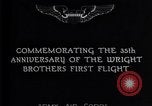
Documentary tilted 'History of Aviation' depicts benefits to mankind brought by development of means of travel, United States.
Documentary tilted 'History of Aviation' depicts benefits to mankind brought by discovery of aviation. A group of travelers on horses and bullock carts, in hot and dusty deserts travels from California to New York. A railroad train runs on railroad between California and New York. Howard Hughes' Lockheed 14 Super Electra Special, Model 14-N2 ( NX18973) seen in aerial views over Manhattan Island, New York City, with New York City skyline and skyscrapers visible. (scene filmed on July 14, 1938). Animated map shows ship sail towards Europe. Brief, distant view of a tall mast traditional sailing ship at sea with full sails deployed. A more modern passenger cruise ship or ocean liner with four large stacks underway in the ocean towards Europe. Howard Hughes airplane takes off in New York, bound for Paris, France.
The United States mobilizes and joins Allies in World War II. A montage of numerous World War 2 period images.
Film opens with views of goosestepping German, Italian, and Japanese soldiers during parade reviews in their respective countries. Emperor Hirohito, on a white horse. American battleships burning in the Japanese attack on Pearl Harbor. U.S. General Douglas MacArthur decorating a soldier in Manila, Philippines. Air raid sirens sounding in Manila and residents hurrying to take cover. Heavy black smoke rising from a bombed site and emergency vehicles responding and rushing to several bombed and burning locations. A burning rickshaw amidst other bombing rubble and bodies of victims. U.S. Army General MacArthur greeted by Australian officials at his headquarters in Brisbane, Australia. Sign reads: Headquarters UNITED STATES ARMY FORCES in Australia. American flag flying on tall flagpole. View from ship underway in supply convoy. A battleship seen on horizon and a destroyer passing the camera ship. U.S. President, Franklin D. Roosevelt signing the "Lend Lease Act" of 1941. A U.S. industrial plant with four tall stacks emitting smoke. A steam locomotive belching steam. A locomotive pulling an open car and some tank cars. New 1941 Plymouth automobiles coming off a production line. A new M3 Medium Tank in a U.S. factory. View of Liberty Ships, including the "Zebulon Pike" and the "Henry Knox" under construction at the California Shipbuilding Corporation yard, Terminal Island, California. U.S. Navy Destroyers constructed at Federal Shipbuilding & Dry Dock Company, Kearny, New Jersey. One is being launched, next to DD-446 (the USS Radford). A formation of U.S. Navy aircraft including Curtiss SBC Helldiver scout bombers and Douglas TBD Devastator torpedo bombers. A tight formation of U.S. Army Douglas B-18 Bolo medium bombers in flight. A formation of U.S. Army Curtiss P-36 Hawk aircraft in flight. Closeup of a U.S. Army Lockheed P-38 Lightning aircraft in flight. Several huge gun barrels for guns under construction at a U.S. war plant. Large artillery shells lined up in a manufacturing plant. U.S. Army M3 Medium tanks under construction at a factory. Steam and smoke rising from a U.S. industrial plant. Aerial view of open pit iron mine. Sparks shooting up inside a steel plant. A virtual "forest" of oil well derricks in the Western U.S. drilling for oil. Coal being transported by railway. View from stern of a warship in a convoy. An Atlanta-class light cruiser leading three destroyers at sea. Transport ships in convoys to places like Australia, Britain, and the Middle East. Troops on a pier near a large transport ship. A stack of wartime supplies on a pier next to a ship destined for Russia. Glimpse of wake from a U.S. warship having triple guns astern. Silhouette of a U.S. Navy Enterprise-class Aircraft carrier, with an aircraft taking off from her deck. The aircraft carrier, USS Saratoga. U.S. Army soldiers marching on parade, followed by numerous jeeps with machine guns mounted in their rears. Young men being drafted into the U.S. military. A draft lottery being conducted. New recruits doing calisthenics. Trucks pulling artillery pieces. B-18 Bolo bombers flying over U.S. tanks. Closeup of M3 tank. Cavalry fording a stream. Soldiers on motorcycles. Troops crossing a pontoon bridge. A loaded troop ship. A troop transport at Newfoundland. Sentry in Trinidad. Troops encamped in Bermuda. Troop transport ship docked in Greenland. Troops disembarking in Iceland. Formations of Curtis P-36 Hawk aircraft. Douglas DC-2 aircraft factory. P-36s with engines running. M3 tank suspended on factory crane. Exterior of Palácio Tiradentes in Rio de Janeiro, Brazil on January 15, 1942. U.S. Under Secretary of State Sumner Welles ascending the steps during Rio Conference of 1942. Officials of Pan American nations meeting there to declare their support for the Allies against the Axis nations. Sumner Welles speaking and declaring, "At this time the issue is clearly drawn. There can be no peace until hitlerism and its monstrous parasites are utterly obliterated." Scenes changes to montage of views of Allied troops including Dutch, Belgian, Yugoslav, Greek, Czech, Filipino, Polish, Norwegian, Free French, Australian, New Zealand, South African and Canadian soldiers. British warships. British Hawker Tempest aircraft. British commandos. Russian troops on parade. Chinese troops on the Great Wall of China.
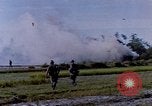
U.S. Marines in action during Vietnam war and training at Camp Camp Pendleton, Calfornia
U.S. Marines in action in the Northern Provinces of South Vietnam, near the DMZ. They are seen in full combat gear, carrying small arms, including recoilless weapons, as they move across green fields where smoke is rising. Next, they are seen spread out and moving across muddy rice paddies. A U.S.jet fighter streaks across a shoreline at low altitude. Views from a Marine jet fighter bomber dropping bombs on Viet Cong targets from low altitude. Explosions on the ground are seen from behind the aircraft as it passes. Brief view from ground of bomb striking and black smoke rising. Closeup (in 1969) of two McDonnell Douglas F-4 Phantoms from U.S. Marine Fighter Attack Squadron 232 (with Red devil insignia on their tails) flying in tight formation. View of pilot in front cockpit an F-4. Aerial view from below of the pair of F-4s. Closeup view from below, as an F-4 releases ordnance in flight. A huge explosion fills the screen as film title slate appeared reading: "Counterpunch." (narrated by Jack Webb). Sign at Marine Corps Air Station, El Toro, California, is shown. Marine sentry at entrance checks identifications of persons arriving at the gatehouse. Marines seen firing mortars, during training. A C-47 transport airplane airdrops supplies to Marines on the ground. Marines in jeeps drive across sand where a bulldozer is working on an airfield under construction. Front view glimpse of a Douglas A-4 Skyhawk aircraft taking off. A pair of Marine Boeing CH-46 Sea Knight helicopters in flight. Group of U.S. Marine Corps officers looking over a model of terrain while being briefed by a Lieutenant Colonel during training "Operation Alligator Hide" in 1967, at the White Beach Marine Corps Base Camp Pendleton in California. Closeup of the detailed mockup of the terrain. Another officer briefs about the use of F-4 and A-4 aircraft support prior to a helicopter assault. Bombs exploding near a bridge. Marines using small 4-wheeled self-propelled open vehicles as they move along a hillside during the exercise. A Captain at a field command post states he will mark a target with white phosphorus (Willy Pete). A tank is seen maneuvering. Pilot is seen responding from cockpit of an A-4 Skyhawk aircraft. An M48A3 Medium Tank is seen on the ground and two F-4s of Squadron 232 in the air. The tank crew fires a white phosphorus round into the hillside, where it generates white smoke. An F-4 is seen flying low toward the area and a bomb explodes on the marked target. Amphibious training is seen, with Marines charging a beach from a landing craft; a tank wading ashore; Marines hit the beach from an LVTP-5 (Landing Vehicle, Tracked, Personnel); Fighter bomber dropping a bomb from offshore; glimpse of Douglas A-4 Skyhawk.
CIA and other U.S. sponsored experiments dealing with control of animals and people using various techniques during the 1960s and 70s.
In 1964, Professor Jose M.R. Delgado, of Yale University's School of Medicine, invented a device he called a stimoceiver. It was a chip that could alter the brain’s electrical impulses via radio signal. In tests sponsored by the U.S. Office of Naval Research, he implanted the device in the brain of a bull. This film opens shows that experiment and its results. A man in Cordova, Spain, opens a bull ring door to allow a fighting bull to enter. It charges a man holding a cape. Another man fires a dart to sedate the bull. Several men plant electrodes for a stimoceiver in the bull's brain. Next, the bull charges a man holding a cape, but pulls up short before hurting him. The bull chases the cape but never attacks the man as the man uses remote control to influence the animal's behavior. The bull charges around in a circle. Scene shifts to Dolley Madison Parkway (Route 123 in Mclean, Virginia, where sign points toward the CIA headquarters at Langley, Virginia. Narrator lists various techniques examined in the 60s and 70s, including brain surgery; psychosurgery; creation of amnesia; parapsychology; and manipulation of genes. Glimpse of some facilities at CIA headquarters. Change of scene to hearing of the Senate Subcommittee on Health and Scientific Research on September 20, 1977. Chaired by Senator Edward M. Kennedy, the Committee sought information about these activities by the CIA. Narrator says witnesses had agreed to limit information they would provide the Subcommittee. Former narcotics officer Charles Siragusa is seen on camera admitting that the man he reported to at the CIA wanted him not to say anything. Former CIA chemist Robert V. Lashbrook is seen testifying that he has no knowledge about the CIA running safe houses. (Narrator states he ran one of them and that a "surprise LSD experiment" was conducted there.) Scene shifts to a California tennis court, where Dr. Sidney Gottlieb is playing doubles tennis, Narrator says he oversaw those activities at the CIA but destroyed all his records when he retired in 1973. View of a letter he wrote at that time, in which he states he and his colleagues had been able to maintain contact with the leading edge of chemical and biological developments in the field of biological and chemical control of human behavior. View of Dr. Gottlieb entering an ante room where he testified before the Senate Subcommittee on Health and Scientific Research without being filmed because of what his lawyer claimed were health and cardiac problems. View of him on the tennis courts as Narrator states he declined ABC News requests for an interview. Change of scene to George White who retired from the CIA and lives in Stinson Beach, California. View of Stinson Beach from high overlooking vantage point. People jogging on the beach. Narrator states that White wrote to Dr. Gottlieb summing up his career saying, "it was fun fun fun, and where else could a red-blooded American boy lie, kill, and cheat, steal, deceive, rape, and pillage, with the sanction and blessing of the All Highest." Narrator strolls on lawn near the U.S. Capitol building and says it appears doubtful that mind control has been achieved. But work, that we don't know very much about, is continuing in this field. He asks how deeply are the Russians and other dictatorships into this. He notes that the CIA is reluctant to give information about it (such as Project MKUltra) and he questions where such a program fits in a democracy. He notes that one person working on these projects told him there are capable, conscientious, and very capable scientists working for our country, and "their work speaks for itself."
Ships destroyed during Pearl Harbor attack salvaged in Hawaii.
Aftermath of Pearl Harbor attack. An animation shows a map of Japan as a fictional character Tojo makes a call from Tokyo to Nagasaki and other cities disseminating the news of Japanese attack on Pearl Harbor. He rejoices at the attack. The United States Navy ship Arizona capsized. Wreckage of damaged ships like Nevada, West Virginia, California. Navy personnel along with civil technicians start the salvage of United States ships. Men work on the ships. Ships like California, Nevada and West Virginia underway after repair. Sailors and supplies aboard the ships. Military preparations in United States to counter the Japanese attack. (World War II period).
Reduction in time taken to cover distance between places due to the development of air power in the United States.
A film titled 'Make America first in the air' on the development of air power of the United States. Animated map of the U.S. with a line from New York to Kansas. A covered wagon train of settlers moving west along desert terrain, depicting the Santa Fe Trail of 1849. Mountains in the background. Animated map of the U.S. with a line from New York to Kansas, and continuing through New Mexico and Arizona to California. Railroads decreased the time taken to cover the distance between the places to four days. A train using a steam locomotive moves to the right along a double track. Animation over a map of the U.S. with a line from New York to California. Airways further reduced the time taken to cover the distance to 27 hours. A U.S. Army Air Service Fokker T-2 aircraft in flight.