


 Francais
 Deutsch
 Italiano
Refine Your Search
Mojave California 1955 stock footage and images
- Showing 2149 to 2154 of 3122 results more
more Hide
Hide
Interstate Highways constructed in United States.
A vehicle tows a caterpillar tractor at the construction site of an Interstate Highway. Highway constructed as vehicles dig up and level the surface. A container lowers down and pours out concrete to lay down a road. Man guides concrete bucket as it empties into forms containing steel reinforcing bars. Aerial view of an intersection of highways and cloverleaf flyovers as vehicles move over it. Point of view (POV) shot from a moving car on an open highway in the western United States. Two 1970s cars pass by on the Interstate Highway. Children play with toy trucks and tractors, emulating such construction activity, on the coast of the Pacific Ocean at Redondo Beach, California.
Martin Matador, a guided missile launched in United States.
Wright Air Development Center in Ohio, United States. A United states B-26 aircraft in flight. F-86 aircraft on an airfield with jet engines. United States F-86 D aircraft. X-1 plane takes off at supersonic speed. Men dressed in protective clothing fuel X-1 aircraft, one of them stands under a shower to wash away rocket fuel from protective clothing. X-1 aircraft in area near rocket fuel stands at Muroc Air force Base in California. X-1 in flight, nose and wheels down as it prepares to land. Martin Matador, a guided missile launched, missile in flight. A document titled ' Nuclear Powered Aircraft' stamped as ' Top Secret' A mosaic of five scenes showing F-59 As diving in low, Matador launched, X-1 aircraft in flight and F-86 D stationary. A top secret document titled ' Nuclear Powered air craft'
Japanese attack on United States aircraft carrier Hornet in the Pacific Theater during World War II.
'I was there' depicts Japanese attack on USS Hornet. A car pulls up to the Naval hospital in California, United States. Men relax by the pool side as electrician's meet on United States aircraft carrier Hornet, Tom Heikendor, narrates how the carrier was attacked by the Japanese planes in the Pacific Theater off Santa Cruz. Japanese fighter planes attack the Hornet and explosions occur. Anti aircraft guns knocks down a Japanese plane. Another set of Japanese planes attack the carrier. Smoke rises as explosions occur. Smoke rises from the carrier. Wounded men aboard the carrier transferred onto a destroyer by breeches buoys. A stretcher transferred onto the destroyer.
Devastation in Elizabeth, New Jersey residential neighborhood after American Airlines plane crash; also mid-air explosion of plane at British air show.
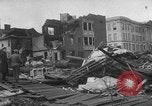
Major catastophe events of the year 1952. Views of destruction on the ground in Elizabeth, New Jersey, after American Airlines flight 6780, a Convair 240, crashed into a house at Williamson and South Streets on January 22, 1952. Burned wreckage and devastation seen at the crash site in Elizabeth following the crash and subsequent explosions damaging or destroying multipole houses in the 600 block of Williamson Street. In the first few seconds of the clip, the Battin High School for Girls is seen in the background. The school was adjacent to the crash but not hit. Narrator also describes the crash of an Army transport plane in California which killed 86 soldiers, but no images of that crash are shown. Next scenes shift to England, on September 6, 1952, as a de Havilland DH.110 jet aircraft, piloted by John Derry, explodes in midair after achieving Mach 1 and then beginning a left bank and climb at 450 knots during the 1952 Farnborough Airshow. Spectators at the British air show are seen on the ground in the area below the explosion and where debris rained down on the crowd causing deaths and injuries. Engines from the blown-up DH.110 plane (prototype, ID WG236) are seen hurtling through the sky toward Observation Hill immediately after the mid-air explosion. Scenes show crowd working to tend to the wounded and shocked families and children crying.
Republican Party candidates prepare for the Presidential elections of 1952 in United States.
Major events of the year 1951. Republican Party nominees Robert Taft, Senator of Ohio and Earl Warren, Governor of California begin their preparations for the 1952 Presidential elections in United States. They address a press conference. Eisenhower remains silent on the issue. President Harry S Truman while addressing the Women's National Democratic Committee refuses to reveal the name of Democratic candidate for Presidential elections.
Relocation of Japanese Americans in United States during World War II.
Shows Milton S Eisenhower speaking about the threat posed by Nisei or Japanese American people in United States during World War II. Japanese residents along the west coast have direct access to American oil fields and harbors. Views of harbors with boats and ships. This heightens the need to migrate the Nisei to interiors of America. Commander General of Western Command at his office plans the migration (internment) of Nisei people. Signs and notice banners with headlines "Civilian Exclusion Order number 6" and "Instructions to all persons of Japanese Ancestry." The signs inform the people of the compulsory mass migration. Nisei people fill up documents and submit it to war relocation authority. People undergo medical examination. They sell their property through 'Evacuee property department'. Japanese load their belongings onto trucks and buses. Deserted shops and homes of Japanese Americans. Rows of temporary houses at Santa Anita race track in Arcadia, California. People of Japanese ancestry eat in a large dining hall and attend church service. Men prepare houses for the Nisei. Japanese Americans boarding railroad trains at train stations, and boarding buses to be moved to relocation centers (internment centers).