


 Francais
 Deutsch
 Italiano
Refine Your Search
Mojave California 1955 stock footage and images
- Showing 2251 to 2256 of 3122 results more
more Hide
Hide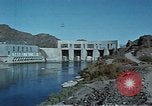
Various dams on Colorado River and their canals system in the United States.
Various dams on Colorado River in the United States, primarily serving California. Parker Dam is at a point 155 miles (250 km) downstream of Hoover Dam. View of the dam. Power plant of the Parker Dam. Canal that provides industrial supplies. Views of Parker Dam, Imperial Dam, Palo Verde Diversion Dam, Hoover Dam and Morelos Dam showing their canals system. Views of the Colorado River.
Politicians address as Hanneagan calls the Democratic National Convention into session at the Chicago Stadium in Chicago.
Democratic National Convention at the Chicago Stadium in Chicago, Illinois. Helen Gahagan (ex Broadway star, wife of film star Melvyn Douglas and herself a candidate for Congress from California) answers media persons. Photographers take photos. Mrs. Claude Pepper of Florida, Congress-woman Mary Norton of New Jersey, Senator Jackson of Indiana, Senator Scott Lucas, old warrior James Farley and others present. Chairman Robert Hanneagan calls the Democratic National Convention into session. Mrs. Charles Tillett of North Carolina addresses the convention. Helen Gahagan gives a speech. Oklahoma's Chief Executive Robert S. Kerr delivers an address.
Franklin Roosevelt and an official deliver speeches during the presidential campaign at the Democratic National Convention in Chicago.
The Democratic National Convention at the Chicago Stadium in Chicago, Illinois. A large crowd gathers for the national convention. People cheer. Banners reading 'Missouri' and 'North Carolina'. U.S. President Franklin Delano Roosevelt, nominee for the president, and other officials standing on a platform. Democratic Party Chairman, Senator Thomas J. Walsh (Montana) speaks to Roosevelt and congratulates him on his nomination to be the Democratic party candidate for President of the United States. The flag of the United States in the background. Another flag with 'California' written on it. Democratic Presidential candidate Franklin Delano Roosevelt speaks.
Life in Britain on eve of War. Chamberlain, Hitler and Mussolini signing the Munich Agreement during World War II.
An Allied propaganda film to solidify Anglo-American solidarity within the ranks as well as to counter Nazi propaganda aimed at weakening the alliance shows British soldiers in Great Britain during World War 2. 1938: in the United States New York Yankees win the pennant in baseball; scene of Yankees team members shaking hands. View of aviator Douglas Corrigan nicknamed Wrong Way Corrigan after his accidental flight from New York to Ireland instead of California as planned. View of trains on the 6th Avenue Elevated (or Sixth Avenue El) before that service was halted in Manhattan New York City. British citizens go about their daily life. Derby horse race in a stadium. A British boy and his father shovel dirt for a backyard garden. Players play a football (soccer) game at Wembley Stadium in England as spectators cheer the 1938 FA Cup Final with Preston North End taking the Cup versus Huddersfield Town as George Mutch scores the winning goal. Scenes in Germany: People cheer for German Chancellor Adolf Hitler and give Nazi salute. Newspaper headlines about Czech occupation. Graves in a cemetery. British Prime Minister Arthur Neville Chamberlain, Adolf Hitler Italian Prime Minister Benito Mussolini sign the Munich Agreement. Despite a peace agreement Hitler invades Czechoslovakia. People read 'Military Training Act, 1939'. British soldiers march along a road. View of Adolf Hitler smiling and laughing. Artillery is fired. A poster reads 'Britain Declares War on Germany'. Airplanes in flight and drop leaflets over Germany. German airplanes in flight. Parachutists jump from the airplanes. Hitler talks to officers and considers the war to be over. Radio news broadcast of the British declaration of war on Germany by Neville Chamberlain. Many different British citizens and families shown in living rooms and work places gathered around radios to listen to the so called "We shall fight on the beaches" speech of Winston Churchill on June 4, 1940. Clip includes scenes from 1938 through 1940; from a film produced in 1943.
A man examines plants at Luther Burbank Experimental farm flower garden and view of irrigated fields
The Luther Burbank Experimental farm (7781 Bodega Avenue, Sebastopol, CA 95472) in Sebastopol, California. A large flower garden at Luther Burbank Experimental farm. A man holds a rose. The man walks through a flower bed. He examines plants, leaves, buds and flowers. Burro stands under willow trees. View of a small stream. An observation tower on the roof of a single room building. Irrigated fields. Base of the observation tower with water running from a pipe. Mountains in the background.
Americans voting and electioneering in national election on November 7, 1944, during World War II.
On November 7, 1944, during World War 2, citizens of Marblehead, Massachusetts, United States, are seen entering the Old Town House (built in 1727) to cast ballots in 40th quadrennial presidential election (in which incumbent President Franklin D. Roosevelt is running for an unprecedented 3th term). Scene shifts to inside a polling place, where voters stand in booths to privately mark their ballots. Others are seen depositing their marked, folded paper ballots in a collection box, as they finish voting. Closeups of several aged voters. One, an African American man, the narrator says is old enough that he was sold as a slave early in his life. Scene shifts to a full-blooded Native American Indian voter in Maryland, entering his polling place to cast a ballot. An old man who is a United States Civil War veteran, is shown sitting on a bench in a park in Los Angeles California, with friends. He holds a newspaper and wears a Civil War Union cap. A U.S. soldier wearing field uniform and steel helmet, looks at a bulletin board containing State-by-State voting information. A Technical Sergeant marks his paper ballot and leaves to mail it. A soldier takes an oath confirming legitimacy of his ballot as he turns it in at a military collection site. Sign in commercial establishment window of a U.S. town declares "Election Today." A bank window sign reads: "this Bank will observe Election Day, Tuesday, November 7th, a Legal Holiday." Sign in Bar window reads: "Bar Closed during Election Hours, Tuesday, Nov.7, 1944. Will Open at 9 PM." Republican political party workers advertise for their Presidential candidate, Thomas E. Dewey. Democratic political party workers drive a truck towing a trailer office plastered with advertisements for their candidate, Franklin Roosevelt. Republican and Democratic party voter information booths are seen next to one another where advertise their respective candidates to passersby on the sidewalk. A voting place identified by white wash sign on a window, and another, in a rural setting, by a sign pointing to it on a fence post. More signs and voters showing sentiments for their candidates. One displays a picture of Dewey on his car. A woman wears a large Roosevelt button on her sweater. Views of more imaginative signs for candidates and for ballot issues. People discussing ballot issues on the streets.