


 Francais
 Deutsch
 Italiano

Refine Your Search
Myitkyina Burma 1944 stock footage and images
- Showing 901 to 906 of 6869 results more
 Hide
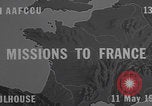
Consolidated B-24 Liberator bombers dropping bombs during an aerial raid of Mulhouse, France (WW2)
Allied bombers bombard railways in Mulhouse, France a month before the Normandy invasion (World War 2). Animated map shows the location of Mulhouse, near the Franco-German-Swiss border. Bombers flying to Mulhouse. United States Consolidated B-24 Liberator heavy bombers in flight. Lockheed P-38 Lightning, Republic P-47 Thunderbolt and North American P-51 Mustang fighters escort the heavy bombers while flying over France. A German fighter aircraft is shot down by a P-47 as seen from a distance. A German pilot is very faintly seen parachuting after ejecting from fighter. Two United States fighters fly away. Aerial view of Mulhouse, Belfort, and surrounding communes. Bombs dropping over Mulhouse and its freight yard. Pillars of smoke rise from Mulhouse. Another aerial raid to Mulhouse took place on May 25, 1944, two weeks after the initial raid. Aerial view of bombs dropping over Mulhouse. Thick clouds of smoke forms over Mulhouse freight yards. A formation of Consolidated B-24 Liberator bombers in flight.

Men transport and load incendiary bombs, chemical officer reads a bomb chart in Europe (WWII)
World War II (WW2) Chemical Warfare Service logo and words, "Incendiaries over the Axis." An M76 incendiary bomb explosion. The United States officers in meeting room in front of wall map of Europe. A man puts a pin into “Berlin” on the map. A pillar of smoke rises from a bombed Nazi German war plant. Allied trucks carry chemical bombs on the road to a chemical park. A man carries a bomb, stacking it on a neat pile of incendiary bombs. Men unload wooden crates with incendiary bombs. Bomb warning reads “Do not assemble fuze to cluster until loaded into airplane”. The chemical officer at the headquarters of the United States Strategic Air Forces in Europe signs a document from his desk before handing it over. The chemical officer reads a chart showing the increased use of incendiary bombs by Allied forces from January to March 1944.
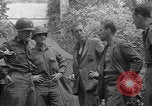
Escaped U.S. Army bomber pilots speak with officers after rescue during World War 2
Two escaped U.S. Army Air Force aircraft pilots, shot down in enemy territory in December 1943 during World War II, speak with U.S. officers after their rescue in 1944. Both pilots are dressed in civilian clothing, and one wears improvised shoes. (Footage shot around the time of the Battle of Cisterna).
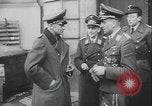
Interview with famous German Luftwaffe pilot Major Hans-Ulrich Rudel; views of aerial shelling of Soviet tanks during World War 2
Famous Luftwaffe ace, Major Major Hans-Ulrich Rudel, and other figures, at an airfield in Berlin, Germany, 1944, during WW2. Narrator notes that Major Rudel is the first fighter aircraft pilot to be decorated with the Knight's Cross with Golden Oak Leaves, Swords, and Diamonds, the highest decoration. Major Hans-Ulrich Rudel was the first and only German to ever receive this award. Standing in front of a group of German soldiers, Major Rudel is interviewed about his most dangerous experience. He talks about a time he outran Soviet troops on foot after being shot in the left shoulder. Once back to safety, Major Rudel says he returned to his aircraft to continue the battle, despite his injury. The men laugh when Major Rudel jokes that he was only able to rejoin the battle because his army doctor was on vacation. Major Rudel talks about the number of tanks he destroyed in his first missions. Shot of Major Rudel climbing into the cockpit of a Henschel Hs 129 ground-attack aircraft. Scene changes to built-on cameras on a German ground-attack aircraft, documenting the shelling of Soviet tanks.
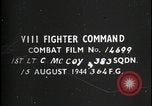
Aerial combat footage by First Lieutenant McCoy of the 383rd Fighter Squadron, U.S. Army Air Force, over Europe during World War 2
Aerial combat footage filmed in Europe during WW2 by USAAF First Lieutenant McCoy of the 383rd Squadron, 364th Fighter Group, VIII Fighter Command, on 15 August 1944. An aircraft is visible in the distance, the ground far below. Gun camera footage on aircraft shows closing of the distance and it opens fire, dislodging a piece of sheet metal from the right wing of the target German aircraft. Scene cuts to what appears to be the destroyed target German aircraft on the ground.
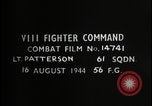
U.S. Army Air Force (USAAF) Ground-attack aircraft strafes train causing explosion of train car during World War 2
Filmed in Europe on August 16, 1944, during WW2 by Lieutenant Patterson of the 61st Squadron, 56th Fighter Group, VIII Fighter Command. Gun camera footage shows aircraft flying low, firing at the front of German or German held railroad train. Second pass, aircraft causes damage to the middle of the train, plumes of smoke. Third pass, the shelling causes a train car to explode, debris flies through the air. Final pass, the ground-attack plane shells the train again causing plumes of smoke and dust.
CRITICALPAST.COM: About Us | Contact Us | FAQs - How to Order | License Agreement | My Account | My Lightboxes | Shopping Cart | Advanced Search | Featured Collections | Website Terms & Conditions | Privacy Policy ©2026 CriticalPast LLC.
License Agreement |
Terms & Conditions |
Privacy Policy
©2026 CriticalPast LLC.