


 Francais
 Deutsch
 Italiano
Refine Your Search
Myitkyina Burma 1944 stock footage and images
- Showing 937 to 942 of 6869 results more
more Hide
Hide
Early pictures of General Eisenhower showing his childhood home and his welcome ceremony when he returned home.
'The Big Picture' depicts the life of U.S. General Dwight D Eisenhower. Sergeant Stuart Queen of the U.S. Army stands in front of a map. He gives an introduction of Eisenhower. In 1945 Eisenhower returns to his homeland in Denison, Texas. A banner reads 'Welcome IKE'. People gather on the sides of the streets to welcome him. He waves from an open car at the cheering crowds. People at parade carry the U.S. flags during a ceremony. Eisenhower salutes. D Day, June 6, 1944- Barges carrying American troops land on the shore of Normandy. Eisenhower with another military officer. Eisenhower salutes. Streets of the city Abilene. Exterior of the Eisenhower Museum. Two boys enter the museum. Pictures of Eisenhower in his childhood - during infancy, house in which he was born, Eisenhower with a group of children, Eisenhower with his family, with his baseball and football team. View of Eisenhower's bedroom- scripture readings on the walls and books in the shelves. A truck passes the creamery where Eisenhower worked in his spare time. Pictures of Eisenhower leaving home to join the Military Academy at West Point. Cadets marching at the grounds of the military academy. Graduation Certificate of Eisenhower. Eisenhower with his wife Mamie Geneva Doud. Fight in Western Europe during the World War I. Picture of Eisenhower with other cadets. The certificate of the Distinguished Service Medal presented to Eisenhower for his services for training tank crews in Pennsylvania.
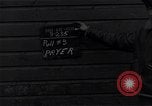
Pilots of the USAAF 334th Fighter Squadron celebrate their victories at Debden Airfield in England, during World War II
Three pilots, Major Gerald Montgomery, Major Howard D. (Deacon) Hively, and Captain Shelton W. "Shell" Monroe, of the U.S. Army Air Forces 334th Fighter Squadron, 4th Fighter Group, discuss a map during World War 2.. Logos of the Eagle Sqadron and the 334th Fighter Squadron displayed above a wall containing small painted German crosses representing enemy aircraft destroyed, probably destroyed, and damaged. Airman stencils two more under the destroyed column. Major Howard D.Hively of Athens, OH.,with another Major looking at record of aerial victories on the wall. Hively holds a sign reading "300 destroyed." He hands it to the other Major who tacks it onto the wall using the butt of his .45 caliber automatic pistol as a hammer. They smile and shake hands. Then Lieutenant Timothy Cronin stencils three more crosses in the destroyed column, under the 300 sign, as Lieutenant Victor Rentschler looks on smiling. The two men each recorded kills on Christmas Day 1944, one of which was the 300th kill for the squadron. (Shelton W. Monroe was later killed in Korea after his plane was shot down on April 17, 1951. )
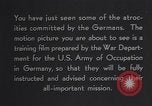
Training film for U.S. troops with the Army of occupation in Germany after world War II
Opens with bell tolling Victory against Germany in World War II. Next, a slate reads: "Victory Leads to Peace," and a farmer is seen with cattle pulling a plow. But narrator says "the problem now is future peace," and a map of Germany is shown overlaid with "Your Job in Germany." A cartoon of a soldier is superimposed on the map, along with one of a World War 1 American soldier and a figure of possible future soldier with similar mission. Camera focuses on parts of German aircraft in a jumbled heap. Closeups of weary defeated German soldiers at end ot World War II. Glimpse of Adolf Hitler speaking and haranguing an audience from a podium in an animated and forceful way. Swastika flags displayed from houses in a quaint German town. Joseph Goebbels, Nazi Reich Minister of Propaganda, at a microphone. Glimpse of a German concentration camp. But as they appear, each of the Nazi elements promptly disappears, showing the scenes without such Nazi symbols and persons. Skeleton remains of bombed buildings. Flower displays. Bucolic German rural countryside and quaint old villages in peaceful settings. Camera focuses on a book titled "German History." Chapter I, titled "Blood and Iron," shows Image of Otto von Bismarck. German troops march in a parade. Narrator states that "under Bismarck, the German empire was built." (He formed the German Empire in 1871, unifying Germany with himself as Imperial Chancellor, while retaining control of Prussia at the same time.) The film shows mounted German lancers as it alludes to Bismarck's campaigns against Denmark in 1867; Austria in 1866; and France, in 1870. Germany's leaders celebrating its status, in 1871, as the mightiest power in Europe. Troops marching and girls dancing nearby. Farmers plowing field with a horse and cow. Classic peaceful rural alpine scenes with local people in agricultural pursuits. A group of local German musicians playing folk music as village people dance outdoors. Back to the book, Kaiser Wilhelm II is shown on Chapter 2, entitled: "Deutschland über Alles." Gathering of German soldiers in Pickelhaube (spiked helmets). A German Big Bertha howitzer firing. German troops marching against Serbia; Russia; and France (with view of war damaged French cathedral). German invasion of Belgium in 1940 (with view of clock tower resting in rubble). German troops seen in Italy, walking past battle-damaged buildings. German Zeppelin dropping bombs on British targets and view of bombed out London neighborhood. Next scene shows a capsized ship with survivors running across its hull. Film slate labels the scene as United States, as if it is a U.S. ship attacked by Germany. (Actually, it is the Austro-Hungarian Battleship, SMS Szent Istvan, torpedoed, by Italian torpedo boats, during World War I.) Next, American soldiers in trench are seen going "over the top" and into "no man's land" on the western front of World War 1. Glimpse through a window of Kaiser Wilhelm II, after defeat of Germany, in 1918. View of Germans in a Beer Garden. Picturesque view of German town. A German orchestra performing. American soldiers marching out of Germany, with flags waving. Back to the history book,as chapter III is revealed, entitled "Today Germany, tomorrow, the world," and featuring Adolf Hitler. German troops invading Austria (where a civilian lies dead on the ground). German troops entering Czechoslovakia (where local people in tears render the Nazi salute). They march into Poland (where a girl weeps over someone, not seen, on the ground). They march into France (where a wounded, bandaged child cries in a bed). Next, is a scene from England, where a British child victim of bombing lies dead in the remains of a shelter. German troops invading Norway, Holland, Denmark, Belgium, Luxembourg and Russia (where a woman tries to rouse a dead woman). They invade Yugoslavia (where women sit near coffins of children) and Greece (where a woman rescues a naked child). A U.S. merchant ship explodes after being torpedoed by a German submarine (unseen). Scenes of destruction with people plucking dead victims from rubble of buildings. American troops invading Normandy, France on D-day, June 6, 1944. Several American soldiers fall to German gunfire on the beach. Wounded American soldiers being transported in jeeps on the battlefield and being placed on landing craft for evacuation. Americans walking past huge piles of destroyed aircraft parts. A landing craft filled with wounded American soldiers. American wounded and dead on a battlefield. Sailors abandoning a burning American ship by jumping into the sea. A sailor picked up in a life boat. A wounded American soldier being dragged from the beachhead at Normandy. Various wounds being treated by U.S. Medical Corps personnel. More scenes of American wounded being moved on stretchers. Scene shifts abruptly to German people folk dancing. Film concludes with question marks about the future.
Newsreel depicting victory of Allied military forces capturing German cities and Nazi officials to end World War II.
Newsreel titled 'Allied Drives Split Germany'. Allied troops, tanks and soldiers fight a fierce battle on the streets of Leipzig and gain the control. Allied soldiers seize and guard the radio station in Leipzig. Allied forces win Nuremberg and Braunschweig. Destroyed buildings and houses after the fight. A German commander surrenders to American Major General. Glimpses of Hitler's speech at Nuremberg in 1932. U.S. soldiers atop the same stadium building in 1944. British Army men prisoners liberated and given food and cigarettes. A camp near river Rhine where German prisoners are released and Nazi army officers surrender. German Generals arrested by the Allied Forces. Soldiers of the 3rd Army explore stashed gold and currency reserves of Germany hidden in a salt mine. They also recover stolen art and classic paintings from German museums. Civilians registered by Allied military officials. A crowd in market hears suspension of Nazi government. Nazi army uniforms, arms, caps and badges in a stack to be destroyed. A map showing German-Russian frontier. Russian tanks rushing into German borders after bombing their bases. Tanks advance between destroyed houses, rising smoke and explosion from fights. U.S. and British forces bombing Magdeburg on the Elba river.

Villagers of Bande, Belgium, massacred by Nazis on Christmas Eve, in retribution for deaths of three German soldiers, in World War II
A sign identifies the village of Bande, in Belgium, during World War 2. View of snow-covered village rooftops from a distance. Closeup of a cafe in the village. Bodies of 34 young men from the village are seen lying in the cellar of the cafe. All had been executed on Christmas Eve, by a unit of the Nazi SD (Sicherheitsdienst) affiliated with the SS (Schutzstaffel) in retribution for the deaths of three German soldiers killed by Belgian maquis (Resistance fighters) on September 5, 1944. (Bande had been occupied by U.S. forces soon thereafter, but was retaken by German forces in the December Ardennes offensive, setting the stage for the massacre.) British troops that re-occupied the village on January 10th, 1945, are seen removing the bodies from the cellar and placing them on the snow-covered street. Wooden coffins are stacked up at the side of the building. Some closeups of the victims are seen. Scene shifts to a snowy field where the bodies are on the ground and men wrap them in sheets and place them in coffins. Closeup of British soldiers placing cover on a coffin and affixing an identification tag on it. Next, the Village Priest presides over a mass funeral for the victims, as villagers stand along the line of coffins. Women in black grieve over the victims. British soldiers carry the coffins to army trucks.The villagers follow behind the trucks as they proceed to the graveyard for burial. The coffins are placed on the ground at the cemetery.
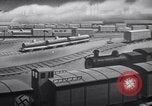
Allied bombing missions to destroy railroads and marshaling yards in occupied France and Germany during World War II
Cartoon representation of German rail yards and war factories, opens the film. Cities of : Anklam; Bremen; and Frankfurt are highlighted as critical factory and railroad junctions. Animated map shows Allied air strikes against French marshaling yards in Spring of 1944 in preparation for the invasion at Normandy. In February, 1945 Allied officers use large wall map to discuss and plan the destruction of all railroad operations in the Ruhr and surrounding areas. View of U.S. bombers in formation (with fighter cover overhead) on bombing missions in Operation Clarion, against all small and medium rail junctions in Germany. View from Allied bomber of Bombs falling and exploding at a rail junction. More aerial views of bombs exploding in numerous places during this operation. An American B-17 Flying Fortress bomber dropping bombs on a railroad marshaling yard. Aerial view of bombs exploding on targets in Essen. Views of wide destruction wrought at German railroad facilities. A US Army Air Forces P-51 fighter plane descending to strafe a target. Gun camera views of aircraft strafing lines of communication in Germany, including road and barge traffic. Closeup of runs firing from P-51 aircraft. Railroad trains being strafed and dramatic explosions at target rail sites.
CRITICALPAST.COM: About Us | Contact Us | FAQs - How to Order | License Agreement | My Account | My Lightboxes | Shopping Cart | Advanced Search | Featured Collections | Website Terms & Conditions | Privacy Policy ©2026 CriticalPast LLC.
License Agreement |
Terms & Conditions |
Privacy Policy
©2026 CriticalPast LLC.