


 Francais
 Deutsch
 Italiano
Refine Your Search
Myitkyina Burma 1944 stock footage and images
- Showing 391 to 396 of 6869 results more
more Hide
Hide
General Stilwell with his family and later assumes office of the Commander of the U.S. Army Ground Forces in Washington DC.
U.S. Army General Joseph Stilwell at his home in California, United States. General Stilwell relaxes at his home after his return from China- Burma Theater of World War II. He speaks to newsmen. He and his wife look at some pictures of their family. Past events show General Stilwell with troops in China-Burma Theater. Stilwell with his dog at a beach. He assumes the office of the Commander of the U.S. Army Ground Forces in Washington DC. General Stilwell at a desk.
The Allied prisoners of war freed in Rangoon (WW2)
Liberated Allied prisoners of war in Rangoon, Burma during World War II. Exterior of a building. A flag on the flag pole at the top of the building. The prisoners march in the war damaged area. They carry a wounded on a stretcher. They walk near a harbor. Ships at the harbor. Houses in the background.
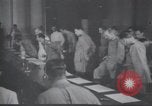
Japanese Lieutenant General Numata and British Lieutenant General Sir Frederick Browning signs the surrender treaty in Rangoon.
Signing of the surrender treaty by Japanese General at Burma Government House in Rangoon towards the end of World War II. The British delegation take their places at the conference table in the Government House. British Lieutenant General Sir Frederick Browning, Lord Mountbatten's Chief of Staff, explains surrender terms. The British officers present documents to Japanese Lieutenant General T Numata. General Numata signs the documents, after which General Browning signs.
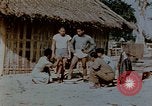
Soldiers demonstrate the application of war paint to disguise while fighting jungles of Burma (WW2)
A World War II Office of Strategic Services (OSS) training film titled, 'War Paint', demonstrates the use of war paint to disguise or camouflage American soldiers and OSS agents (precursor to Central Intelligence Agency or CIA) with white skin fighting in the Far East jungles, so they are less obvious to the Japanese enemy. American and a native Burmese soldier apply war paint on their legs. Burmese man looks in a mirror and applies color paint on his face. Soldiers apply war paint on their bodies. A soldier applies hair dye on the hair of another soldier. Kachin and White troops move in field. An experienced American commando demonstrates application of paint on the body to darken skin of white man. He gears up, smiles and poses for the camera. Narrator asks "are you going to use it" (the paint). The man seems to shake his head answering no. Next is a dramatized scene showing a soldier in a tree being shot. His helmet with blood on it falls to the ground. Implication is that he was not using camouflage paint to change the tone of his white skin, which made him a more obvious target.
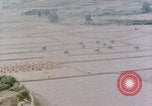
Chinese troops pass through a rice paddy field and carry essential supplies for delivering it to the trained soldiers.
Chinese troops trained by OSS (Office of Strategic Services) in China Burma India Theater during World War II. A flooded rice paddy field. They walk in a line and passing through the paddy field. The trainees cross the flooded paddy field. The troops carry rifles on their back and march forward. Farmers in the background harvest crops. Hay stack in the foreground and the troops walk past the stacks. They carry gun of their shoulders and advance. The troops advancing in the grassy area. They enter a town. The troops carry essential supplies for delivering it to the trained soldiers.

Testing of AZON or VB1 smart bombs by United States
AZON one of the first smart bombs developed by United States, for destroying narrow railway bridges in Burma, being tested. An AZON marked 62 is dropped much above the surface by United States B -24 Liberator aircraft. The bomb drops and strikes an isolated area and an explosion occurs. AZON is officially designated as VB-1 i.e. vertical bomb which is a guided weapon to maximize damage to target and minimize civilian destruction. Various dimensions of VB-1 being explained like, battery ,gyro stabilizer,radio receiver and antenna. Bomb releases and explosion occurs. (World War II period).
CRITICALPAST.COM: About Us | Contact Us | FAQs - How to Order | License Agreement | My Account | My Lightboxes | Shopping Cart | Advanced Search | Featured Collections | Website Terms & Conditions | Privacy Policy ©2026 CriticalPast LLC.
License Agreement |
Terms & Conditions |
Privacy Policy
©2026 CriticalPast LLC.