


 Francais
 Deutsch
 Italiano
Refine Your Search
Myitkyina Burma 1944 stock footage and images
- Showing 427 to 432 of 6869 results more
more Hide
Hide
Various cities in Europe being liberated from Nazi occupation (WW2)
Allied campaign against the Axis powers in 1944 during World War II. People gathered outside the Colosseum (Piazza del Colosseo, 1, 00184 Roma RM, Italy) in Rome, Italy celebrate their liberation from occupation by Nazi Germany. Allied soldiers in trucks move past the cheering crowds. Pope Pius XII addresses the people from a balcony. Victory parade in Paris, France at the Arc de Triomphe (Pl. Charles de Gaulle, 75008 Paris, France) on August 26, 1944. French children clapping. People cheer as they carry banners. In Bucharest, Romania soldiers loaded onto trucks drive past crowds cheering after their liberation. On 3rd of September 1944 people cheer on the streets of Brussels, Belgium as Allied troops enter. A woman sits on top of a moving Jeep. In Belgrade, Yugoslavia on October 20, 1944 people celebrate their liberation. In Athens, Greece women carry a Greek flag and a flag being hoisted after their liberation.

British aircraft sink the German Kriegsmarine battleship Tirpitz off the coast of Tromso, Norway.
Activity in European Theater of Operations during World War 2. Animated map shows Tromso, Norway. Views of British Royal Air Force attempts to sink the German Kriegsmarine battleship Tirpitz in October 1944. Shows extensive smoke cover that hides the battleship Tirpitz, preventing attack. A second attempt failed on 29 October, 1944, as smokescreen and weather clouds prevented clear bombing. During that attempt, the Tirpitz is seen firing her 15 inch guns at incoming British aircraft, while she is moored off Hakoya Island outside Tromso. She was damaged by one bomb during that attack. Later, on November 12, 1944, aerial views show British aircraft of No. 617 Squadron ("Dambusters") and No. 9 Squadron RAF bombing the Tirpitz, having caught her by surprise and without smoke screen. German Battleship Tirpitz bombed by multiple 6-ton "earthquake" bombs (or seismic bombs) dropped by British Lancaster bombers. The Tirpitz is seen as it rolls over before sinking at Tromso, Norway.
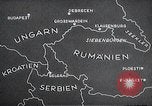
German 23rd Panzer Division engages Soviet and Romanian forces in Hungary (Northern Transylvania) on Eastern Front in World War II
Battle of Grosswardein, precursor to Battle of Debrecen, in World War 2. In late September, 1944, the German 23rd Panzer division was ordered to clear Grosswardein (aka Oradea or Nagyvárad) and environs occupied by Soviet and Romanian forces (who had switched sides a month earlier). In late September, 1944, the German 23rd Panzer division was ordered to clear Grosswardein (aka Oradea or Nagyvárad) and environs occupied by Soviet and Romanian forces (who had switched sides a month earlier). This was prelude to the World War 2 Battle of Debrecen, in October, 1944. Map shows areas of interest and reflects German treatment of Grosswardein and Debrecen as part of Hungary (Northern Transylvania), A German 88mm artillery piece is seen being towed uphill by a SdKfz 6 half-track. Battery of German 15 cm schwere Feldhaubitze 18 cannons being fired from high ground. Their shells striking at edge of wooded area. View of shells being loaded. Chalk writing on one "trotzdem siegen win" or in English "We will win despite all this". German Panther medium tanks move at the head of a column that includes Stug III and other armor. A Stug III camouflaged with tree branches. German armor advancing across and open field. Two tanks parked, and their crew members watching the battlefield. Explosions in the field. German machine gunners firing against Soviet infantry. Romanian soldiers surrendering in a grove of trees, are searched and processed as prisoners of war. German infantry moving through field of corn stalks, along with armored personnel carriers (Schutzenpanzerwagen SdKfz 250/10 Neu). A truck burning in the field, with a field piece attached on a towbar.
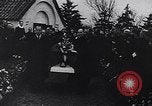
Denmark under German martial law during World War II
Film made by Danes, after increasing tensions between them and German occupation forces that invaded Denmark in 1940, boiled over in August 1943, and the Germans placed Denmark under martial law. It covers the period 1943 and 1944, after which the film was smuggled out of the country. Opening scene shows pallbearers at the funeral of Kaj Harald Leininger Munk (aka Kaj Munk) a Danish playwright and Lutheran pastor, who was assassinated by Nazi Gestapo agents, on 4 January, 1944. Narrator states that Nazi murder leagues assassinated some of Denmark's greatest leaders to intimidate the Danes and quell any rebellions. The coffin of Pastor Munk is lowered into its grave. Memorial stone and flowers are shown. Smoke rising and then a large conflagration are seen, from Danish acts of sabotage. Damaged buildings and more fires, from Danish resistance, are seen. In response, the "Schalburg Corps," a Danish volunteer branch of the Nazi SS, began counter-sabotage (called Shalbotage by the Danes). Film shows fireman on ladders at the building of the Paramount Movie Company, Ltd. where smoke is coming from the windows. (Narrator says film companies that refused every form of collaboration were blown up.) View of severely damaged Nordisk film studio at Helerup. Windows shattered in department stores and in all shops along a street. Illums Bolighus (famous store of Scandinavian design) and many others are wrecked. Camera pans up the side of damaged building with bird painted on its side and the words: "mod lysere Dage.." (Brighter Days). Views of the destroyed Royal Yacht Club pavilion, in Copenhagen harbor. Destruction in Tivoli Gardens. Its concert hall completely destroyed. Fire burning at the Syndicate, Denmark's largest armaments factory, from bombing by saboteurs, in June, 1944. Danes walking in Copenhagen, on a summer evening, flaunting the Nazi curfew from 8PM to 6AM and then lighting bonfires after dark. Abandoned wheel barrows and empty streets are shown when residents of Copenhagen all go home in a general strike. Several German soldiers are seen in otherwise empty street, as the German Commander in Chief declares the city of Copenhagen under siege. A German tank parked in the street amidst pedestrians. Barricades set up by strikers in a street. The American flag flying high over a street. The "Bulldog" a department store in flames. A car serving as an ambulance drives down a street displaying a white flag. A long line of Danes wait at a street corner shop for self-rationed food. Danes drawing fresh water from lakes to be brought to hospitals, where needed. View from above of strikers at a barricade. Narrator states that after 5 days, the Germans gave in and agreed to Danish terms. View of open area in the city, where people stand in silence to commemorate those who lost their lives in the struggle. Danish man looking through chain link fence. More scenes of continued sabotage by Danes.

Allied assaults against the German Gustav Line at Monte Cassino, Italy during World War II
Opening scene shows peaceful Italian mountains, including one snow-capped, in Spring, 1944, during World War 2. Camera focuses on the town of Monte Cassino and its historic Monastery, on a mountain above the town. (German forces held the Rapido-Gari, Liri and Garigliano valleys and some of the surrounding peaks and ridges that formed the heavily defended Gustav Line.) Animated relief map shows where, by mid January, 1944, American, Polish, and British forces had cleared the enemy from mountains east of Cassino and drawn up on the east side of the Rapido valley. Map shows progress of subsequent Allied attacks that finally reached Mount Castellone and then up Abbey Hill at Monte cassino, itself. Image of German soldier is superimposed on the scene, using binoculars on Abbey hilltop to observe Allied forces. (Narrator states: On February 9th, 75 yards from the abbey, we were stuck.") U.S. Army Air Forces Douglas A-20 Havoc aircraft are seen starting engines. Closeup of Fifth Army leaflet warning the local people to leave the Monte Cassino Abbey to avoid shelling and bombing. View of U.S. troops packing the leaflets into thin-skinned shells to deliver the warning by artillery fire. Next, 105 howitzer guns are seen under camouflage netting, firing bombardments of warning shells. Formation of A-20 aircraft taking off. Aerial view from high above, of B-25 bomber formation in flight. Formations of B-17s, B-24s, B-26s in flight enroute to bomb Monte Cassino. Bombs dropping from B-25 Mitchell bombers. Bombs exploding on Monte Cassino and the Abbey. Batteries of 155 mm guns firing. Formation of 6 B-25 bombers in formation. More bombs bursting on Monte Cassino. Animated map shows German forces taking up their earlier defenses again following the Allied artillery and air attacks. It also shows supplies streaming in to the German Green Devils Parachute Division (Luftwaffe’s 1st Fallschirmjaeger [Parachute-Hunter] division.) The map illustrates all the locations in the town that they occupied and would defend to the last man. Map also illustrates circling positions of Allied artillery batteries. Camera focuses on Polish troops and M4 Sherman tanks moving forward in an offensive. Glimpse of U.S. Army Air Forces mechanics working on a Douglas bomber engine. M4 prime movers towing 155mm howitzer guns. Gun crews camouflaging their positions with netting. Various views of A 240mm howitzer being put in place by a crane. Soldiers deploy detector microphones to locate enemy gunfire sources. They test them, and then enclose them in water-proof containers, bury and cover them. Sound from the microphones being recorded on film at a machine in the Command Post. The data being plotted on a map and corresponding grid locations phoned to Battalion headquarters. View of bombers resuming attacks again, on March 15, 1944. Formations of Douglas bombers, followed by B-25s, seen dropping bombs that explode in the town of Monte Cassino. Artillery firing. Formation of B-24 Liberator bombers in flight. Formation of B-17s dropping bombs. String of bombs exploding in a line on the town. More views of artillery barrages. More lines of bombs exploding. Allied forces storming the shattered town found German soldiers using destroyed structures as shelters to fire from and rubble obstructing the movements of Allied tanks, so the Allied advance was again stopped. Later, a newspaper headline reports resumption of Allied offensive.
Strafing and attacking ground targets, ME-109 and FW-190, European Theater.
The 8th Fighter Command Operations, European Theater. 27-May-1944; Lieutenant R L Baker of 82nd squadron 78th fighter group flies the aircraft. Attacking the ground targets as seen via gun camera footage. Strafing of two flak towers. A decoy aircraft in flight. 29-May-1944; Captain B L McGratten of 335th squadron 4th fighter group flies the aircraft. Attacking ME-109 and FE-190. Aircraft fly fighter protection for formation of B-17's. Chasing and hitting of FW-190. 30-May-1944; Lieutenant J R Cook of 360th squadron 356 fighter group flies the plane. Strafing of large freighter, schooner and two small targets. (World War II period).
CRITICALPAST.COM: About Us | Contact Us | FAQs - How to Order | License Agreement | My Account | My Lightboxes | Shopping Cart | Advanced Search | Featured Collections | Website Terms & Conditions | Privacy Policy ©2026 CriticalPast LLC.
License Agreement |
Terms & Conditions |
Privacy Policy
©2026 CriticalPast LLC.