


 Francais
 Deutsch
 Italiano
Refine Your Search
Myitkyina Burma 1944 stock footage and images
- Showing 523 to 528 of 6869 results more
more Hide
Hide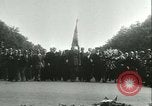
French General Charles De Gaulle leads victory celebration of French resistance fighters in Paris
The Liberation of Paris in August 1944. French General Charles De Gaulle leads troops as they march on the Champs Elysees. Soldiers with the French flag. A large crowd of civilians join the celebrations. De Gaulle pays tribute at the Eternal Light at Arc de Triomphe. He is accompanied by French officers and soldiers. Civilians crowd around. De Gaulle and his men parade on the Paris streets. Civilians cheer and celebrate the liberation. Men and women on tanks. U.S. General Eisenhower together with U.S. General Omar Bradley join in the celebration, smile, and talk to American and French military leaders in front of the Arc de Triomphe. The French Resistance flag unfurled on a building. Parisians give the victory sign. The French flag raised on a building. (World War II period).

Bomb damaged Place de la Concorde and unscathed Champs Elysees, Eiffel Tower, Arc de Triomphe, Notre Dame in Paris after WWII.
Results of selective strategic bombing by the British Royal and United States Eighth Air Forces in German-occupied Paris and surrounding areas during World War II. September 1944: Pont de Grenelle bridge over the Seine river. Eiffel Tower (Champ de Mars, 5 Avenue Anatole France, 75007 Paris, France) in the background. The Statue of Liberty replica on the Ile aux Cygnes Island (Pont de Grenelle, 75015 Paris, France). Shell blast damaged buildings and the Obelisk at Place de la Concorde (75008 Paris, France). Cyclists and motorists at the Place. Military cars pass the Arc de Triomphe (Place Charles de Gaulle, 75008 Paris, France) at Champs Elysees. Civilians around the Eiffel Tower. The French flag atop the undamaged tower. Unscathed Notre Dame de Paris (6 Parvis Notre-Dame - Pl. Jean-Paul II, 75004 Paris, France). United States military vehicles in the square before the cathedral. U.S. Army soldiers and French civilians crowding in front of the Cathedral. An FFI (French Forces of the Interior) flag at Notre Dame.
U.S. General Patch, U.S. Admiral Hewitt, and French Admiral Lemonnier lead the Allied fleet invasion of southern France.
Amphibious and airborne Allied forces land in southern France during World War II. (Operation Dragoon in August 1944). Map of France depicts Allied landings at Normandy on D-Day. Naples: An Allied naval force assembles, poised for landing in Southern France, 10 weeks after the Normandy D-Day invasion. Thousands of landing crafts, trucks, tanks, mobile cannons, military vehicles and equipment in the embarkation area. Barrages in flight overhead. Allied officers supervise as the vehicles are loaded into ships. US, French, British, Greek and Polish troops move up to their ships. The ships underway in the Mediterranean. U.S. Secretary of Navy James Forrestal, U.S. Army General Alexander Patch, French Admiral Andre Lemonnier and U.S. Navy Admiral Henry Hewitt (Chief of the Atlantic Invasion Fleet) aboard the flagship. Allied soldiers stitch sleeve patches. An animated map depicts the Allied invasion of southern France near Toulon in a combined amphibious and airborne assault. Hundreds of transport aircraft carry paratroop forces. The paratroopers get ready, jump, and descend to the ground. The amphibious forces near the French coast. German shore batteries fire at the approaching naval vessels. Explosions on ships and in water. Allied troops crouched in landing crafts. They hit the beach under shell fire and advance in land.
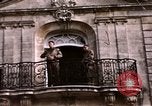
U.S. Army officers and war correspondents at the bombed, abandoned French Chateau de Pont-Rilly during World War II after D-Day
Uniformed U.S. war correspondents and U.S. Army officers explore the house and grounds of the French Chateau de Pont-Rilly, in Négreville near Normandy France, soon after the Invasion of Europe. (The chateau was designed in 1765 by architect Pierre-Raphaël de Lozon for the Marquis d'Ourville). U.S. Army officers in the balcony of the mansion overlooking the entrance. Exteriors of the palatial chateau. A large bomb hole is visible in the roof, right of the main entrance. A French boy points out something distant on the grounds of the Chateau. A swan in a pond. Exteriors of the mansion. At the end of July 1944, near the time this footage was shot, the chateau became the headquarters of Advance Section of Com Z, also known as "ADSEC" (Advance Section, Communications Zone).
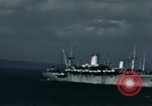
U.S. war correspondents and 101st Airborne Division mingle with citizens of a coastal French town after Allied Invasion of France in World War 2
U.S. war correspondents traveling with the 101st Airborne shortly after the Invasion of France by Allied forces in the summer of 1944. Allied officers aboard a ship. Soldiers on a beach of coastal France. Town buildings rising up from the shore. A French woman holds a cat. A war correspondent and a soldier from the 101st Airborne look at pictures and smile. Town buildings along a street of a coastal French town. A barbed wire fence with a beach in the background. A Red Cross flag on an American jeep. Massive seawall fortifications separating the beach and the coastal French town. Children play, walking on the sea wall and playing in the sand of the beach. Allied soldiers confer inside a tent. Ships on the coastline. An American flag aboard a ship.
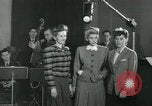
Andrews Sisters Patricia Marie, Maxine Angelyn and Laverne Sophie record Boogie Woogie Bugle Boy for 'V-Disc
A Colonel thanks Andrews Sisters on behalf of the Music Section of the Special Services Division for recording the three discs. Patricia Marie, Maxene Angelyn and Laverne Sophie record a song named 'Boogie Woogie Bugle Boy'. Musicians check instruments during the recording. Studio staff work on the pressing of the phonograph record. (Note: Although "Boogie Woogie Bugle Boy" was recorded commercially for Decca Records on January 2, 1941, this filmed V-Disc recording session took place over three years later on September 25, 1944.)
CRITICALPAST.COM: About Us | Contact Us | FAQs - How to Order | License Agreement | My Account | My Lightboxes | Shopping Cart | Advanced Search | Featured Collections | Website Terms & Conditions | Privacy Policy ©2026 CriticalPast LLC.
License Agreement |
Terms & Conditions |
Privacy Policy
©2026 CriticalPast LLC.