


 Francais
 Deutsch
 Italiano

Refine Your Search
Myitkyina Burma 1944 stock footage and images
- Showing 5359 to 5364 of 6871 results more
 Hide
Color Sound

Allied soldiers enter Rome, Italy as civilians cheer and celebrate during World War II.
Liberation of Rome by the Allies during World War II. Allied soldiers loaded onto a tank enter Rome. A sign in Italian. Civilians gathered in St. Peter's Square. Allied soldiers ride bikes. Civilians and traffic with the Colosseum in the background. A large crowd gathered in St. Peter's Square cheers. A child in a pram. A woman kisses a soldier.
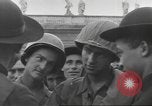
Italian civilians celebrate the Liberation of Rome, Italy (WW2)
Liberation of Rome by the Allied forces during World War II. Allied soldiers are greeted by civilians. Roman Catholic priests speak to Allied soldiers in Saint Peter’s Square, Vatican City. Italian people and children clap and cheer as they celebrate the liberation of Rome from Nazi German rule. People gathered outside the RAI building. Tanks move past Victor Emmanuel II National Monument (Altare della Patria, Piazza Venezia, 00186 Roma RM, Italy). Soldiers walk as civilians look on. Children seated along a sidewalk. Civilians milling about in front of the Colosseum. Civilians gathered around a bulletin board. Allied soldiers on a truck near the Victor Emmanuel II National Monument.

Italian civilians celebrate the Liberation of Rome, Italy and General Clark visits the Vatican City during World War II.
Liberation of Rome by the Allies during World War II. Allied soldiers in Jeeps drive on the streets of Rome. Soldiers salute while on moving Jeep entering the Vatican City. United States Army General Mark Clark leads a convoy of Allied soldiers. French General Charles de Gaulle and retinue walk out of a building inside the Vatican. Swiss Guards with halberd follow the retinue. The Jeeps pass under a bridge. General Mark Clark with a cardinal as he visits the Vatican City. Civilians gathered on a street. A Swiss Guard in regular duty service dress uniform talks to a young United States soldier. Cheering people crowd Via Del Corso. The King Victor Emmanuel Monument (Altare della Patria Piazza Venezia, 00186 Roma RM, Italy) in the background. Civilians run on a street. People cheer and wave.

Allied soldiers prepare material for especially prepared German broadcasts at Radio Luxembourg during World War II.
Radio Luxembourg operated by the Allied Forces' Psychological Warfare Division to break down German morale and induce nazi troops to surrender during World War II. The Radio Luxembourg station in Luxembourg. U.S. Army soldiers in the recording studio. They read information from a document over the microphone. Other soldiers seated inside. Towers at Radio Luxembourg, the most powerful long wave station in Europe. A man at the controls. officers check the wavelengths. for various locations of reach. The Radio Luxembourg news room. Army Intelligence and other military sources prepare material for the especially prepared German broadcasts. The recording studio: A soldier operates controls. Two soldiers seated at a table. They read from a document into a microphone.

U.S. soldiers operate M36B1 tank destroyers in Germany and Allied cargo arrives at the port of Rouen in France.
Activities in the European Theater of Operations during World War II. M36B1 tank destroyers in Germany. The tank destroyers advance through slush and mud. Soldiers of the 692nd Tank Destroyer Battalion attached to the U.S. Army 104th Infantry Division, seated on the tank destroyers. A 90mm gun is test fired. A soldier removes the barrel cover and fires the gun. Soldiers observe the impact. First United States Army soldiers instruct the 8th Infantry Division troops about the use of captured German guns. A soldier demonstrates the use of a captured German Panzerfaust, a recoilless anti- tank launcher. A tank is hit. Damage caused by the hit. France: The port of Rouen along the Seine River. Various ships arrive with cargo for the Allies battling at the Rhine. A LIberty and Victory ship arrives. The Marine Division of the Army Transportation Corps on board. Women soldiers at work. A soldier near an organizational chart on the ship.

A USAAF officer instructs a new B-17 pilot about ground inspection and safety precautions prior to take off.
A U.S. Army Air Forces (USAAF) training film titled 'How to fly the B-17. Part I. Ground Operations.' about inspections and safety precautions by a pilot prior to take off. A USAAF officer trains a new pilot beginning his career as a USAAF B-17 Flying Fortress pilot. A B-17 parked nearby. The recruit confirms possession of weather codes and radio charts. A Sergeant (engineer) gets down the hatch in the aircraft belly and joins the other two. External Inspection: The three airmen inspect various aircraft parts. Tire inspection for slippage marks, outboard brake line for oil leakage, tire tread for cuts or damage, brake line on the in board side. Inspection of the right oleo for the load, whip antenna. Similar inspection of the left hand gear, oleo, and tire. The officer performs checks for: turbo wheel on the engine, check for cracks at welded joints, wheel for clearance, missing bucks, mechanical linkage on the wastegate, skin covering access doors. Check: nicks, dents, cracks on the propeller number 2, anti ice boots, stones between the boot and blade. Inspection of the three blades, propeller governor, engine for proper cooling, engine and propeller number 1. Checks: DI support on one side under the wing, all access and inspection doors, aileron fabric, aileron trim tab for play, antennas present and accounted for. Inspection of the ball turret door, guns horizontal and pointed to the rear, trailing antenna anchored, marker beacon antenna on, breaks, stabilizer, elevator covering and trim tab play. Inspection of the rudder covering and trim, damaged skin parts, elevator down spring through the tail gunner's hatch. The officer instructs the new pilot to repeat the same inspections on the right wing and engines 3 and 4.
CRITICALPAST.COM: About Us | Contact Us | FAQs - How to Order | License Agreement | My Account | My Lightboxes | Shopping Cart | Advanced Search | Featured Collections | Website Terms & Conditions | Privacy Policy ©2026 CriticalPast LLC.
License Agreement |
Terms & Conditions |
Privacy Policy
©2026 CriticalPast LLC.