


 Francais
 Deutsch
 Italiano
Refine Your Search
Naha Okinawa Ryukyu Islands 1945 stock footage and images
- Showing 199 to 204 of 9403 results more
more Hide
Hide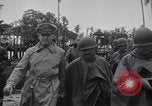
Under General Douglas MacArthur command, the Allied troops capture Philippines from the Japanese.
The life of General Douglas MacArthur. MacArthur on captured islands in the Pacific theater. Gen. Douglas confers and walks with other commanders. Animated map shows Allied advance from New Guinea Islands towards the Philippine Islands. General Douglas in conference with President Roosevelt, and Admiral Nimitz. MacArthur points at a map and explains his plan of action. In accordance to the plan the Allied convoy sails towards Leyte Islands. Fighting and combat at the Philippine Islands. Behind naval bombardment the allied troops land on the island. MacArthur's face is iluminated by intermittent light from Naval Gunfire at night as he watches the landing from a battleship. In daylight, MacArthur on deck with with a three-star general, as he smokes his corn cob pipe. Allied troops establish a beachead on Leyte. General MacArthur gets off an Landing ship and wades ashore. Allied troops move towards Manila. Block-by-block fighting on streets of Manila against Japanese forces. American paratroopers jump and land on Corregidor; scenes of parachutes descending and landing. MacArthur and his staff stroll down a street in Manila. He visits the prison camps and speaks with joyful, liberated, former prisoners of the Japanese. MacArthur salutes as the American Flag is raised in a ceremony over Corregidor. Image of atomic bomb explosion. MacArthur gets off a plane wearing 5 stars. Scenes of Japanese surrender ceremony aboard the Battleship Missouri at end of World War 2 in 1945. MacArthur gives an address to conclude the proceedings. (World War II period).
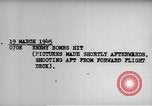
Violent explosions and fire fighting as Japanese bombs hit USS Franklin (CV-13) in Pacific Ocean during World War II.
Opening Slate reads: 19 March 1945, Enemy bombs hit (pictures made shortly afterwards shooting aft from forward deck). It refers to Japanese bombs striking the American Aircraft Carrier USS Franklin (CV-13). Heavy billowing smoke obscures the view for a moment. Then sailors are seen on the flight deck of the Franklin fighting a fire with hoses. More fire breaks out and smoke billows from the deck. Fire fighters continue efforts with hoses. New fire breaks out near the edge of the deck opposite the ship's island superstructure. View from other direction shows sailors all over the deck near the island trying to contain the fire. A slate appears reading: A series of violent explosions begin (made from USS Hickok - DD-673). This refers to filming from the USS Hickok. The USS Franklin is seen consumed by fire and covered by dense black smoke rising high into the sky. The smoke turns more white. A new view from the Hickok shows fire and smoke coming from the area of the carrier's island and blowing aft. A different view shows both white and dense black smoke enveloping the Franklin. Next, firefighters are seen again, on the Franklin's flight deck, forward of the island, continuing to battle the fires that see concentrated amidship. Slate reads: USS Miller alongside (refers to the destroyer, USS Miller, DD-535).View of the USS Miller close-by. Another view of sailors fighting the fire on the Franklin's flight deck. Brief view, from a parapet on the island, shows smoke. Also seen are water intakes stretched out from the ship, presumably providing water for firefighting. Back on the Franklin's flight deck, firefighters work against a backdrop of white smoke. a closeup shows portions of the flight deck broken and tilted into the hangar deck. More views of sailors on deck, forward of the island, fighting the fires. Glimpse of hangar deck below, where large section of flight deck has fallen. Firefighters with hoses working there.
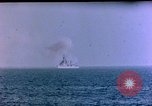
U.S. Navy ships bombard beach at Kerama Retto, Okinawa, during World War II
U.S. Navy bombardment of beach at Kerama Retto, Okinawa, during World War 2 invasion of Okinawa. LSMs (Landing Ship, Medium), destroyers and battle ships underway. Rocket barrage fired. Rocky shoreline of the island in the background. Details seen include: Time 00:25 is the battleship USS New Mexico, BB-40 firing main and secondary batteries. Time 00:41 is a detailed closeup bow-on view of the battleship USS New Mexico, BB-40. (Note: As seen, the USS New Mexico did retain its casemated 5-inch/51 caliber guns for the Okinawa invasion, contrary to some historic references.)
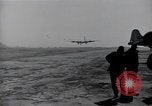
B-29 bombers of United States Army Air Force land at a base on island Iwo Jima, during World War II.
United States Army Air Force at their base on the island of Iwo Jima, during World War II. B-29 bombers of the U.S. Air Force land on landing strip one after the other. Airmen at the runway. Airman marshaling a B-29. A pilot looks out form cockpit window of one of the B-29. The aircraft with painted nose art of an attractive, semi-nude woman and slogan 'A-Broad With Eleven Yanks.' (B-29 number 42-24698. Assigned to 499th BG, 877th BS. Shot down over Kyushu, Japan July 11, 1945. 1 crewman killed, 10 survived and rescued. Missing Air Crew Report (MACR) 14344.)
War Correspondents and photographers in PacificTheater during World War Two. Surrender of Japanese at Truk, Caroline Islands
American combat correspondents and photographers in Pacific Theater during Second World War. Close up of American flag flying over a U.S. military cemetery. A sailor kneels before a cross marking the burial site of a comrade. War correspondent types report on portable typewriter. Combat photographer loading film in his camera. Photographer developing film in dark room. Scene shifts to the event photographed, which is Japanese Lieutenant General Shunzaburo Mugikura, Commanding General, Japanese 31st Army, on board USS Portland (CA-33), signing document of surrender for the Japanese base at Truk, Caroline Islands, 2 September 1945.
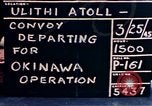
U.S. Convoy departs for Okinawa operation from Ulithi Atoll in Caroline Islands.
U.S. convoy departs for Okinawa operation. View from side of ship, convoy leaves Ulithi Harbor. LST (Landing Ship, Tank) sails ahead. Craft with signal flags up. Anchor comes up from water. Ship rides roughly in sea.
CRITICALPAST.COM: About Us | Contact Us | FAQs - How to Order | License Agreement | My Account | My Lightboxes | Shopping Cart | Advanced Search | Featured Collections | Website Terms & Conditions | Privacy Policy ©2026 CriticalPast LLC.
License Agreement |
Terms & Conditions |
Privacy Policy
©2026 CriticalPast LLC.