


 Francais
 Deutsch
 Italiano
Refine Your Search
Naha Okinawa Ryukyu Islands 1945 stock footage and images
- Showing 211 to 216 of 9403 results more
more Hide
Hide
Montage of World War II scenes, encompassing the allied Pacific campaigns and Big Three wartime meetings.
Allied campaigns against Imperial Japan during World War II. Animated map depicts Allied victories in various Pacific islands like Guadalcanal, Palau, and the Mariana Islands. A map of the Philippines. United States troops invade the Philippines. Naval guns fire at a shore and flak bursts are seen. Dramatic shot of a Japanese Zero aircraft approaching United States Navy ships that are firing guns. The Japanese aircraft is hit at close range to the ship, a wing ruptures, it is consumed in fire and crashes with explosion in the sea beside the ship. Many landing craft with U.S. Army forces landing at beach on Leyte. Soldiers land and advance inland. United States Army General Douglas MacArthur and President Sergio Osmeña of the Philippines wade ashore. Filipino women and children on the island are assisted by U.S. forces and provided with food and protection. Following are meetings of wartime Allied leaders, shown briefly in the ending of the film: Prime Minister Winston Churchill meeting President Franklin D. Roosevelt on the battleship, USS Augusta, at Newfoundland, during the Atlantic Conference, 1941. Roosevelt stands at the railing, assisted by his son, Army Captain Elliot Roosevelt. Roosevelt and Churchill meeting with Generalissimo Chiang Kai-Shek, at the Cairo conference, in 1943. Joseph Stalin, Roosevelt, and Churchill pose outside the Livadia Palace (Baturyna St, 44-а, Livadiya, 98655) during the Yalta conference in 1945. Soviet Foreign Minister Molotov, American Ambassador Harriman, British Foreign Minister, Anthony Eden, and Churchill's daughter, Sarah, in uniform, are among those standing behind the seated Big Three. Delegates from 51 Nations gathered for the first meeting of the UN General Assembly, in Westminster Central Hall, London, England, in 1946.
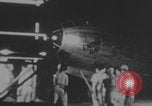
Enola Gay mission to drop “Little Boy” atomic bomb over Hiroshima, Japan (World War 2)
Enola Gay atomic bomb mission over Hiroshima, Japan during World War 2. The Enola Gay, a Boeing B-29 Superfortress bomber, prepares to leave for the Hiroshima mission. Army Armed Forces maintenance men and Enola Gay crew prepare the Enola Gay in Tinian, Northern Mariana Islands, checking their watches as the glance at the horizon. Maintenance men check bomb bay doors before closing. Pilot Colonel Paul Tibbets looks out of cockpit window of Enola Gay. Nose art of Enola Gay is seen. Close up of controls with hand show "starter" and "engine primer." Enola Gay engine starts and one of it propellers turns. The Enola Gay takes off from North Field, in the Northern Mariana Islands. Point of view through B-29 cockpit window as plane speeds down runway. Motion picture cameraman films the take off. The Enola Gay seen overhead as it leaves for Japan. Aerial View of Iwo Jima Island in Japan. The Enola Gay begins slow climb to bombing altitude over Iwo Jima. Crew member, possibly Tibbets, uses a pair of binoculars. Aerial view of Hiroshima. Enola Gay crew check instruments last time before dropping. The Enola Gay begins its bomb run. Crew bombardier turning a dial on a bomb site. View of Enola Gay with bomb bay doors open. Moving gauge pointer as bomb is dropped and seen exiting bomb bay. The Enola Gay banks away from Hiroshima at high speed. Aerial view in color of mushroom cloud forming over Hiroshima after the atomic bomb detonates in the city. (This actually shows the Nagasaki bomb blast from August 9, 1945, not the Hiroshima blast, despite the statements of the narrator in this edited film). Gigantic mushroom cloud from atomic bombing.

Scenes of various atomic bomb tests conducted by America during a course of time.
Scenes of various atomic bomb tests conducted by America during a course of time. Shows the atomic bomb test in Alamogordo, New Mexico(1945). Nuclear weapons tests for shot Able and shot Baker, tested at Bikini Atoll in the Marshall Islands as part of Operation Crossroads(1946). Close -up view of massive nuclear explosion at sea seen from shore with blast wave approaching unmanned ships near harbor and a palm tree on shore seen waving dramatically. Atomic bomb tests at the Enewetak Atoll (sometimes spelled Eniwetok or Eniewetok) In the Marshall Island as part of Operation Sandstone (1948). (World War II period).
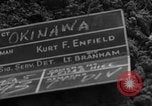
Major General Archibald V Arnold and Lieutenant General Simon B Buckner observe action from hilltop observation point.
United States 7th Infantry Division soldiers advance on Okinawa Island. Aircraft in flight over Okinawa. Major General Archibald V Arnold and Lieutenant General Simon B Buckner observe action from hilltop observation point. Smoke arises from explosions in field. (World War II period).
United States Army 187th Airborne Regimental Combat Team returns to Japan from Korea and is welcomed by City of Beppu, Oita
Clip opens with rapid changing scenes: American troops in trench in Korea during the Korean War. American tank on street in Germany. American Ski troops in Alaska. Amphibian assault training in Puerto Rico. Rotating Globe shows: U.S. Army on alert to defend against aggression. Sergeant Stuart introduces episdoe and states that U.S. Army has come to Japan to know their culture and make friends after war and occupation. U.S. Army troops of the 187th Airborne Regimental Combat Team, are seen arriving by railroad train at a train stateion near their base near Beppu,Oita on the island of Kyushu, Japan. U.S. Army soldiers, including white and African American soldiers, exit train cars. They receive a warm welcome from Japanese population. Banner reads:" Welcome Pala Troop comin back from Korea, City of Beppu."[sic] Women holding flowers and families with small children waving American and Japanese flags, welcome them on the train station. A sign over the train station platform reads: "Welcome 187 Para Troop Coming Back From Korea, City of Beppu." The troops stand in formation on the platform while the unit's officers receive the flowers from the women. Japanese men in fraternal uniforms and the general population all join in the welcoming ceremonies. The troops march off the train station under another sign reading: Welcome Home 187 RCT." and march down the main street of Beppu under a swirl of paper confetti. Next scenes are from autumn of 1945, as U.S. soldiers march through streets of Japan during occupation following the end of World War 2. U.S. troops seen marching behind Japanese police to occupy Japan, in 1945, amidst the aftermath of suffering and destruction of the war. The local population standing at road sides and watching with worry and concern. Scenes of postwar destruction in Japan. Rubble of bombed buildings. Scene of simple wooden dwelling shacks and wreckage nearby. A Japanese boy with his baby brother on his back. The baby is crying. Next scene moves again to circa 1950 in streets of a Japanese city, possibly Tokyo, rebuilt and with busy scenes of traffic on streets and commerce. Large outdoor rally with a Communist speaker addressing large crowd of Japanese people who sit and listen. Scenes from a what the narrator describes as a Communist rally in Japan, against America, which turns violent. Protestors running in streets during demonstration, with signboards and police and fire fighters extinguish flames at scene of an overturned, burning car. Flashback again to 1945 or 1946 as U.S. Army soldiers use tractors and heavy equipment to clear and level an area of war rubble and debris during rebuilding efforts after World War 2. Japanese citizens look on, watching the machines at work.
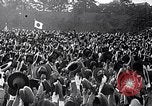
U.S. war effort is concentrated against Japan after the fall of Nazi Germany in World War II
Overlaid on scenes of fervently patriotic Japanese people waving flags and cheering, is slate reading: "Japan is firmly determined to fight a hundred years war to crush the United States." A huge explosion. Glimpse of U.S. Marine Flame Thrower Tank M67 directing flame on a Japanese bunker. U.S. marines charging in an amphibious assault on a Japanese held Pacific Island during World War 2. U.S. troops wading through surf from their landing craft, during amphibious assault. Marines fighting Japanese in Pacific Island jungle. Landing craft at beach in background. American flag being raised on a palm tree. Soldier saluting the American flag. General Douglas MacArthur wading ashore in the Philippines followed by staff officers and soldiers, including Filipinos. U.S. aircraft bombing Japanese held Corregidor in the Philippines. U.S. Navy ships bombarding the Philippine coast. American paratroopers of the 503rd Parachute Infantry Regiment, jumping at low altitude, from C-47 aircraft onto a critical hill known as "Topside" on Corregidor. Views from ground of paratroopers descending. and landing at the hilltop. U.S. troops in an amphibious assault, under fire. The American flag being formally raised as General MacArthur and other officers salute the flag. Marines in amphibious assault on Iwo Jima. A U.S. battleship firing at the coast. Explosions along the coast from Naval bombardment. Marines charging across the black sands of Iwo Jima. Marines firing a 75mm Pack Howitzer M1. Shells exploding at the base of Mount Suribachi. The famous flag raising by Marines on Iwo Jima. American forces attacking the Japanese Island of Okinawa. A Landing Ship Medium (R) firing rockets at Okinawa. Numerous explosions ashore. The USS LSM(R)-198 firing rockets. U.S. troops using a flame thrower to attack Japanese troops in a bunker. A Japanese defender is shot and tumbles down a hill from a fortification. American flag raising on Okinawa. Army officers salute the colors. A U.S. Navy destroyer firing its stern 8-inch guns. A Japanese warship struck by a bomb or shell, with flash of fire and explosion. More views of U.S. Navy warships bombarding Okinawa. A torpedo seen below the water as it is launched A Japanese ship exploding with fireball and huge cloud of smoke. Glimpse of helmsmen inside U.S. submarine. A formation of Douglas SBD Dauntless Dive Bomber aircraft peels off, and dives. A Japanese ship being strafed and bombed. It explodes. U.S. Army Air Forces B-29 bomber aircraft taking off from captured islands to attack Japan. A formation of B-29s in flight. B-29s flying over Japan. Mount Fuji is visible. B-29 raining bombs on Japan. View from aircraft as bombs strike, exploding on ground. Closeup of falling bomb. Huge clouds of smoke rising from struck targets. More views of B-29 aircraft in flight. Some leaving contrails at high altitude. View from bridge of U.S. battleship bow plunging into heavy seas that cover deck. (Ship's forward triple gun turrets are visible.) Aerial view of landing craft speeding toward a beach, leaving white wake in water. Glimpse of U.S. battleship, in camouflage paint, bombarding a shore. Closeup of twin 40mm Bofors anti aircraft guns being fired from U.S. Navy ship. A Japanese Kamikaze airplane on fire, falling through flak clouds. A Japanese Mitsubishi G4M bomber aircraft flying low past a U.S. Aircraft Carrier. U.S. Navy sailors on a ship's deck firing a twin 40mm bofors gun. A Japanese Kamikaze airplane hit and in flames as it falls. A squadron of U.S. aircraft in formation. Gun camera film of Japanese airplane bursting into flames while being shot at by U.S. aircraft. Flaming aircraft falling straight down towards the water and splashing on contact. U.S. troops wade through surf as they leave Landing Ship Infantry Large USS LCI(L)-337. Troops rush past a beached Landing Vehicle Tracked (LVT) on sand beach. Troops in tracked landing vehicles approaching the shore from a cove. White smoke in the area. A banner erected at shore reading: "CIC." Explosions nearby. Soldiers using a flame thrower. Scene shifts to U.S. Secretary of War, Henry Lewis Stimson, speaking from his office in Washington, DC. He speaks of destroying Japan's armed forces and war fighting capability. A soldier shouting with a beached LVT behind him. American soldiers firing small arms from sheltered positions. An artillery soldier closing the breech of a heavy gun after loading it. Montage of scenes similar to all seen already. A liberty bell and "V" for victory is shown.
CRITICALPAST.COM: About Us | Contact Us | FAQs - How to Order | License Agreement | My Account | My Lightboxes | Shopping Cart | Advanced Search | Featured Collections | Website Terms & Conditions | Privacy Policy ©2026 CriticalPast LLC.
License Agreement |
Terms & Conditions |
Privacy Policy
©2026 CriticalPast LLC.