


 Francais
 Deutsch
 Italiano

Refine Your Search
Naha Okinawa Ryukyu Islands 1945 stock footage and images
- Showing 3277 to 3282 of 9416 results more
 Hide
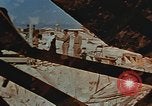
U.S. Navy and Marine personnel recover after the battle of Midway in World War II
Recovery actions by U.S. Navy and Marine personnel in the wake of the Battle of Midway in World War 2. Opening scene shows religiious services being held by a bomb crater that had once been a chapel on Midway Island. That evening, marines are assembled near flag-covered coffins of fallen comrades, in a burial ceremony. A marine chaplain conducts a funeral service, as Marines stand, with their rifles, at parade rest Several views from different perspectives of the event. An honor guard fires a volley with rifles. The American flag is at half staff, in the background. Among the officers seen is Marine Major James Roosevelt, son of the U.S. President, Franklin Roosevelt. Next, Navy boats are seen offshore, carrying the fallen for burial at sea. U.S. Navy aircraft fly in formation overhead. A marine scans the sky with binoculars as dense black smoke continues to billow from the petroleum facility bombed by the Japanese several days ago, and hangs like a pall over Midway Island. The American flag on a tall pole, is highlighted against the black smoke. Film ends with series of Slates summarizing Japanese losses in the Battle of Midway. The first shows 4 Japanese Carriers sunk. It is painted over by a brush containing red paint. Another slate announces 28 Japanese Battleships, Cruisers, Destroyers sunk or damaged. A paint brush places a large black cross over that slate. A final slate states 300 Japanese aircraft destroyed. The red paint brush appears again, but this time it marks a big “V” for Victory across the slate.

Douglas World Cruisers take off from the U.S. for their first flight from America to Asia.
U.S. Army Air Service Douglas World Cruisers (DWC) in the United States during the first flight around the world. In Aleutian Islands, Alaska: Flier Douglas World Cruiser on a lake before the hop across the Pacific to Japan. A snow-covered mountain in the background. Two cruisers. One of the cruisers warms up. One of the cruisers as it is being raised onto a Coast Guard ship. Raised aircraft engine shows engine change in Lieutenant Leigh Wade's (Pilot of the World Cruiser) airplane for a hop to Attu Island in Japan. Lt. Lowell H. Smith standing on the nose of the aircraft holding the propeller blade. A stationary cruiser on a shore. Another cruiser seen. Both are equipped with pontoons. Three of the world cruisers in flight while they are in their first flight from America to Asia. Animated map shows the dangerous route across the Pacific. The Pacific crossed by airplane. Animated map of the coastline of North America and Asia with 'Second Division Chicagoff to Kagoshima, Japan' written on the map.
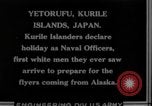
Japanese natives perform for the Americans and welcome them on the first stop of Douglas World Cruisers in Japan.
U.S. Army Air Service Douglas World Cruisers (DWC) in Japan during their first flight around the world. At Etorofu, Jurile Islands, Japan: Natives congregate and carry flags. Natives of the island observing the Americans. Children do a dance. The natives perform for the Americans. World cruisers flying over snow-covered mountains, their first stop in Japan. One of the cruisers on a lake. A cruiser with personnel in the foreground. Natives enjoy a feast in honor of the Yankee pioneers. Crew of the Japanese destroyer "Isokaze" entertains with the ancient sport of sumo. One of the cruisers afloat in water. Mechanics working on aircraft. A large crowd of Japanese children waving flags. Several views of Japanese welcoming the Americans.

F2H-2 Banshee in readiness and ordnance men secure 5" rockets under wings of Banshees aboard USS FDR in the Atlantic Ocean.
Midway-class aircraft carrier USS Franklin D. Roosevelt in the Atlantic Ocean during Operation Long Step. A pilot steps into a U.S. Navy F2H-2P Banshee and his airplane captain assists him with harness and strap. The pilot sits in readiness prior to launch while his airplane captain cleans the windshield. Jets on the flight deck being readied for launch. An airplane guard destroyer in the background. Silhouette: Essex-class aircraft carrie USS Leyte, heavy cruiser USS Columbus and escorting destroyers in formation. A U.S. Navy AJ-1 (Savage) aircraft lands aboard USS FDR. The Savage aircraft spotted forward. A rocket cart loaded with 5" rockets being wheeled aft. Ordnance men secure 5" rockets under wings of Banshees. A large water spout beyond a destroyer escort during the operations. Island structure of USS FDR. F2H-2 Banshee aircraft from USS Roosevelt flying in formation past the ship. A F2H-2 landing aboard, passes the island forward to the elevator.

View of skyscrapers from the Queensboro Bridge,59th Street Bridge over the East River in New York.
The skyline of New York. View of Queensboro Bridge, the 59th Street Bridge, a cantilever bridge over the East River in New York City. The skyscrapers seen in the background. View of the skyscrapers from Governors Island. Staten Island Ferry underway at sea in the foreground.
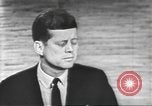
Kennedy and Nixon talk on drawing the defense line in the Far East during a presidential election debate in Washington DC.
The second Kennedy-Nixon Presidential Debate in Washington DC, United States. Edward P. Morgan of ABC asks Democratic candidate Senator John F. Kennedy to comment on whether Quemoy (Kinmen) and Matsu Islands were unwise places to draw U.S. defense line in the Far East. Kennedy states that he believes strongly in the defense of Formosa (Republic of China or Taiwan) and says that the U.S. will defend Quemoy (Kinmen) and Matsu if it is a part of a general attack on Formosa (Taiwan). He says that the U.S. should consult with the Nationalists. He states that the Americans should protect their commitments. Republican candidate U.S. Vice President Richard M Nixon states that he disagrees completely with Senator Kennedy on this point and states the example of the Korean War. Regarding Quemoy (Kinmen) and Matsu he says that these two islands are in the area of freedom and under the control of the Nationalists. He states that the U.S. should not force the Nationalist allies to get off of them and give them to the Communists because the Communists aren't after Quemoy (Kinmen) and Matsu, but after Formosa (Taiwan).
CRITICALPAST.COM: About Us | Contact Us | FAQs - How to Order | License Agreement | My Account | My Lightboxes | Shopping Cart | Advanced Search | Featured Collections | Website Terms & Conditions | Privacy Policy ©2026 CriticalPast LLC.
License Agreement |
Terms & Conditions |
Privacy Policy
©2026 CriticalPast LLC.