


 Francais
 Deutsch
 Italiano
Refine Your Search
Naples Italy 1943 stock footage and images
- Showing 1915 to 1920 of 4562 results more
more Hide
Hide
Training film for U.S. troops with the Army of occupation in Germany after world War II
Opens with bell tolling Victory against Germany in World War II. Next, a slate reads: "Victory Leads to Peace," and a farmer is seen with cattle pulling a plow. But narrator says "the problem now is future peace," and a map of Germany is shown overlaid with "Your Job in Germany." A cartoon of a soldier is superimposed on the map, along with one of a World War 1 American soldier and a figure of possible future soldier with similar mission. Camera focuses on parts of German aircraft in a jumbled heap. Closeups of weary defeated German soldiers at end ot World War II. Glimpse of Adolf Hitler speaking and haranguing an audience from a podium in an animated and forceful way. Swastika flags displayed from houses in a quaint German town. Joseph Goebbels, Nazi Reich Minister of Propaganda, at a microphone. Glimpse of a German concentration camp. But as they appear, each of the Nazi elements promptly disappears, showing the scenes without such Nazi symbols and persons. Skeleton remains of bombed buildings. Flower displays. Bucolic German rural countryside and quaint old villages in peaceful settings. Camera focuses on a book titled "German History." Chapter I, titled "Blood and Iron," shows Image of Otto von Bismarck. German troops march in a parade. Narrator states that "under Bismarck, the German empire was built." (He formed the German Empire in 1871, unifying Germany with himself as Imperial Chancellor, while retaining control of Prussia at the same time.) The film shows mounted German lancers as it alludes to Bismarck's campaigns against Denmark in 1867; Austria in 1866; and France, in 1870. Germany's leaders celebrating its status, in 1871, as the mightiest power in Europe. Troops marching and girls dancing nearby. Farmers plowing field with a horse and cow. Classic peaceful rural alpine scenes with local people in agricultural pursuits. A group of local German musicians playing folk music as village people dance outdoors. Back to the book, Kaiser Wilhelm II is shown on Chapter 2, entitled: "Deutschland über Alles." Gathering of German soldiers in Pickelhaube (spiked helmets). A German Big Bertha howitzer firing. German troops marching against Serbia; Russia; and France (with view of war damaged French cathedral). German invasion of Belgium in 1940 (with view of clock tower resting in rubble). German troops seen in Italy, walking past battle-damaged buildings. German Zeppelin dropping bombs on British targets and view of bombed out London neighborhood. Next scene shows a capsized ship with survivors running across its hull. Film slate labels the scene as United States, as if it is a U.S. ship attacked by Germany. (Actually, it is the Austro-Hungarian Battleship, SMS Szent Istvan, torpedoed, by Italian torpedo boats, during World War I.) Next, American soldiers in trench are seen going "over the top" and into "no man's land" on the western front of World War 1. Glimpse through a window of Kaiser Wilhelm II, after defeat of Germany, in 1918. View of Germans in a Beer Garden. Picturesque view of German town. A German orchestra performing. American soldiers marching out of Germany, with flags waving. Back to the history book,as chapter III is revealed, entitled "Today Germany, tomorrow, the world," and featuring Adolf Hitler. German troops invading Austria (where a civilian lies dead on the ground). German troops entering Czechoslovakia (where local people in tears render the Nazi salute). They march into Poland (where a girl weeps over someone, not seen, on the ground). They march into France (where a wounded, bandaged child cries in a bed). Next, is a scene from England, where a British child victim of bombing lies dead in the remains of a shelter. German troops invading Norway, Holland, Denmark, Belgium, Luxembourg and Russia (where a woman tries to rouse a dead woman). They invade Yugoslavia (where women sit near coffins of children) and Greece (where a woman rescues a naked child). A U.S. merchant ship explodes after being torpedoed by a German submarine (unseen). Scenes of destruction with people plucking dead victims from rubble of buildings. American troops invading Normandy, France on D-day, June 6, 1944. Several American soldiers fall to German gunfire on the beach. Wounded American soldiers being transported in jeeps on the battlefield and being placed on landing craft for evacuation. Americans walking past huge piles of destroyed aircraft parts. A landing craft filled with wounded American soldiers. American wounded and dead on a battlefield. Sailors abandoning a burning American ship by jumping into the sea. A sailor picked up in a life boat. A wounded American soldier being dragged from the beachhead at Normandy. Various wounds being treated by U.S. Medical Corps personnel. More scenes of American wounded being moved on stretchers. Scene shifts abruptly to German people folk dancing. Film concludes with question marks about the future.

German and Italian trucks, tanks, motorcycles and armored cars advance into Libyan territory, North Africa during World War 2
German trucks, German Panzer Pz.III tanks, motorcycles and armored cars advance into Libyan territory, North Africa during World War II. Scenes near Bengazi Libya. German pilots and Italian pilots in conversation near Axis aircraft on an airfield. Italian soldiers carrying rifles ride on motorcycles. Natives on camels watch them. Convoy of Axis military vehicles and many trucks on roads. A post of Soldiers of Army of Italy in desert. Italian air force pilots in collaboration with German forces discuss prior to take off for a mission. Italian biplane aircraft taking off. Barb wired border lines in desert guarded by Italian soldier. Italian troops on the move on motorcyles. Nazi planes bomb British positions in desert. Gun camera footage of German Luftwaffe Messerschmitt Bf 110 (Me 110) aircraft attacking and firing on British targets on the ground in the desert.
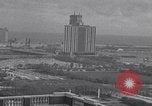
Scenes of West Side neighborhoods in Chicago, Illinois.
Elevated views of large buildings of Chicago and ground nearby. Buses and 1960s cars on busy roads, streets, and highways in West Chicago area. A streetcar or trolley goes by on the road. Its connecting electric rod can be seen above it. Pedestrians walk on roads and sidewalks in the Little Italy neighborhood of Chicago. Shops in the area. Three women walk on sidewalk in front of a pizzeria. Old men on streets. A residential housing area, and the Notre Dame de Chicago Roman Catholic Church (1335 W Harrison St, Chicago, IL 60607, United States) nearby. High rise apartment buildings and housing projects. City of Chicago workers, of the Department of Urban Renewal, work to clean debris from an area and load it on a truck. A huge building under construction.
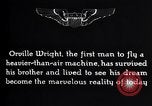
Various biplanes in formation and various medals to Wright brothers.
History and development of early airplanes. Orville Wright at a ceremony of first flight of his plane. Separate scene showing Wilbur Wright in France, before his death, talking to two French men. A large airfield and number of bi-planes parked in rows, in Italy. A number of planes in formation. Take off of a Luthhansa Junkers G.38 4 engine passenger aircraft (the largest aircraft in the world at that time) circa 1930. Spattend tandem main wheels visible on the giant airplane. Soviet planes fly above a Russian building. Biplanes in formation doing loop the loop. Russian four engine bombers pass over a building. Medals awarded to Wilbur and Orville Wright by various governments and aero clubs of different countries.
Soviet Union backs out of 4-power administration of Berlin and blockades the City. U.S. Army Air Forces supply the city by airlift.
Teacher and school children playing amid rubble in Berlin, in the aftermath of World War II. Children receiving food outdoors. Children in a school classroom being given cups of soup by their teacher. In March, 1948, a Soviet soldier is seen lowering their flag from one of four flag poles displaying it, along with flags of the British, American, and French flags. (They no longer wished to share occupation of Berlin with the other Allied powers.) View of Western representatives preparing to issue a new stable currency. Next, the Soviets block all access to West Berlin (the "Berlin Blockade.") Open rail cars filled with coal are brought to a halt in their tracks. Trucks servicing West Berlin are stopped from moving over a highway. West Berlin citizens stand at a fence watching a U.S. Army Air Forces C-47 transport plane flying supplies to them. View from below of a C-54 transport plane descending to land, with supplies, at Templehof airfield in West Berlin. A C-54 taking off to make another supply run. A pallet of coal being offloaded from a C-54. A tram running on restricted schedule. A Berliner planting food in a deserted lot near a demolished building. People assembled in front of the severely damaged Bundestag and in other places surrounded by war torn buildings. Berlin Mayor Ernst Reuter, speaks of seeking assistance from America, England, France, and Italy, to help his city. Closeups of some of the Berliners applauding him. An airlift airplane labeled "Operation Santa Claus" with a soldier dressed like Santa, dispensing wrapped gifts or candy to German children near the plane's doorway. German children can be seen and heard singing "deck the Halls" in English. A soldier dressed as St. Nicholas stands next to one dressed as a Native American Indian. Children sing Martin Luther's hymn, "Ein feste Burg ist unser Gott" ("A Mighty Fortress Is Our God"). A British Sunderland flying boat, takes off on the Havel River, in Berlin, after delivering supplies to the city. Grateful Berliners surrounding American pilots. Children run in a street carrying a large model of an airplane to simulate the Berlin airlift. Children playing "airlift" on a sidewalk. An airlift plane crashed and burning in a residential section of Berlin. German fire fighters battle the flames with hoses. A C-54 airlift plane descending to land with its gear extended. Scene at midnight, May 2, 1949, as the barriers isolating Berlin are raised, as the Soviets promised free and improved access to Berlin. People waving flowers as trucks once again move into the city. But Communists are seen violently storming the Greater Berlin City Hall in the Eastern Sector of the city. Non-Communist deputies in the Eastern Sector are forced to meet in West Berlin, where they meet without being molested. View of the Berlin Logo (Bear). Free election vote being deposited in a ballot box. Animated map shows how Berlin was cut in two, separating East Berlin from West Berlin.

The United States Army presence in Europe and America during the Cold War era.
Opening scene shows Headquarters, United States Army, Europe (USAREUR) at Campbell Barracks, Heidelberg, Germany. A line of U.S. 7th Army M48 Patton tanks contributing to NATO defenses. One backs out of position. A line of M113 Armored personnel carriers proceeding along a dirt field. A tank destroyer followed by M113 APC. M113s of a U.S. Armored Brigade drive in Berlin, affirming allied rights in the city. Bridge in Italy displays logo of U.S. Army Southern European Task Force (SETAF). A Sergeant Missile Battalion of SETAF provides nuclear capable support to NATO. One of its Sergeant missiles is seen maneuvering on its mobile launch platform. Two Italian soldiers are seen being trained in missile operations. A motorized tractor pulls several wheeled containers of military supplies stockpiled at one of NATO's European storage facilities. More supplies are seen being moved outside a warehouse. Army personnel using keyboards and computer tape drives to keep track of war materiel. Yards full of military hardware, including lines of jeeps, provide backup for military operations. A sign at the Headquarters United States Southern Command in Quarry Heights, Panama. A ship is seen moving through the Miraflores locks of the Panama Canal. U.S. and allied soldiers are seen working with ropes to traverse a river, during Jungle Warfare training. Soldiers seen moving through jungle underbrush during training at the Southern Command School of the Americas. Scene shifts to U.S. Army, Alaska at Fort Richardson, near Anchorage. A U.S. M113 APC is seen driving and firing its weapon on a snowy field. Its stops and soldiers in white arctic gear step from a rear hatch to take up positions. A Piasecki H-21 Army helicopter is seen flying low above the terrain. It is equipped with landing gear skis. Rear view of tank moving in snow.