


 Francais
 Deutsch
 Italiano
Refine Your Search
Naples Italy 1943 stock footage and images
- Showing 2029 to 2034 of 4562 results more
more Hide
Hide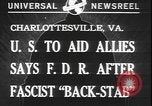
President Roosevelt addresses graduates of University of Virginia and talks about U.S. decision to aid the Allies.
U.S. President Franklin Delano Roosevelt addresses graduates of the class of 1940 at the University of Virginia, before the U.S. entrance into World War II. Speaking in Memorial Gymnasium, the President speaks into a microphone and addresses the University community and graduates, including his son Franklin Roosevelt Jr., who was graduating with a law degree. He speaks about the United States' decision to aid the Allies by extending to them the material resources of the United States in the war. He says that the U.S. took the decision after Italian Government's back-stab decision to engage in the war, after having earlier worked for the preservation of peace in the Mediterranean area. (Roosevelt had learned that morning of Italy's declaration of war on France.)
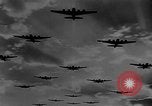
Lt. Gen. Carl Spaatz and Maj. Gen. F. L. Anderson plan 'Operation Frantic' at a USAAF headquarters in the European Theater.
A film on U.S. shuttle bombing operations over Germany from bases in Great Britain, Italy and Russia during World War II. Animated diagram shows the advantages of using Soviet airfields during the operation. United States Army Air Force Lieutenant General Carl Andrew Spaatz seated at a desk in his office. Deputy Commanding General for Operations Major General F. L. Anderson discusses the plans with other officers in his office. They plan 'Operation Frantic' at a USAAF headquarters. Ships at a British port are loaded with supplies including food, gasoline, bombs, ammunitions, trucks, jeeps and other equipment. A man watching through binoculars from the deck of a ship. A convoy passes through the Arctic Ocean. Supplies are unloaded in Russia. These are transported by train to a headquarters in Russia.
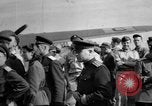
Russian and American pilots and crew talk and shake hands at an airfield in Russia during Operation Titanic.
A film on U.S. shuttle bombing operations 'Operation Titanic' over Germany from bases in Great Britain, Italy and Russia during World War II. U.S. bombers land on an airfield in Russia. Crew disembarks from the airplanes. They shake hands and talk to Russian pilots. Officers interrogate the fliers about the mission. Russian and U.S. crewmen service the airplanes. The crew eat in an outdoor kitchen. They sleep in tents.
American bomber crewmen play games and visit town near Soviet base in Poltava during Operation Frantic.
A film on U.S. shuttle-bombing operations in "Operation Frantic" over Germany, operating from bases in Great Britain, Italy and the Soviet Union during World War II. Aircraft parked at an air base in Poltava, Ukraine, Soviet Union. Nose art and painted insignias on the U.S. Army Air Force aircraft. American crewmen standing near the bomber aircraft. They sleep in tents. They wake up and get ready. A group of Soviet civilian workers walks by with farming tools. A man shaves. Others wash their faces. American Colonel Albert Kepler and Russian officers confer for their next bombing mission. They select target areas for the bombardment. Gasoline, bombs, ammunition and other supplies are provided to the crew. American and Russian crewmen of a bomber aircraft play baseball and cards and interact. Some American soldiers write letters home. Others milk a cow with a Soviet soldier. Crewmen drive in a jeep to visit the nearby town where German bombing campaigns have destroyed many buildings in Poltava. They view a destroyed leather industry factory, and the grave of Ukrainian writer Vladimir Korelenko. They see only rubble remaining of the birth home of Korolenko. Damaged buildings and rubble in the area. People walking on a street. The American soldiers interact with the Ukrainian civilians of the town. Women and children of the town are seen. Closeup view of the hand of a a U.S. Army soldier as he hands out chewing gum candy to eager Ukrainian children. On the way back to the base the soldiers view the Column of Glory in Poltava, honoring the 1709 Battle of Poltava.
African American soldiers engaged on all fronts in World War 2
Film opens with map of the world showing the various theaters of operation in World War II. Narrator refers to Allies liberating town after town, as they advance. View of American troops being welcomed in a European town during an advance (probably Italy in 1944). Next, African American troops are seen boarding troop transport ships. A huge convoy of ships is seen from the air. Huge piles of war materiel on a dock. Ammunition being delivered by landing craft from the transport ship USS Hunter Liggett (APA-14) to American troops at a beachhead in the Pacific. An African American sailors directs the lowering of a piece of artillery from a ship into a landing craft. Construction equipment being used to clear the way for a new landing field. Docks, roads, and bridges being built as the Allies advance. American troops in the swamps of the South Pacific. American Army engineers clearing trees to build the Alaska Highway (ALCAN Highway) in 1942. Corps of Engineers building the Ledo Road (from India to China) during the war. African American soldiers building a bridge across a river in Europe. A U.S. Army truck under fire, driving along a dirt road in Europe as shells burst all around it. U.S. troops firing various kinds of field artillery and tank guns. U.S. infantryman using a flame thrower. Closeup of African American soldier using a bayonet and others firing small arms. A tank being blown up by artillery fire. A Japanese Mitsubishi A6M3 Zero aircraft maneuvers overhead in the Pacific theater. An African American soldier runs to man his Browning .50-caliber, water-cooled antiaircraft machine gun, and begins firing as the Zero fighter plane strafes his position. Closeup of Japanese pilot in his cockpit and his machine guns firing from leading edges of his plane. His rounds strike all around the U.S. gunner, who turns and follows him with more fire. His tracers show behind the plane. Closeup of the African American gunner as he continues firing. View of the Japanese airplane rolling over and diving. Next the Japanese plane, aflame, crashes on a tropical island and explodes. (Note: It is apparent that some of these combat scenes have been made up of clips from other sources, edited into this film.) (World War II; WW II; World War 2; World War Two)
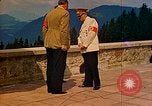
Adolf Hitler talks to officials on the terrace of Berghof in Berchtesgaden, Germany.
German Chancellor Adolf Hitler at Berghof in Berchtesgaden, Germany during World War II. Hitler on Berghof terrace with SA-Obergruppenfuhrer (3 Star General) Wilhelm Brückner. Leibstandarte SS Adolf Hitler (LSSAH) honor guard. Hitler does a little dance. LSSAH honor guard at the steps of Berghof. German photographer Heinrich Hoffmann, Foreign Minister of Italy Graf (Count) Galeazzo Ciano and others arrive at the Berghof .
CRITICALPAST.COM: About Us | Contact Us | FAQs - How to Order | License Agreement | My Account | My Lightboxes | Shopping Cart | Advanced Search | Featured Collections | Website Terms & Conditions | Privacy Policy ©2026 CriticalPast LLC.
License Agreement |
Terms & Conditions |
Privacy Policy
©2026 CriticalPast LLC.