


 Francais
 Deutsch
 Italiano
Refine Your Search
Naples Italy 1943 stock footage and images
- Showing 2023 to 2028 of 4562 results more
more Hide
Hide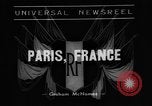
Students protest in a rally and shout their demands at the Latin Quarter in Paris, France.
A students' protest rally against Italy in Paris, France. Students protest in a rally at the Latin Quarter. They hold banners. A banner reads "Venice Aux Francais". They shout their demands. They protest against Italian demands for French territory.
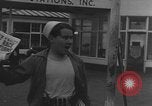
Republcan Thomas E. Dewey and incumbent Democrat Franklin D. Roosevelt, compete in 1944 U.S. Presidential election during World War II
The 1944 U.S. Presidential election in 1944, during World War 2. Newspaper boy hawks newspaper extra edition, with headline referring to "Nip and Tuck" race. View of Times Square in Manhattan, New York City, at twilight, as lights begin to turn on. Wooden barricades seen set up in front of some establishments to protect against damage from large crowds anticipated as election returns come in. Moving illuminated marquee sign on the Times building reads: "Nearly 45 per cent of Bronx and Manhattan voters said to have cast ballots." Two men look up at the sign. Officials open a voting machine and begin to report information. At another location officials remove paper ballots from their precinct box. A radio announcer reviewing results and reporting them over the air. A woman is seen entering voter returns in chalk, on a national tote board. Citizens gathered to watch results. American soldier listening to results over a radio, in Italy and France. Newscasters reporting on radio as the returns come in. Many people listen to radios. An American family of man, woman, boy and girl children seated in their living room listening to vintage console radio reporting voting returns. A fire is burning in the living room fireplace beside the console radio. Another, different scene is shown with a family gathered around a radio listening to election reports. A framed photograph of a U.S. Army soldier is atop the console radio. Scene is shown of crowds surging in Times Square as returns displayed on Times Building marquee indicate likely victory for FDR (Franklin Roosevelt). Crowd in Times Square including many American military service members in uniform.
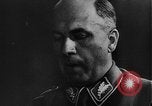
Nazi leaders speak. Faces of Allied soldiers. Nazi massacres. Victims mourned. German troops surrender. American life.
Nazi leaders in Germany giving speeches during World War 2. Soldiers from various countries like England, Poland, Greece, America and Norway. View of young boy soldiers in Germany at end of World War 2. Earlier scene of Nazi Waffen SS soldiers as they march with goosestep on parade. Victims executed in Nazi massacre in Italy shown with hands tied behind their backs. Nazi victims mourned in France. Bodies of women and children slain by the Nazi SS in Belgium. A large crowd of civilians gathered to pay homage to the dead in Lublin, Poland. Allied military vehicles and personnel trample and walk on Nazi flags and posters in Germany. A pile of Nazi flags burning in the street, as men, women and children walk past. German prisoners of war assembled in a large outdoor enclosure, and moving out in a line. German soldiers surrendering, with white flags displayed. American soldiers look at open mass graves of persons shot dead by Nazis. Emaciated boy children inmates of Buchenwald concentration camp stand behind barbed wire fence around the time of its liberation. The prior scenes are contrasted with ordinary life in the United States. A boy retrieves a ball from a pond, and throws it. Children play on see saws at a playground. A baby take first few faltering steps. A girl hangs from monkey bar. A man and two women share a newspaper article.

Paul Takeshi Fuji wins the World's Junior Welterweight boxing title against Sandro Lopopolo in Japan.
World's Junior Welterweight boxing title in Japan. U.S. Marine Paul Takeshi Fuji and Sandro Lopopolo of Italy in ring. Spectators cheer the boxers. Paul Takeshi Fuji wins the World's Junior Welterweight boxing title against Sandro Lopopolo.
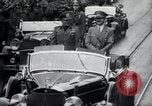
Adolf Hitler, Benito Mussolini, Neville Chamberlain, and Edouard Daladier, sign the Munich Agreement
Signing of the so-called Munich Agreement between Germany, Italy, Britain, and France, in 1938. German Chancellor Adolf Hitler and Italian Dictator Benito Mussolini ride together in an open car enroute to the Führerbau of the Nazi Party, near the Konigsplatz, in Munich, Germany. Each of the Conference principals enters the Führerbau (Arcisstraße 12, 80333 München, Germany). Adolf Hitler, Benito Mussolini, Hermann Goering, Neville Chamberlain, and Edouard Daladier are seen moving about and conversing. They begin signing the accords. Hitler and Mussolini converse together. After the signings, Hitler shakes hands with the French Foreign Minister, Daladier, and the four principals, Hitler, Chamberlain, Mussolini, and Daladier, stand together.
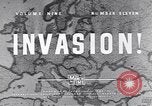
News media military analysts discuss the problems of Allies invading Europe to defeat Germany in World War II
Map of Europe and label "Invasion." Westbrook Van Voorhis leading a panel discussion about the problems arising from the Allied invasion of Europe in World War 2. He introduces panelists: Hanson Baldwin (military editor of the New York Times) Dewitt MacKenzie (Associated Press military analyst), and Paul Schubert (of Mutual Radio Network). He asks Mr. Baldwin about the importance of aerial bombing campaigns. Baldwin also stresses importance of a land invasion of Europe. Relief map of Europe highlighting major German cities. Asked about the merit of invading Italy on the way to Germany, Mr. Schubert cites the problem of the Alps and suggests other more effective invasion routes. Van Voorhis asks Mr. MacKenzie about best route into fortress Germany. He considers the criterion of ease of supply as most important, and suggests the Atlantic coast, near a good port and not far from England. Animated map shows this idea. When asked about this, Mr. Baldwin agrees completely, calling the conflict "a quartermaster's war." He adds, "The problem of victory is the problem of supply."
CRITICALPAST.COM: About Us | Contact Us | FAQs - How to Order | License Agreement | My Account | My Lightboxes | Shopping Cart | Advanced Search | Featured Collections | Website Terms & Conditions | Privacy Policy ©2026 CriticalPast LLC.
License Agreement |
Terms & Conditions |
Privacy Policy
©2026 CriticalPast LLC.