


 Francais
 Deutsch
 Italiano
Refine Your Search
Naples Italy 1943 stock footage and images
- Showing 379 to 384 of 4566 results more
more Hide
Hide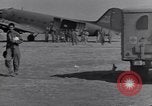
U.S. C-47 aircraft perform air evacuation missions during Operation Torch in Oran Algeria, during World War II
Opening scene shows American soldiers gathered around a C-47 transport plane on a desert field in Oran, Algeria during World War 2. They walk away en masse from the plane. Another C-47 is seen with tail number tail number 42-23507 (Records show this aircraft was delivered to Oran on May 20, 1943 and supported Operation Torch- The Italian Campaign of World War 2.) Scene shifts to interior of a C-47 rigged as an air evacuation aircraft, with wounded American soldiers in stacked bunks on both sides of the aircraft. A nurse and corpsmen are attending to the wounded. Two soldiers carry one of the wounded soldiers on a litter to the aircraft door. View from the outside of the soldier being carried by others to a waiting field ambulance. More views of the wounded being transferred from the plane to waiting ambulances. Scene shifts to ambulances parked on the desert field with a large Red Cross flag above them. A Curtiss P-40 fighter plane taxis past the camera. A large open field tent with a large Red Cross flag flying above it. Nurses and medical corpsmen tend to wounded soldiers lying in ambulances. A nurse serves water to some wounded.
Highlights of the War on various European Fronts captured by U.S. Coast Guard combat cameramen.
'Highlights of the War' depicts work by combat cameramen that has been honored with citations for outstanding photography. 'The Coast Guard at War' depicts the work of combat cameramen on the U.S. Coast Guard. U.S. Coast Guard Arctic Patrol. CG personnel aboard a cutter. Deck gun and the U.S. flag. A sailor communicates over the radio. Sailors on deck, the bow and deck. Combat cameramen record the CG activities including a religious ceremony. Sicily Invasion, 1943: Combat cameramen capture the scene as a German bomb hits an ammunition ship off the coast. Explosion on the ship, a mushroom cloud rises up. Sailors watch with binoculars. Normandy, 1944: Allied troops climb down rope ladders into Landing Craft Personnel (LCP). which deliver the men and cargo to the Normandy beaches. Soldiers wade through the water towards the shore under enemy fire.

World War 2 film promoting public investment in War Bonds and stamps to aid the war effort and temper inflation
World War 2 era film that also includes some World War 1 scenes. Show girls or chorus girls in follies-like show, costumed as U.S. silver dollars and marching to tune and lyrics alluding to dramatic increase of currency in circulation, over the years. Animation with stacks of coins shows increase in national income from $46 billion,in 1933, to $71 billion, in 1939, and $142 billion in 1943. Back to the "follies dollars," a boy asks why, and then scenes of the Japanese attack on Pearl Harbor,are shown, with U.S. battleships being sunk. Wartime arms plants are shown. An M2A3 Light Tank rolls off a production line. Ships being constructed in a shipyard. B-24 Liberator bombers being built in a factory. Artillery shells being produced. Defense workers receiving their pay. The "follies dollars" group themselves to illustrate the fractions of income devoted to taxes and savings. But other spending is curtailed by wartime shortages. A woman talking with clerk in a drug store. U.S. Army troops crossing a pontoon bridge in open trucks, towing 75mm M1A1 howitzers. Infantry on the march. Animation showing industrial production devoted to war materiel and lots of dollars chasing few civilian goods. A grocery clerk offers to sell a woman customer butter for more than the established price, and she agrees. The "follies" performers then introduce the idea of an "inflationary dollar," and some history of past U.S. inflations. Animated examples of price inflation are shown. Glimpses of World War I scenes are seen, circa 1917 -1918, including: a 12-inch railway gun firing; a huge explosion from shell bursting near the camera; various scenes of United States infantry soldiers and French soldiers in battle action, running to bomb craters for cover and emerging from trenches to go up "over the top" into no-mans land during combat. Meanwhile, singing narration refers to the home front inflation due to competition for limited civilian goods. Map shows Europe and singing narration cites rising prices for food in occupied France and other countries suffering ravages of World War II. Montage of scenes showing needy civilians obtaining food in those countries. Animation shows increases, by 1944, in cost of U.S. civilian goods since the Pearl Harbor attack. "Follies" character called "Double-duty dollar," appears explaining he serves the war and curtails inflation on the home front by being saved through investments in War Bonds and stamps.
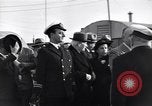
Greek Prime Minister, Themistoklis Sofoulis, boards the Greek Destroyer, RHS Hastings, in the Port of Piraeus.
Themistoklis Sofoulis (Sophoulis) Prime Minister of Greece, arrives at the port of Piraeus. Officials greet and welcome him. A color guard of Greek sailors presents arms in salute as Sofoulis is taken by the arm and escorted by a Greek admiral. He doffs his hat in acknowledgment. With the Admiral at his side, and , surrounded by civilian officials,and several naval officers, he makes his way to the Greek Navy Destroyer, RHS Hastings, tied up at the pier. A junior officer assists him as he ascends a gangway to board the ship. On deck, the ship's captain greets him and introduces several junior officers who salute and shake hands with him. The Greek National flag is seen fluttering in the breeze from the ship's mast. View of ship's bow as forward line is hauled aboard. The Greek State Flag is displayed from the ship. View from the pier as the ship backs away, followed by views of her underway. (This ship is the former British HMS Catterick, Class III Hunt destroyer, which was transferred on loan to Royal Hellenic Navy in 1946,as the Greek RHS Hastings. The number 15 appears on her hull which was formerly assigned to the Greek Destroyer Vasilissa Olga, that was sunk in 1943.)
General Twining congratulates pilots of the 339th Fighter Squadron, on Guadalcanal, Solomon Islands during WWII
Major General Nathan F. Twining, Commanding General, 13th Air Force. arrives to congratulate fighter Pilots of the U.S. Army Air Forces, at Henderson Field, on Guadalcanal, Solomon Islands, during World War 2. (The 339th had successfully accomplished a highest priority mission, shooting down Japanese Admiral Isoroku Yamamoto's airplane on April 18, 1943.) Major General Twining, wearing a pith helmet, steps out of his jeep and walks towards a group of 339th Squadron Pilots. He examines the nose wheel of a P-38, as a group of pilots stand around him. General Twining converses for a while with Major John W. Mitchell, Commander, 339th Fighter Squadron, who led the mission to down Admiral Yamamoto's airplane. Later, members of the 339th Squadron are photographed in conversations with one another.
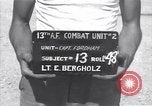
General Twining congratulates Pilots of U.S. Air Force who shot Japanese planes, in Guadalcanal Solomon Islands during WWII.
General Twining arrives to congratulate fighter Pilots of the U.S. Air Force, in Guadalcanal in Solomon Islands, during World War II. General Nathan Twining steps out of his jeep and walks towards a group of Air Force Pilots. He congratulates Captain John Mitchell and then speaks to Pilots of the 339th Fighter Squadron. General Twining and other Pilots stand in front of a P-38 fighter airplane and talk. Pilots who shot three Zero Fighters and three bombers of the Imperial Japanese Navy Air Service (IJNAS) over Ki hill Airfield near Munda Point. The three Pilots, Captain Thomas Lamphier, Jr.,, Lieutenant Busby Frank Holmes and Lieutenant Alex E Barber pose for a photograph. (These three would later participate in U.S. Operation Vengeance, on April 16, 1943, in which they engage a group of Japanese aircraft, including one carrying Admiral Isoroku Yamamoto, the architect of the Pearl Harbor attack. He would perish when they down the Mitsubishi G4M bomber carrying him.) Pilots leaving in a jeep. A Pilot stands on the wing of P-38 fighter, besides its canopy.
CRITICALPAST.COM: About Us | Contact Us | FAQs - How to Order | License Agreement | My Account | My Lightboxes | Shopping Cart | Advanced Search | Featured Collections | Website Terms & Conditions | Privacy Policy ©2026 CriticalPast LLC.
License Agreement |
Terms & Conditions |
Privacy Policy
©2026 CriticalPast LLC.