


 Francais
 Deutsch
 Italiano
Refine Your Search
Nevada United States 1936 stock footage and images
- Showing 8947 to 8952 of 27248 results more
more Hide
Hide
Farmers discuss problems of the land including soil erosion and poverty in United States during Great Depression.
Opening view is in Pennsylvania: Farm houses, smoke from a chimney. Fences around barns. A farmer with his wife and child walks in a field. Haystacks in the field. The family moves towards the houses. Barren trees around the houses. Damaged and abandoned stone houses. Men and women farmers with children standing and seated on benches together outside a meeting area. Farmers discuss the problems of the eroded land during a meeting. Eroded fields due to loss of soil in Dust Bowl. Farmers walk through the eroded fields. Sun rays through the clouds. Tennessee: Dry land and dry rivers. Rain washes away the soil. Hills bare of trees and grass. Devastated salt like patches of soil with deep fissures and evidence of massive erosion.

Young girls at a farm house or dilapidated plantation house in the southern United States.
Farm houses and former grand plantation houses, now in disrepair, seen among trees during time of poverty in Great Depression. A clothes line outside a house. Entrance to a house with large columns. Plaster and paint have peeled from the columns revealing the bricks. Young girls stand by a pillar at the entrance. Eroded land near an abandoned house.

A young boy and a woman from a poor farm family live in poverty and dilapidated shacks, United States.
Destitute children from poor migrant farm families play near dilapidated houses and tent communities and shacks during the Great Depression in America. A poverty stricken woman stitches and sews in a tent. A sick young boy moves his hands in his sleep as he thinks he's picking peas, while his mother watches over him at his bedside in a tent or shack.
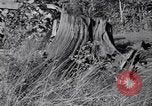
Trees are felled to clear land during massive expansion of farming and a carrot harvester at work in the United States.
A man drives a bulldozer to fell trees during the Great Depression in America. A woman with children watches the logging operation. The bulldozer clears trees and rocks from the land. Trees are felled and uprooted to create more farm land (ultimately leading to overproduction of crops, drops in prices, and depression conditions for farmers). Boxes full of carrot in a truck. A carrot harvester picks carrots in a field. Men tie up the carrots together. Men and women workers stand and watch the machine at work. Workers seated on and around boxes of carrots. An African American worker lights a cigarette. An elderly migrant from the Cumberland Mountains. Expansive views of the Cumberland Mountains and a farm house on a mountain side. A house, horses, hens, ducks and a cow with her calf on the farm. A stern wheel paddle steamer steam ship or river boat moves up a river. Two workers operate machines at a grinding mill or grist mill with water wheel running. A man operates a horse wheel. Elevated views of a river flowing in a valley between mountains and nearby farmland. Tall grass in a field.

Farmers sort wheat yield transported in cargo ships. and work to stock pile corn in a ever-normal granary in the United States.
Factories on river banks during late 1930s in the Great Depression. Wheat yield from 15000 acres of field in a single cargo ship underway. Men operate machines to sort and separate wheat. Wheat harvesters at work. Smoke from stacks. Close up views of faces of young girl and boy children from poverty stricken farming families. Farmers work at a ever-normal granary where they stock pile corn to store their crop and to stabilize farm crop prices as part of a buffer stock scheme. Vast reserves in the ever-normal granary stored by farmers to preserve a market for their crop in the face of overproduction and glut in the market for wheat driving down prices. A farmer inspects and tastes corn that is being loaded by machine belt into top of a storage granary silo.
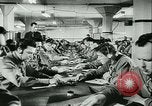
U.S. Army Signal Corps officers train at Fort Monmouth and production of signal communication items in the United States.
The role and contribution of the U.S. Army Signal Corps in combat and war. U.S. Army Signal Corps officers train at the Signal Corps Officer Candidate School (OCS) Fort Monmouth, New Jersey. Officers train at telegraph machines under the supervision of an instructor. Officers seated at desks in a classroom. Instructors take classes with the help of charts, diagrams and black boards. Officers seated atop electric poles for training. Two officers train in hand-to-hand combat at the OCS. Officers learn to use Radio Relay. Students listen to an instructor as he demonstrates the process. A U.S. soldier lays field wire across a hilly terrain to establish wire communications in the European Theater during World War II. Soldiers on the hill. Soldiers set up a sending station at the point where the wire can't go forward. A receiver is set up at the point from where the wire can go forward again. A soldier receives a photograph of a map through facsimile. Items of signal communication including radio relays, receivers, walkie-talkies, radio boxes and fuses to be produced and distributed by the USA Signal Corps to all other ground forces, navy and the Allies. New, modern, improved efficient signal communication equipment. A soldier displays two old type fuses and their counterparts.
CRITICALPAST.COM: About Us | Contact Us | FAQs - How to Order | License Agreement | My Account | My Lightboxes | Shopping Cart | Advanced Search | Featured Collections | Website Terms & Conditions | Privacy Policy ©2026 CriticalPast LLC.
License Agreement |
Terms & Conditions |
Privacy Policy
©2026 CriticalPast LLC.