


 Francais
 Deutsch
 Italiano
Refine Your Search
Nevada United States 1936 stock footage and images
- Showing 895 to 900 of 27248 results more
more Hide
Hide
The anti war protests against the United States involvement in the Vietnam War.
Anti-war protests in the United States during the Vietnam War. Protesters march and demonstrate against the United States involvement in the Vietnam War from Central Park to the UN headquarters in New York City. Demonstrators in crowd holding protest signs. A number of African American marchers hold signs that read, "Black men should fight white racism, not Vietnamese freedom fighters." Another sign reads, "They are our brothers whom we kill." Masses of people including doctors, teachers, and businessmen on streets. People dressed in different costumes and 1960s hippie fashion as they protest. Young men participate in burning their draft cards while a crowd gathers around to watch the draft card burning. Pro-war counter protestors (sometimes called "Hawks") also demonstrating and arguing with anti-war activists. Pro-war banner reads, "End Hanoi Sanctuary. Let's bomb Hanoi to win the war and destroy the Communist conspiracy." Another Hawk sign reads, "Anarchy Cannot be Permitted in the USA. Fight Communism and Red Termites." African American civil rights activist Martin Luther King Jr. walks toward the United Nations building with other officials advocating peace. Policemen drag a protester. Scene changes to San Francisco: 50000 people carry banners as they protest the war in Vietnam and march to the Kezar Stadium (670 Kezar Dr, San Francisco, CA 94118, United States) for a mass assembly. People push each other during the protest as pro-war demonstrators clash with anti-war demonstrators and pacifists. A huge crowd gathered at a stadium.
United States 3rd Infantry soldiers and civilians on a street during riots in Washington D.C., United States.
Aftermaths of Washington Riots in Washington D.C (after death of civil rights leader Martin Luther King). African American people walk on a street. Fire brigade truck parked outside a burning building. United Stats 3rd Infantry soldiers patrol on street with rifles in hand. U.S. soldier speaks to a woman. Civilians walk on streets.
Ford Education Library Motion Picture about Anthracite Coal found in United States
Industrial Geography of the United States regarding mining of Anthracite Coal. Film depicts usage, importance and types of coal. Features of hard coal. Value of, and places where hard coal is found in United States. Geographical map of United States, pointer shows the places where coal is found. The process of mining for coal. Diagram of cross section of earth showing shaft, rooms built at mine stations, and first coal vein 50 feet under ground.
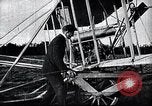
Launch of Wright plane in North Carolina on 17 December 1903 and in Virginia on 09 September 1908, United States.
Launch of Wright plane in North Carolina on 17 December 1903 and in Virginia on 09 September 1908, United States. Wibur Wright places wheels beneath wing on Kill devil hill, Kitty Hawk, North Carolina, United States. Wright plane takes its first flight after launch. Flight of plane in France. Two men pull props through on the Wright aircraft. Frenchmen stand and watch Wilbur Wright who makes adjustment on aircraft engine. Launching tower at right. Wright plane launches by catapult in France. Civilians and officers attend the air show. Wright plane passes overhead. Flight of Wright plane in United States. Orville Wright and Lieutenant Lahm sits on control section of the plane. Wright plane launches by catapult launch track at Fort Myers in Virginia on 09 September 1908. Plane in flight at Fort Myers. Spectators watch the plane. Army personnel move the Wright plane across open terrain they remove hangar doors from storage building. Army personnel grouped around the Wright aircraft. President Taft stand along the spectators. President Taft walk through spectators.
U.S. Federal Marshals at check post with U.S. army vehicles during AIM (American Indian Movement) occupation, in United States.
Activities of United States Federal Marshals during AIM (American Indian Movement) occupation at the outskirts of Lakota Nation in United States. U.S. Helicopter in flight, United States flag on check post. U.S. troops and U.S. vehicles at check post. Troops with rifles and guns stand past vehicles. A U.S. army jeep arrives. Wood logs at post. Vehicles go in field.
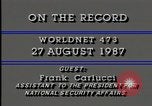
The US-Latin American relations discussed in Television news on WorldNet, Frank Carlucci being the guest, United States.
Television discussion about United States- Latin American relations in United States. Frank Carlucci, Assistant to President for National Security Affairs discusses United States reaction to elections in Mexico. News reader Maria C Siccardi presents the news on WorldNet. The discussion is made via satellite in which questions are asked by the people and Frank Carlucci gives the answers.
CRITICALPAST.COM: About Us | Contact Us | FAQs - How to Order | License Agreement | My Account | My Lightboxes | Shopping Cart | Advanced Search | Featured Collections | Website Terms & Conditions | Privacy Policy ©2026 CriticalPast LLC.
License Agreement |
Terms & Conditions |
Privacy Policy
©2026 CriticalPast LLC.