


 Francais
 Deutsch
 Italiano
Refine Your Search
Nevada United States 1936 stock footage and images
- Showing 9565 to 9570 of 27248 results more
more Hide
Hide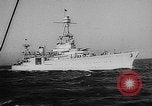
A United States Coast Guard Cutter underway at a sea carrying an admiral's flag
A U.S. Coast Guard cutter underway at a sea. An admiral's flag flutters on the mast of the ship. She has two smoke stacks; appears to be armed with a forward battery of three heavy guns, and carries several amphibious biplane aircraft. View of teletype operators in ship radio room.
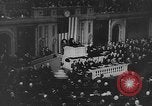
United States passes and implements the Lend Lease Act during World War II. War materiel flows to Allies.
President Franklin D. Roosevelt addressing Congress on January 6, 1941, asking for authority to supply war materiel to Britain and allies. Animated map showing streams of war materiel going to china and to European allies. Views of transport ships, Douglas A-20 Havoc aircraft with British roundel on them. A U.S. light tank M2; a large artillery barrel; and sacks of goods, being loaded on a ship. View of U.S. Capitol. Lend Lease Act passed. Animated map shows German forces overrunning Yugoslavia and Greece, and attacking Soviet Union. German troops in small boats crossing river to invade. German tanks and artillery operating on the Eastern front. Civilian men and women digging fortifications. Lend lease war materiel being unloaded in Britain, and at Red Sea port for British in Africa.Trucks carrying supplies over the Burma road to China. Lend lease supplies piled up in Murmansk, Russia, and Iran. "Hammer and Sickle 'em" chalked on a shipment.Stevedores rolling large tires.Hitler speaking. Head of Statue of Liberty. Animated illustrations about effects of Axis victory. U.S. Forces entering Greenland and Iceland, with consent of their governments.
The film of T-3A camera developed and a print is taken from B-7 printer in United States.
A U.S. Army training film about developing camera film containing aerial reconnaissance views. Film titled 'Aerial Photography', Part -5, 'Processing the Film'. A T-3A camera is unloaded from a plane. It is taken to a dark room at photographic laboratory Dept. 59. Exposed film roll is removed from camera and is put into its original box. The T-3A film development assembly, placed on table consist of 3 metal boxes, spool plates and motor to transfer film and a loading plate. Development of film starts with first fixing the film onto the loading plate and transferring it on to spools. These spools are then immersed in clean water and transferred from one solution to other. It is then transferred to the developing solution, then in water and hypo solution and then kept in fixing base for 30 minutes. It is washed in running water for 30 minutes. Film is then dried on film dryer blower drum. Then it is transferred to take up spool and laid on lettering table. Each film is lettered on right lower side with title, location, organization, date, day, length and altitude. Developer is prepared at appropriate temperature with water. Print is taken on paper. A B-7 printer is used for printing. The paper is immersed into different solutions and then dried on a canvas belt over a heated drum.
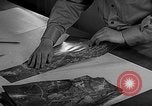
The film mosaic of T-3A camera is assembled together and interpreted in United States.
A U.S. Army training film about interpreting a camera film with aerial views. A print of T-3A camera film is developed. The mosaic prints are mounted by adhesive or staples. Completed mosaic is matched for contrast control networking. It is contrasted with U.S. geographical survey sheets and road maps. These are used to mark known places. Then these prints are pasted together. These pictures are send to an interpreter officer who translates the desired information. He uses stereoscope to find new enemy gun position, camouflage or other informations. (World War II period).
Parts of a K-12 camera described in United States.
A U.S. Army training film about parts of the K-12 camera. Title of the film 'Aerial Photography', Part 2, 'The K-12 Camera'. A man shows a K-12 camera used for night photography. A diagram of the camera. A pointer shows parts of the camera like photo electric cell and amplifier. A solenoid is attached to the shutter. Lenses and 12 volt battery. The aligned system of camera must be 13 and a half inches. Portals attached to a battery current. Before assembling the camera it is cleaned by air blower. Lenses are wiped. Amplifier is attached and locked over camera. Electric nodes are fastened. horizontal and lateral leveling of camera is measured. Number of exposures are calculated. Shutter speed is provided at three levels. Shutter and amplifier are set at on position. Cut film holder is loaded in a dark room and roll film magazine is loaded. The man shows the parts of camera mount.
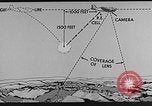
The process of taking pictures from a K-12 camera is described in United States.
A U.S. Army training film about the functioning of K-12 camera. Animation shows the process of aerial photography. A plane flies at 4000 feet above the ground. Lenses of camera are beyond the coverage of bomb. A photographer adjusts the mounting ring. As the pilot signals he sets the amplifier on and releases the bomb. At the sound of explosion he switches the amplifier off. A dark slide is replaced from holder. Exposed film is removed. The electrical connections are checked time to time. Film magazine is placed and locked. Suction tube is checked on cheek. The process is repeated again. One time filming covers one quarter square mile. Overlapping of the field must be done at 35% as it facilitates careful matching. (World War II period).
CRITICALPAST.COM: About Us | Contact Us | FAQs - How to Order | License Agreement | My Account | My Lightboxes | Shopping Cart | Advanced Search | Featured Collections | Website Terms & Conditions | Privacy Policy ©2026 CriticalPast LLC.
License Agreement |
Terms & Conditions |
Privacy Policy
©2026 CriticalPast LLC.