


 Francais
 Deutsch
 Italiano
Refine Your Search
Nevada United States 1936 stock footage and images
- Showing 9739 to 9744 of 27248 results more
more Hide
Hide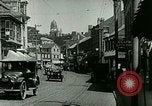
Motorcars becoming commonplace during the 1920s in the United States.
Automobiles driving along a street in small U.S. city in the 1920s. People coming and going in and around shops along a sidewalk. Two women walking outside a shot while one of them eat an ice cream cone. A woman exits a shop with packages of things she bought. Men gathered out side a shop tip their hats to one another. Numerous 1920s cars are seen in a parking area at center of a street and parked along the sides as well. A motorcar enters the garage of a service station, where an attendant refuels it with gasoline. Several cars are parked at the station, awaiting repairs. A street of the city filled with automobiles driving and many parked along the curb sides.
Actors portraying bootleggers during prohibition receive liquor from ship offshore, and bring it into the United States.
Movie in which actors portray bootleggers receiving liquor from a schooner offshore. They load containers into a small boat and bring them ashore. 'Oil' written on the containers. They pour liquor from the containers into bottles, at their hideout during prohibition.
An armaments factory in the United States during World War I
Men work at fabricating siege mortar shells. A shell blank is heated over a furnace and then transported to a machine where it is formed, while still glowing, into the desired shell shape. A number of finished shells is shown in a yard. Next, men are seen welding the shells. Finally, men are shown filling them with gunpowder. They pound the gunpowder into the shells using wooden rams and wooden mallets (to avoid creating sparks). A worker is seen topping off a shell with gunpowder, from a ladle, pounding it tight, and fastening a cap on the top. (World War I; World War 1; WWI; WW1)
Ammunition manufacturing in the United States during World War I
Men and women work at belt-driven lathes on a crowded machine shop floor in an armaments factory during World War 1. A stack of machined shell cylinders sits on the floor. In another area of the munitions plant, workers are seen with large shells and caps for them. At another machine shop, workers turn large diameter shells in lathes. Camera pans across various work stations where different manufacturing processes are taking place. Closeup of a woman working on a standard size lathe, and of other women working in the machine shop. Men and women sealing hot shells and handling them large tongs. Women working on small caliber ammunition. Women stacking finished shell in trays. Women weighing out gunpowder into sacks, and others loading the sacks into boxes that they dump onto open shells, where women use them to fill shells. A group of women placing objects into shells (fuses?) and sealing them, as a superviser watches. A man taking the shells from a conveyer belt and packing them in boxes. Another area of the plant where items are packed into containers. (World War I; World War 1; WWI; WW1)

US, British and other flags at half mast after the death of Filipino President Manuel Luis Quezon in the United States (WW2)
A World War II film titled 'Manuel Quezon' on the death of Filipino President Manuel Luis Quezon. Buildings along the side of a street. Men wave U.S. and other flags. US, British and other flags flying at half-mast on flag poles. Past events show President Manuel Quezon seated at a desk in his office and working. He talks to his son, Manuel L. “Nonong” Quezon Jr. U.S. President Franklin Delano Roosevelt seated in a chair. Officials standing nearby. President Roosevelt talks to Quezon. A document by President Roosevelt on the death of President Quezon.
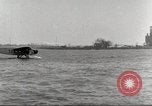
A seaplane being towed by a tugboat in the United States.
A Ford 5-AT Tri-motor Float plane is seen being moving under its own power in a river during tests in 1925. (Its first flight was in 1926.) Later, it is seen being towed close to a tugboat, by a line fastened to its nose. Two men in life jackets stand atop its wing, and several follow in a dory. Several men monitor the tow line from the back of the tugboat.
CRITICALPAST.COM: About Us | Contact Us | FAQs - How to Order | License Agreement | My Account | My Lightboxes | Shopping Cart | Advanced Search | Featured Collections | Website Terms & Conditions | Privacy Policy ©2026 CriticalPast LLC.
License Agreement |
Terms & Conditions |
Privacy Policy
©2026 CriticalPast LLC.