


 Francais
 Deutsch
 Italiano
Refine Your Search
Nevada United States 1936 stock footage and images
- Showing 991 to 996 of 27248 results more
more Hide
Hide
Senator Edward Brooke of Massachusetts talks about Richard Nixon in United States.
Richard Nixon and Spiro Agnew election campaign TV advertisement for the 1968 Presidential campaign in the United States. Senator Edward Brooke of Massachusetts talks to a man about Richard Nixon. They sit in an office. Brooke indicates that he favors Richard Nixon for the Presidential election. Edward Brooke states that Richard Nixon will restore law and order in United States coupled with justice and he will create jobs for the unemployed citizens.
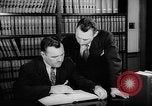
Federal Bureau of Investigation officers discuss German and Japanese agents and their activities in the United States.
The director of the Federal Bureau of Investigation (FBI) John Edgar Hoover talks about enemy agents and spies in the U.S. at the time of World War II. Two officers sit in an office. German and Japanese suspects in the United States. A German agent on a street. A Japanese spy takes photographs from a bridge. Purported Nazi German agents arriving as tourists in the United States. German and Japanese diplomats greeting one another and exchanging a Nazi salute. The conference room of the Federal Bureau of Investigation. Officers discuss the activities of Nazi German secret agents and Imperial Japanese agents operating in South America. Nazi signs on an animated map show the advance of German agents in areas such as Patagonia. Narrator states that Nazi German and Imperial Japanese agents setup radio listening posts in multiple locations in South America to track and report on U.S. shipping in the world's oceans. Animated map shows settlements northward migration through Brazil of "more than 300,000 Japanese colonists". Animation shows expansion of German airline services through South America from Argentina to Colombia.
Colonel Oveta Culp Hobby is the first commanding officer of Women's Army Corps in the United States.
Women's Army Corps in the United States. Women's Army Auxiliary Corps, created in 1942 is converted to WAC (Women's Army Corps) in 1943. A WAC carries a cake. 'WAAC' written on the cake. A WAC walks outside a building. Several men stand and talk. The WACs parade on a field. A United States flag. Duties performed by WACs. Women work as mechanics and handle complicated equipment. They take photographs through cameras. The U.S. Capitol building in view. U.S. Army General George Marshall and U.S. Secretary of State Henry Stimson. Colonel Oveta Culp Hobby is the first commanding officer of WAC. A dramatization depicts recruitment and induction of WAACs. A sign reads 'WAAC, information and recruiting'. A woman appears in an interview. The women undergo physical examination and are then recruited. WAACs undergo a training. They perform physical exercises and swim. Several WACs go to specialization classes. WACs cook food. A woman receives an award for her husband's bravery during World War II.

President of the United States Dwight D. Eisenhower inspects the flood devastated area in North East America.
Us President Dwight D. Eisenhower inspects flood devastated area in the Northeast states of the United States. President of the United States Dwight D Eisenhower views a map during his aerial tour of the flooded region. He looks out aircraft windows and flood damage below. Ground level views of many damaged buildings and heaps of debris. Civilians clear the debris with shovels. The victims of the flood lined up for immediate aid supplies. A nurse treats victims in a hospital. American citizens in lines to receive vaccinations against disease. Bulldozer and forklifts clears heaps of debris. A man repairs the communication lines.

Chief Executive and high government officials greet the King Mohammed V of Morocco during his visit to the United States.
King Mohammed V of Morocco visit to the United States. King disembarks from the President's plane. Chief Executive and high government officials greet and receive the King. Troops give a gun salute. Troops hold flags. His 3 days United States visit is to confer with Secretary of State, Dallas on the Algerian questions and retention of American bases in Morocco. He gets into the car and leaves for the White House.
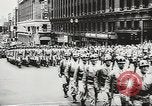
Work and achievements of Harry S. Truman during his first Presidential term in the United States
President Harry S. Truman marches with veteran soldiers of U.S. Army Company D (129th Field Artillery) with whom he served as an officer in World War 1. Wide view of men lined up on White House lawn. Disabled veteran soldiers of World War 2 greet the President. Narrator discusses problem of lack of housing for veterans and their families after World War 2. Aerial view of trailer homes or recreational vehicle (RV) camper units lined up in open space, serving as temporary housing for veterans. Truman sitting at desk while he signs the Veterans Emergency Housing Act of 1946. Views of long lines of new homes being built, and construction workers hammering to build frames of new houses in the United States. During a time of price inflation, scene shows grocer changing price signs on eggs, meats, cheeses to show increasing prices. Truman ata work in his office reviewing paperwork at his desk. Narrator mentions Taft Hartley Labor Act that Truman vetoed. View of car on road with sign on side that reads, "Veto Hartley Taft Slave Labor Bill." President Truman reading at his desk. Close up view of cover page of report entitled "To Secure These Rights. The Report of The President's Committee on Civil Rights. View of Episcopal church Bishop Henry Knox Sherrill seated at a desk. Bishop Sherrill is talking to another man. Narrator states that Truman acted on a civil rights program recommended by Bishop Sherrill, head of the Civil Rights Commission. Car pulling up to portico of White House and view of President Truman shaking hands with visiting President of Mexico, Miguel Alemán. President Truman being presented a sacred Torah by Israeli President Weizmann. Discusses foreign policy matters with Secretary of State George Marshall and comes up with Truman doctrine, Marshall plan and European recovery program. View of Truman signing Economic Cooperation Act of 1948 on April 3, 1948 (of which the Marshall Plan was a part).
CRITICALPAST.COM: About Us | Contact Us | FAQs - How to Order | License Agreement | My Account | My Lightboxes | Shopping Cart | Advanced Search | Featured Collections | Website Terms & Conditions | Privacy Policy ©2026 CriticalPast LLC.
License Agreement |
Terms & Conditions |
Privacy Policy
©2026 CriticalPast LLC.