


 Francais
 Deutsch
 Italiano
Refine Your Search
Nevada United States 1936 stock footage and images
- Showing 1003 to 1008 of 27248 results more
more Hide
Hide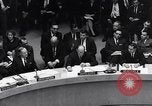
U.S. Ambassador Adlai Stevenson informs UN about steps taken in meeting of Organization of Consultation in United States.
Ambassador Adlai Stevenson addresses United Nations Assembly about United Sates action against Cuba and Russia, during timeframe of Cuban Missile Crisis. Ambassador Stevenson hopes and prays for peace. He tells Soviet Union to end their actions against United States. He refers to the initiative of President John F Kennedy to quarantine war. He informs about the Organization of Consultation meeting, which is a part of the Organization of American States. He then talks about the resolutions in 19 paragraphs adopted by them. First is immediate dismantling of offensive metals from Cuba. Second, he refers to article 6 and 8 and all necessary measure including use of arms against any offensive attempt on U.S. Third, is to inform security council of UN under article 54 of U.S. charter about the resolution, and the same information to be given to Cuba.
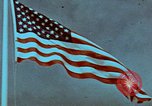
Documentary of United States military establishment and readiness.
Flag of United States. United States men and women in uniform representing every element of U.S. military establishment. U.S. Army soldiers march on a grass parade field. Aerial view of a base camp. U.S. armored unit of tanks and self-propelled artillery, maneuvering and firing their guns. U.S. Army paratroops seen hooking up static lines and jumping from C-130 aircraft. U.S Army helicopters deliver soldiers and transport heavy vehicles and artillery pieces. (Sikorsky CH-37 Mojave delivering the jeep and the artillery piece.) Various scenes of U.S. Army heavy artillery being fired, including a self propelled howitzer.
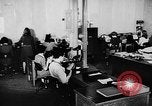
Workers and employees of the U.S. Army Signal Corps work with great care in the United States (WW2)
Film highlights many different ways that American soldiers and civilians contribute to the war effort in World War 2, including on the home front in America. A woman works at the United States Army Signal Corps office during World War II. She answers the phone. A paper containing sensitive information drops from her desk. Soldiers fighting in the Pacific Theater. A Mickey Mouse watch on the wrist of a dead soldier. A woman clerical worker puts a file in a drawer. A soldier runs and throws a grenade at Japanese positions. A screw is tightened on an equipment. A man works on a blueprint. Closeup of hands of a woman typing on a typewriter. Women writing number codes in columns on paper, and stamping documents. A man welds some equipment. A forklift lifts packets and stores. Carts with cables and machines. Cargo trucks in front of a warehouse depot. Logistics loaded on a ship. Smokestacks of a factory. Spools of cable and crates on deck of cargo ship. Cargo ship supplies logistics to different units. Soldiers board a troop transport ship on the way to the war front and they wave from the deck. A landing craft on a beach. Soldiers run on the beach. A closeup view of a German wrist watch with a Nazi swastika symbol on it. Various scenes of United States soldiers firing artillery. Signal Corps women typing, working in factories, signing documents, operates switchboards, and pulls out a file from a drawer.

United States President Lyndon Johnson declares that U.S. pilots have resumed bombings over North Vietnam.
United States President Lyndon Johnson addresses the nation. United States resumes bombings over North Vietnam. U.S. aircraft carry out air strikes against Vietnam. President Johnson sits in his office. U.S. pilots inspect their aircraft and work under the wings. Air raids on supply depots and railroad lines. The planes take off from an aircraft carrier. U.S. soldiers in trenches. An aerial view of the land below. Smoke rises up due to explosions. A meeting in the United Nations Headquarters. Dignitaries of various countries seated during the conference. (Vietnam War period).
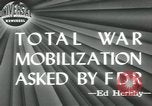
President Franklin D. Roosevelt advocates National Conscription and supports the Atlantic Charter in the United States.
The President of the United States Franklin Delano Roosevelt addresses the nation in the United States. President Roosevelt advocates National Conscription (military draft) for material reasons and for reasons of morale. He defends the principles of the Atlantic Charter. He summons the United Nations to protect their own sanctity and that of small nations as well. Men wearing head phones listen to the speech.
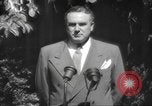
United States Senator Brien McMahon speaking about the first atomic bomb test explosion conducted by the Soviet Union.
United States Senator Brien McMahon, chairman of the Joint Commission on Atomic Energy, addressing the nation in the United States. Senator McMahon standing at the microphones speaks about the first atomic bomb test conducted by Soviet Russia (called RDS-1, First Lightning, or Joe 1) on August 29, 1949. The Senator talks about the President's announcement that the Soviet Union has exploded its first atomic bomb. He speaks about the atomic energy project and the necessity for U.S. President Truman to talk to the Russians. He says that the whole world has to be alerted about the atomic bomb explosion and interference of the United Nations is necessary in the matter.
CRITICALPAST.COM: About Us | Contact Us | FAQs - How to Order | License Agreement | My Account | My Lightboxes | Shopping Cart | Advanced Search | Featured Collections | Website Terms & Conditions | Privacy Policy ©2026 CriticalPast LLC.
License Agreement |
Terms & Conditions |
Privacy Policy
©2026 CriticalPast LLC.