


 Francais
 Deutsch
 Italiano
Refine Your Search
Nevada United States 1936 stock footage and images
- Showing 1009 to 1014 of 27248 results more
more Hide
Hide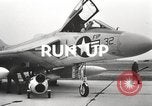
Training film shows run ups of Douglas F4D-1 Skyray in the United States.
United States Navy training film shows ground operations of Douglas F4D-1 Skyray aircraft, in the United States. Run ups of Douglas F4D-1 Skyray aircraft. Pilot checks the hydraulic system. Hydraulic Pressure Unit. He checks the fuel gauge with the test button.
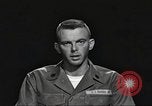
United States Marines attend Army Airborne School (AKA Jump School) at Fort Benning, Georgia.
United States Marine Corps Recon unit personnel undergoing training at the United States Army Airborne School (AKA Jump School), Fort Benning, Georgia. The course is three weeks long and consists of three phases: "Ground Week", "Tower Week" and "Jump Week". Marines jumping from a low platform, learning how to safely fall, during phase one. Marines climbing a ower, during phase two, and sliding along a cable, while suspended from parachute risers. Next, they are seen in controlled parachute descents from a tall tower. A closeup of one hitting the ground. Marines seated with full parachute gear, in an airplane during the third (Jump week) phase of their training. They stand and move toware the jump door, with their chutes hooked to a static line. View from below, of open parachutes descending. Marine receiving his parachute wings, upon graduation from Jump School.
President Truman and other personalities attend the Labor Industry Conference in the United States.
The Labor Industry Conference in the United States. United States President Harry S. Truman inaugurates the Labor-Industry Conference. Inside view of the conference hall. Various dignitaries and officials in the conference hall. President Truman speaks before the labor-industry members. The dignitaries include Philip Murray (Congress of Industrial Organization), John L. Lewis (United Mine Workers of America), William Green (American Federation of Labor), Eric Johnston (Chamber of Commerce) and Charles Wilson (General Motors). “On this conference have been based many high hopes of the American people. Their eyes are turned here in the expectation that you will furnish a broad and permanent foundation for industrial peace and progress. This is your opportunity to prove that you can come to understanding and agreement without political or government pressure. The whole world now needs the produce of our mils and factories. Everything stands ready and primed for a great future,” said President Truman.
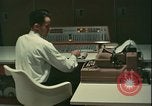
Parts and systems of electronic computers for bookkeeping, in an early 1960s computer room in the United States.
A film on bookkeeping services and use of early model computer technology to improve efficiency of banking services in the United States. A man seated at a desk while at work. Early model computer central processor in operation. A bank check being placed in the loading mechanism of a "reader-sorter" machine. The machine reads symbols printed in magnetic ink. The bank identification number of the check is checked. After checking the identification number, documents are read. Information contained in the magnetic symbols is checked. The documents are sorted. The information is placed on a magnetic tape. Close-up views and wider views of of computer magnetic tape and magnetic tape drive machines. Next, the information is processed and sent to a high speed printer for immediate examination. Man wearing glasses examines pages from the printer as it runs a continuous feed paper roll. Sorting of the documents. The documents are arranged in numerical order by the machine. A woman works loading magnetic tape reels on the tape drive machine. The master file containing complete data of each account is worked upon. Views of lights on the early model computer. The computer reads an identification number. Several information and transactions of the customers are added to previous transactions. Another master file is created using the information. It records the information of the customer account. Other information like that of overdrafts and closed accounts is also recorded. The customer statement is prepared. Customer information and opening balance is recorded from a tape. Information about the current balance is also recorded. A woman works on a reader sorter machine in operation. It sorts the checks. Close-up view of printer running continuous feed paper and printing transaction information. Tape unit containing complete information of all accounts is printed. View of an analog clock and a hour glass with sand in it. Narrator states that the computer will take 3 or 4 hours to complete the accounting for up to 30,000 daily deposit transactions, which would formerly take 60 man hours for the same operation. Views of the computer central processor unit (CPU) and views of the computer operator's console. A man seated at the console desk works. Three men wearing business suits, who are employees or officers of the Merchandise National Bank of Chicago, are seeing viewing blueprints and discussing.
SS United States underway in Elizabeth River.
Port bow view of the S.S. United States comes up the river. S.S. United States underway, two large red stacks, sides of ships are painted black. American flag flies forward of the no. one stack. Several life boats are in the Davits along the port side. Stern view of a civilian tug underway up the Port bow of the S.S. United States. Port bow of the ship shows letters 'UNITED STATES' on the ship, buildings seen along the water line. Steam emitted from both the stacks. Bow view of ship underway in the river, merchant ship on the way in right and shoreline is seen to the left and right. Port bow of the United States underway in the Elizabeth River.

U.S. President Dwight D Eisenhower with cabinet members arrives for a meeting at Camp David in Maryland, United States.
U.S. President Dwight David Eisenhower calls for a cabinet meeting at Camp David in Maryland, United States. Dignitaries disembark from a car at Camp David. United States Secretary of the Treasury George Magoffin Humphrey, U.S. Secretary of the Interior Douglas McKay and other cabinet members arrive for the meeting. The President gets off his car. He is greeted by officials. The President is joined by United States Ambassador to the United Nations Henry Cabot Lodge, Jr. and United States Secretary of State John Foster Dulles . The cabinet seated for the meeting.
CRITICALPAST.COM: About Us | Contact Us | FAQs - How to Order | License Agreement | My Account | My Lightboxes | Shopping Cart | Advanced Search | Featured Collections | Website Terms & Conditions | Privacy Policy ©2026 CriticalPast LLC.
License Agreement |
Terms & Conditions |
Privacy Policy
©2026 CriticalPast LLC.